Featured Post

Amazon Banned My Book: This is My Response to Amazon

Logic is an enemy  and Truth is a menace. I am nothing more than a reminder to you that  you cannot destroy Truth by burnin...

31 July 2013

Incredible Technology: How to See the Big Bang

While we may never know all the details of our universe's explosive birth, scientists have been able to piece together quite a bit by studying the ancient light that saturates the cosmos.
The universe burst into existence 13.8 billion years ago in a "Big Bang" that blew space up like a giant balloon. For nearly 400,000 years after that, the universe remained a seething-hot, opaque fog of plasma and energy.

But then, in an epoch known as recombination, the temperature dropped enough to allow the formation of electrically neutral atoms, turning the universe transparent. Photons began to travel freely, and the light we know as the cosmic microwave background (CMB) pervaded the heavens, filled with clues about the first few moments after creation. [Big Bang to Now in 10 Easy Steps]

"As far as we know, that's as far [back] as we can see — we get an image of the universe as it was when it was about 389,000 years old," said John Mather of NASA's Goddard Space Flight Center in Greenbelt, Md., senior project scientist for the space agency's James Webb Space Telescope, the successor to the Hubble Space Telescope. Mather and George Smoot won the 2006 Nobel Prize in Physics for their work on NASA's Cosmic Background Explorer satellite mission.

"We believe — although it's not 100 percent proven — that spots that we see in the microwave map from when the universe was 389,000 years old were actually imposed on it when [the universe] was sub-microseconds old," Mather told SPACE.com. "There's an interpretive step there, but it's probably right."

"We believe — although it's not 100 percent proven — that spots that we see in the microwave map from when the universe was 389,000 years old were actually imposed on it when [the universe] was sub-microseconds old," Mather told SPACE.com. "There's an interpretive step there, but it's probably right."

Most researchers think the "bang" portion of the Big Bang came during a dramatic and extremely brief period of inflation, which began about 10 to the minus 36 seconds — one trillionth of a trillionth of a trillionth of a second — after the universe's birth.

During inflation, the theory goes, the universe expanded faster than the speed of light, doubling in size perhaps 100 times or more in just a few tiny fractions of a second. (Einstein's theory of special relativity holds that no information or matter can travel faster than light through space, but this rule does not apply to inflation, which was an expansion of space itself.)

"Inflation theory is the idea of going from spontaneous quantum fluctuations to something of macroscopic size," said WMAP principal investigator Charles Bennett, of Johns Hopkins University in Baltimore, Md. (The WMAP spacecraft, which launched in 2001, stopped gathering data in 2010.)
The precision mapping of the CMB performed by COBE, WMAP and Planck has provided strong support for inflation, helping cement its position as the leading explanation of the universe's first few moments.

"Why the cosmic microwave background temperature is the same at different spots in the sky would be a mystery if it was not for inflation saying, well, our whole sky came from this tiny region," Bennett told SPACE.com. "So the idea of inflation helps answer some of these mysteries, and it explains where these fluctuations came from."http://news.yahoo.com/incredible-technology-see-big-bang-153127374.html

25 July 2013

Light stopped completely for a minute inside a crystal: The basis of quantum memory

Scientists at the University of Darmstadt in Germany have stopped light for one minute. For one whole minute, light, which is usually the fastest thing in the known universe and travels at 300 million meters per second, was stopped dead still inside a crystal.
This effectively creates light memory, where the image being carried by the light is stored in crystals. Beyond being utterly cool, this breakthrough could lead to the creation of long-range quantum networks — and perhaps, tantalizingly, this research might also give us some clues on accelerating light beyond the universal speed limit.

24 July 2013

White self-preservation angers some people

A monument on a hill overlooks the Kleinfontein community. "We are here for our culture, for our safety, for our people," said Annatjie Oncke, a resident.

20 July 2013

Canadian scientists helping to unravel the secret of the universe's existence

VANCOUVER - Science is one step closer to solving one of the most profound mysteries in the cosmos due to what an international team of physicists say is an unprecedented observation about a fundamental particle in the universe.

When the universe was created, the Big Bang converted energy into matter and antimatter — two materials that destroy each other when they come into contact.

"In some sense, we're asking why anything exists at all, if it wasn't annihilated by equal quantities of matter and antimatter," Tanaka said in an interview.

"There's some kind of imbalance that occurred when the matter became dominant, and that is something that we can't explain."

"By studying these elementary particles, we're sort of looking at the universe near the time of the Big Bang," he said.

"It gives us a glimpse into what might have happened, what particles where doing, and explaining how the universe started from the Big Bang to where we are now, with galaxies, and molecules and...people.

19 July 2013

World's first mission to the Moon's South Pole announced: cosmic speciation

The world’s first mission to the South Pole of the Moon was announced Thursday, opening up the possibility that the public will be able to access images from the moon online.
 
The private enterprise mission, announced by the International Lunar Observatory Association and Moon Express, Inc., will be both scientific and commercial, and plans to deliver the International Lunar Observatory (ILO) aboard a Moon Express robotic lander.

Artist's depiction of the ILO lunar telescopes that will be delivered by a Moon Express lander (Moon Express)
 
The observatory is intended to establish a base for permanent astrophysical observations and a lunar commercial communications systems for researchers to utilize.
 
“We are very excited to announce that our second Moon mission will be to the lunar South Pole to deliver the International Lunar Observatory and to prospect for resources,” said Moon Express CEO Dr. Robert Richards.  “The mission will provide a historic landing in an unexplored region of the Moon that may harbor some of the greatest resource deposits in the solar system.”
 
If successful, the ILO will be the first private space telescope to operate from the lunar surface and be available to researchers, educators and the general public through the internet.
 
It will allow them to access images from the surface of the Moon, and it is hoped that it will create a new model of “citizen science” public participation and international collaboration.

Chimps, Orangutans Have Human-Like Memory: cosmic Brotherhood of Sentience

Now, a new study published today in Current Biology shows that captive chimpanzees and orangutans can quickly recall past events like people. Chimpanzees are our closest relatives.
 
A chimpanzee named Frodo seems to pose in Gombe Stream National Park, Tanzania.
 
“I think [the study] tells us that our memory systems are not unique,” said study co-author Gema Martin-Ordas, a postdoctoral researcher.
 
 
Chimps and orangutans ”share some features of autobiographical memories that humans have, but we can’t be sure whether they’re aware of those memories, and that’s the debate,” Martin-Ordas said.
 
The science of memory storage and remembrance is still a field in its infancy: The brain is such a complex organ that it’s difficult to pinpoint exact memory-storage processes. (See a 3-D memory interactive.)

CIA said to back study on ways to hack the global climate

This file graphic illustrates techniques to cool the Earth via a thin cloud of aerosols, including, from left, artillery cannons, a miles-long tower, military aircraft and stratospheric balloons. (Brian West / American Geophysical Union)
 
The U.S. intelligence community is helping to fund a study that is evaluating ways to cool the global climate, including proposals to pump the skies full of sunlight reflecting particles and build machines that vacuum greenhouse gases from the atmosphere.
 
A final report is tentatively scheduled for release in the spring or summer of 2014 by the National Academy of Sciences, which has convened a committee of science and policy experts to study the issue.
 
As for concerns that intelligence community funding will make some or all of the committee's findings secret, Rugani said not to worry.
"The report is unclassified. It will be conducted in the public sphere and will be made available to the public in its entirety once it is completed," she said. "So, there's nothing nefarious going on here."

Gut Microbes Can Split a Species: holonic hologram

Here's how to create a new species. Put animals—say finches—from the same species on separate islands and let them do their thing for many, many generations. Over time, each group will adapt to its new environment, and the genomes of the two populations will become so different that if you reintroduce the animals to the same habitat, they can no longer breed successfully. VoilĂ , one species has become two. But a new study suggests that DNA isn't the only thing that separates species: Some populations diverge because of the microbes in their guts.
The paper is "important and potentially groundbreaking," says John Werren, a biologist at the University of Rochester in New York. "Scientists have studied speciation … for many years, and this opens up a whole new aspect to it."
 
Bordenstein goes one step further. The genes of microbes harbored by an organism are just as important for evolution as the genes in its own cells, he says, calling both together a "hologenome."

Newborn Star's 'Snow Line' Reveals Clues About Planet Formation

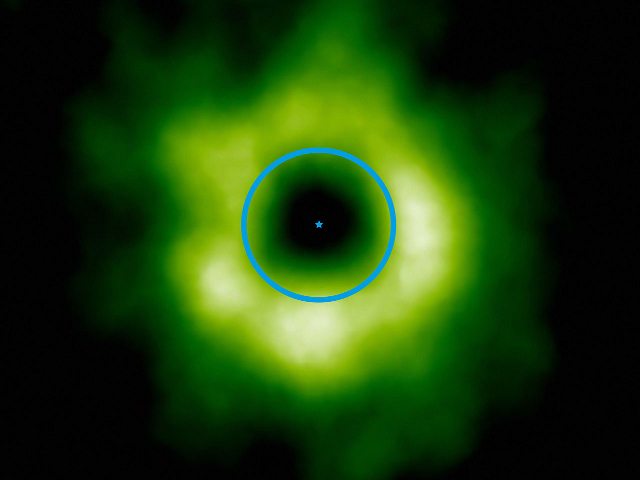
The location of the snow lines for volatiles can affect planetary formation. Recent research has indicated the water snow line, shown here, lies farther out than previously suspected. Credit: NASA, ESA, and A. Feild (STScI)
 
Astronomers have identified the point where carbon monoxide (CO) freezes in the disk around a sunlike star — information that could help them understand how planets form.

A team of international scientists has calculated the CO "snow line" for a star called TW Hydrae, determining that the gas solidifies at about the distance of the orbit of Neptune, where it could help feed the formation of the outer edges of the system.

"The CO snow line is interesting, not only because CO is abundant in the disks, but its snow line is the most accessible to direct observations due to its low freeze-out temperature — it's farther away from the star," said principal investigator Chunhua Qi of the Harvard-Smithsonian Center for Astrophysics. "It could mark the starting point where smaller icy bodies, like comets, and dwarf planets, like Pluto, would begin to form."
 Stars form when a disk of dust and gas collapses in on itself due to gravity. The remaining material continues to orbit the newly formed object in a disk of material.
 
As dust and gas particles pass through the disk, scientists say, they come together to form larger and larger clumps that can eventually grow into planets. Frozen volatiles help this process along.
 
"The snow line provides more sticky solid grains, and enhances the planet formation efficiency and grain growth," Qi told SPACE.com in an email. But determining the location of these grains can be a challenge. Emission from volatiles along the outside of the disk can make it difficult for scientists to image the telltale signs of frozen compounds.
 

Star light, star bright

47 Tucanae, 16,700 light-years from Earth, is 10.5 billion years old and one of the brightest of our galaxy’s globular clusters.
 
UBC astronomers have used NASA’s Hubble Space Telescope to track the orbital motion of 33,000 stars in one of the galaxy’s oldest globular clusters, offering new insights into the formation of the Milky Way.
 
The careful examination of “cosmic choreography” enabled researchers, for the first time, to link the movement of stars within the cluster to the stars’ ages. The study reveals two distinct generations of stars within globular cluster 47 Tucanae, 16,700 light-years from Earth.
 
The lack of heavier elements in the population of older, redder stars reflects the initial composition of the gas that formed the cluster. After the most massive of these stars completed their stellar evolution, they expelled gas enriched with heavier elements back into the cluster. This gas collided with other gas and formed a second, more chemically enriched generation of bluer stars that was concentrated toward the cluster centre. Over time these stars moved slowly outward into more elliptical orbits.
 
This is not the first time Hubble has revealed multiple generations of stars in globular clusters. In 2007, Hubble researchers found three generations of stars in the massive globular cluster NGC 2808. But Richer’s team is the first to link stellar dynamics to separate populations.
 
Astronomers need to continue analyzing these multiple generations to better understand how stars formed in distant galaxies in the early universe.

18 July 2013

Newly discovered “Pandoravirus" could redefine life as we know it

The genome of Megavirus chilensisa, the previous record holder for largest virus, with 1,200 genes. The new pandoravirus has roughly 2,500 genes. (Photo: Wikimedia)
 
The discovery of two new jumbo-sized viruses is blurring the lines between viral and cellular life and could point to the existence of a new type of life, scientists suggest.
 
The two large viruses, detailed in this week's issue of the journal Science, have been dubbed "Pandoraviruses" because of the surprises they may hold for biologists, in reference to the mythical Greek figure who opened a box and released evil into the world.
 
The discovery of Pandoraviruses is an indication that our knowledge of Earth's microbial biodiversity is still incomplete, explained study coauthor Jean-Michel Claverie, a virologist at the French National Research Agency at Aix-Marseille University.
 
"Huge discoveries remain to be made at the most fundamental level that may change our present conception about the origin of life and its evolution," Claverie said.

16 July 2013

Decapitated worms can regenerate their brains, and the memories stored inside: harmonic bio-immanence

As for where these memories are coming from, the researchers don’t really know. They speculate that the memories might be stored elsewhere in the body, perhaps in the neurons that make up the worm’s nervous system (see the network diagram in the image above). It is possible that the nervous system also learns something during training, and then somehow these neurons play a role in the recreation of old memories when the brain is regenerated.
 
A lot more research will need to be done to work out exactly what’s going on here — and more importantly, whether other animals, including humans, also store memories outside of the brain.

14 July 2013

Antarctic Lake Vostok: Inhospitable Lake Somehow Full Of Life, Could This Mean Species On Mars?

The Vostok research facility in Antarctica. (Photo : Reuters)
 
Lake Vostok, hidden beneath an Antarctic glacier, is so deep and cold that it resembles an alien planet where life should be impossible Scientists have discovered a surprising amount of critters beneath the frigid water.

The researchers identified billions of species through DNA and RNA sequencing, in a place where life should not be able to exist, according to a Bowling Green State University press release.
 
"The bounds on what is habitable and what is not are changing," Dr. Scott Rogers, a Bowling Green State University professor of biological sciences who worked on the study, said.
 
Lake Vostok is the fourth deepest lake on Earth, and the largest sub glacial lake known in Antarctica.
The lake is under high pressure thanks to 1.5 million years-worth of ice coverage and a depth of nearly two miles.
Due to the lake's conditions there are almost no nutrients available. It lies below sea level and experiences harsh and unpredictable weather conditions.
 
Scientists thought the lake's conditions rendered it inhospitable to all types of life, even bacteria.
The team proved past speculations wrong when they examined the underside of the million-year-old ice.
 
"We found much more complexity than anyone thought," Rogers said. "It really shows the tenacity of life, and how organisms can survive in places where a couple dozen years ago we thought nothing could survive."

Primeval underwater forest discovered in Gulf of Mexico

Scuba divers have discovered a primeval underwater forest off the coast of Alabama.
 
The bald cypress forest was buried under ocean sediments, protected in an oxygen-free environment for more than 50,000 years, but was likely uncovered by Hurricane Katrina in 2005, said Ben Raines, one of the first divers to explore the underwater forest and the executive director of the nonprofit Weeks Bay Foundation, which researches estuaries.
 
The forest contains trees so well-preserved that when they are cut, they still smell like fresh cypress sap, Raines said.
 
The stumps of the cypress trees span an area of at least 0.5 square miles (0.8 kilometers), several miles from the coast of Mobile, Ala., and sit about 60 feet (18 meters) below the surface of the Gulf of Mexico.

Immersed & Permeated

NASA's Interstellar Boundary Explorer, or IBEX, recently mapped the boundaries of the solar system's tail, called the heliotail. By combining observations from the first three years of IBEX imagery, scientists have mapped out a tail that shows a combination of fast and slow moving particles. The entire structure twisted, because it experiences the pushing and pulling of magnetic fields outside the solar system.

12 July 2013

WeinerSpitzer: Welcome to the desert of the real

 
Five years after a prostitution scandal forced former New York Gov. Eliot Spitzer from office, many Democrats appear willing to give him a shot at political redemption, according to a new poll that shows him with a strong lead in the city comptroller race.
Spitzer only announced his candidacy Sunday, and it isn't yet clear whether he will gather enough signatures by a Thursday deadline to make the Sept. 10 Democratic primary ballot. But 42 percent of registered Democrats already say they support Spitzer, compared to 33 percent for his potential rival, Manhattan Borough President Scott Stringer, the NBC 4 New York/Wall Street Journal/Marist Poll shows.
 
The second coming of disgraced and oversexed pols Anthony Weiner (quite probably the next mayor of New York City) and Eliot Spitzer (who has announced a bid for city comptroller) helps to explain widespread and growing contempt for government:

In a comprehensive survey of public attitudes done last September, Gallup found that just 19 percent of Americans think they “can trust the government in Washington to do what is right” “just about always” or “most of the time.” The latest CNN/ORC poll, from mid-June, shows large majorities convinced that Obama is failing on the economy, the deficit, foreign policy, civil liberties, and just about everything else. The one upside? He’s still doing better than Congress.

06 July 2013

Radio waves from young universe stun scientists

LONDON: Scientists have detected mysterious bursts of radio waves that last only for a tenth of a blink of an eye, originating billions of light years away. A single burst of radio emission of unknown origin was detected outside the Earth's galaxy about six years ago, but no one is certain what it was or even if it was real. Scientists have spent the last four years searching for more of these explosive, short-duration radio bursts.

This image obtained on July 4, 2013 from Nasa's Galaxy Evolution Explorer shows NGC 6744, one of the galaxies most similar to our Milky Way in the local universe. The galaxy is situated in the constellation of Pavo at a distance of about 30 million light-years. NGC 6744 is bigger than the Milky Way, with a disk stretching 175,000 light-years across. (AFP Photo)

However, a paper published on Friday described four more such bursts, removing any doubt that they are real. The radio bursts last for just a few milliseconds and the furthest one detected was several billion light years away.

The international research team rule out terrestrial sources for the four fast radio bursts and say their brightness and distance suggest they come from cosmological distances when the universe was just half its current age.

The burst energetics indicate that they originate from an extreme astrophysical event involving relativistic objects such as neutron stars or black holes.

Study lead Dan Thornton from England's University of Manchester said the findings pointed to some extreme events involving large amounts of mass or energy as the source of the radio bursts.

Astonishingly, the findings — taken from a tiny fraction of the sky — also suggest that there should be one of these signals going off every 10 seconds.

05 July 2013

White man's skull has Australians scratching heads

A centuries-old skull found in northern New South Wales in late 2011, in Canberra. The skull of a White man is raising questions about whether Captain James Cook really was the first European to land on the country's east coast. (AFP)

The centuries-old skull of a White man found in Australia is raising questions about whether Captain James Cook really was the first European to land on the country's east coast.
 
The skull was found in northern New South Wales in late 2011, and police initially prepared themselves for a gruesome murder investigation. But scientific testing revealed that not only was it much older than expected, but possibly belonged to a White man born around 1650, well before Englishman Cook reached the eastern seaboard on the Endeavour in 1770. "The DNA determined the skull was a male," Detective Sergeant John Williamson told The Daily Telegraph. "And the anthropologist report states the skull is that of a Caucasoid aged anywhere from 28 to 65."
Australian National University expert Stewart Fallon, who carbon-dated the skull, pulling some collagen from the bone as well as the enamel on a tooth, said he was at first shocked at the age of the relic.
 
"We didn't know how old this one was, we assumed at first that it was going to be a very young sample," he told AFP. "When we first did it we weren't really thinking about people coming to Australia and things like until we started to look at the dates and say, 'Oh, that's becoming intriguing'." He said the test used was quite accurate for dates after 1950 but for earlier samples it was more difficult, and the two samples yielded different dates - though both were within the error range. "Using them (the dates) together we can do some modelling as to what we expect the calendar age to be ... and the way it works out by using those two dates is that we get about an 80 percent probability that the person was born somewhere around the 1650s and died somewhere between 1660 and 1700," Fallon said.
 
He said there was a 20 percent probability the skull, which was found well-preserved and intact but without any other remains near the Manning River, belonged to someone born between 1780 to 1790 who died between 1805 and 1810. Historians were cautious. "Before we rewrite the history of European settlement we have to consider a number of issues, particularly the circumstances of the discovery," archaeologist Adam Ford told the Telegraph. "The fact the skull is in good condition and found alone could easily point to it coming from a private collection and skulls were very popular with collectors in the 19th century."
 
Cassie Mercer, editor of Australia And New Zealand Inside History, said the skull "could be an incredible find." "I guess it's a very exciting find because it could open up a whole lot of avenues of history that we haven't been able to explore before," she told AFP. Dutch explorers made the earliest European landings in Cape York in Australia's far north and western Australia in the 1600s.
 

Early galaxy may reveal answers about our own Milky Way

Quasars are among the brightest objects in the universe and can be used as lighthouses to study the universe between the quasars and Earth. Here researchers have discovered a galaxy that lies in front of a quasar and by studying the absorption lines in the light from the quasar, they have measured the elemental composition in the galaxy in great detail, despite the fact that we are looking approx. 11 billion years back in time. / Niels Bohr Institute, Chano Birkelind
 
Researchers are looking to the stars to find out more about the origin story of our own galaxy.
Using data gathered by the ESO Very Large Telescope and the Hubble Space Telescope, researchers have been able to determine the size, mass, content of elements that make up another early galaxy and figured out how quickly it can form stars.

"Galaxies are deeply fascinating objects. The seeds of galaxies are quantum fluctuations in the very early universe and thus, understanding of galaxies links the largest scales in the universe with the smallest. It is only within galaxies that gas can become cold and dense enough to form stars and galaxies are therefore the cradles of star's births," co-lead researcher Johan Fynbo, professor at the Dark Cosmology Centre at the Niels Bohr Institute at the University of Copenhagen, said in a press release.

Back when the universe was forming, galaxies were created from large clouds of gas and dark matter. When gas cools down, it becomes so dense and compact that it collapses in on itself when gravity's pressure heats up its matter. That process creates a glowing ball of gas, or what we call a star.

Inside the stars, hydrogen and helium melt and form heavier elements carbon, nitrogen, oxygen. Eventually, magnesium, silicon and iron are formed. When the core of the star has turned to iron, no more energy can be taken out, and the star burns out and dies in a supernova explosion. This causes clouds of gas and other elements to be shot out into space, where new gas clouds form. The gas clouds cool and eventually become dense, the star process begins again.

Earlier stars only had 1/1000th of the amount of elements found in our own Sun. Today's galaxies have more stars and not as much gas compared to earlier galaxies. This means that newer stars contain even more elements, and heavier ones at that.

To figure out how the changes affect newer galaxies, researchers located a galaxy that started forming 11 billion years ago. In comparison, our galaxy, the Milky Way, is 13.2 billion years old.
"We want to understand this cosmic evolutionary history better by studying very early galaxies. We want to measure how large they are, what they weigh and how quickly stars and heavy elements are formed," co-lead researcher Johan Fynbo, a PhD student at the Dark Cosmology Centre at the Niels Bohr Institute, said

The researchers followed a quasar, an active black hole that is brighter than a galaxy, to determine the location of the young galaxy. They were able to see the recently formed stars in the galaxy and figure out how many stars there were in relation to the total mass, which they calculated from stars and available gas.

This allowed them to figure out that heavier elements are equally spread throughout the younger galaxy, and that stars formed in the center of the galaxy help provide more gas for new stars in the outer regions.

The new stars also only contain about 1/3 as much oxygen as our Sun's original content. This means stars made at least 11 billion years ago and earlier may have enough elements to create livable habitats like the Earth.

The study was published on Tuesday in Monthly Notices of the Royal Astronomical Society.

04 July 2013

The Lion’s Share of Galaxies

The Universe is built in layers. The fundamental units, you could argue, are stars. Some are solitary (like the Sun), some orbit each other as binary stars. By the hundreds or thousands they comprise clusters, and if you have a few billion to a few hundred billion, you get a galaxy.
 
Our Milky Way is part of a small group of about 50 other galaxies, most of which are smallish dwarfs. The next step up from a group is a galaxy cluster, which can contain hundreds to thousands of galaxies.
 
One of the nearest galaxy clusters is Abell 1367, more commonly called the Leo Cluster. A search of the astronomical literature shows it’s unclear how many galaxies can be considered Leo citizens; there are at least 70 major galaxies and perhaps many more. It’s 300 million light-years away in the constellation of Leo (of course).
 
And it’s gorgeous. Astronomer Adam Block took an amazing image of the central region of the cluster using the 0.81 meter Schulman telescope on Mt. Lemmon in Arizona:
 
A city of galaxies: the Leo Cluster.
 
And it goes up from there. The Coma Supercluster, along with many others, forms a structure called the Great Wall, a vast complex hundreds of millions light-years long. It’s one of the largest structures in the entire Universe, but there are many like it.
 
It’s incredible, mind-numbing. The scale of the Universe crushes our sense of size, fills our capacity of awe to overflowing. I know some people despair when they think about this, but it has the opposite effect on me: I am uplifted. Not only is it wonderful enough that such things exist at all, but how astonishing is it that we can see them, study them, understand them? Perhaps not completely, of course, not yet and perhaps never in their entirety.
 
But we can try. And that makes us important, even at the tiny, tiny scale of this vast, vast Universe we inhabit.

Great ape genetic diversity catalog frames primate evolution and future conservation

 
"By avoiding inbreeding to produce a diverse population, zoos and conservation groups may be entirely eroding genetic signals specific to certain populations in specific geographic locations in the wild," Sudmant said. One of the captive-bred apes studied by the researchers, Donald, had the genetic makeup of two distinct chimpanzee subspecies, located about 2,000 kilometers away from each other in the wild.

The research also delineates the many changes that occurred along each of the ape lineages as they became separated from each other through migration, geological change and climate events. The formation of rivers, the partition of islands from the mainland, and other natural disturbances have all served to isolate groups of apes. Isolated populations may then be exposed to a unique set of environmental pressures, resulting in population fluctuations and adaptations depending on the circumstances.

Even though early human-like species were present at the same time as the ancestors of some present day great apes, the researchers found that the evolutionary history of ancestral great ape populations was far more complex than that of humans. Compared to our closest relatives, chimpanzees, human history appears "almost boring" conclude Sudmant and his mentor Evan Eicher. The last few million years of chimpanzee evolutionary history are fraught with population explosions followed by implosions demonstrating remarkable plasticity. The reasons for these fluctuations in chimpanzee population size long before our own population explosion are still unknown however.

Sudmant said his interest in studying the great apes, and wanting to preserve great ape species, stems from the similarity of great apes to humans and their curiosity about us.

"If you look at a chimpanzee or a gorilla, those guys will look right back at you," he said, "They act just like us. We need to find ways to protect these precious species from extinction."

Revolutionary instrument delivers a sharper universe to astronomers

Astronomers recently got their hands on Gemini Observatory’s revolutionary new adaptive optics system, called GeMS. “And the data are truly spectacular!” said Robert Blum, deputy director of the National Optical Astronomy Observatory with funding from the U.S. National Science Foundation. “What we have seen so far signals an incredible capability that leaps ahead of anything in space or on the ground — and it will for some time.” Blum is currently using GeMS to study the environments in and around star clusters, and his preliminary data, targeting the spectacular cluster identified as RMC 136, are among the set of seven images being released. The remaining six images — spanning views from violent star-forming regions to the graceful interaction of distant colliding galaxies — only hint at the diversity of cutting-edge research that GeMS enables.

After more than a decade in development, the system, now in regular use at the Gemini South Telescope in Chile, is streaming ultra-sharp data to scientists around the world — providing a new level of detail in their studies of the universe. The images now being made public show the scientific discovery power of GeMS (derived from the Gemini Multi-conjugate adaptive optics System), which uses a potent combination of multiple lasers and deformable mirrors to remove atmospheric distortions (blurriness) from ground-based images.
 
  NGC 4038
This multiple pointing, 3-band, near-infrared image obtained with GeMS/GSAOI reveals remarkable, colorful details in NGC 4038, one of the components of the Antennae Galaxies (NGC 4038/NGC 4039), despite a short total exposure time.
Stuart Ryder of the Australian Astronomical Observatory, with funding through the Australian Research Council, whose work requires crisp images of distant galaxies to reveal exploding stars (supernovae), also anticipates the potential of GeMS for his research. But mostly he’s blown away by the raw technology involved. “I was fortunate enough to witness GeMS/GSAOI in action, and I was awestruck by the sight of the yellow-orange laser beam piercing the clear, moonlit night,” said Ryder. “When one considers all the factors that have to work together, from clear skies to a steady stream of meteors burning up in the upper atmosphere sprinkling enough sodium atoms to be excited by the laser — it’s wonderful to see it all come together.”

01 July 2013

"Twisted light" idea makes for terabit rates in fibre

A novel way of boosting data rates in optical communication using "twisted light" has been shown to work in optical fibres.

The light is effectively corkscrew-shaped, and more data can be encoded in differently twisted beams.

The concept had been shown off over "free space" but it remained unclear if it would work in fibres.

Now a team reporting in Science has demonstrated data rates of 1.6 terabits per second over 1km of optical fibre.

This is still short of the "over-the-air" rate of 2.5 Tb/s demonstrated by members of the same team in 2012. But it is a powerful proof of principle for adapting the technique to use with fibres in, for example, data centres.

The idea behind twisted light is based on the fact that photons, the most basic units of light, carry two kinds of momentum - a kind of energy in their movement.
"Spin angular momentum" is better known as polarisation. Photons "wiggle" along a particular direction, and different polarisations can be separated out by, for example, polarising sunglasses or 3D glasses.

But they also carry what is called orbital angular momentum. This is best explained in analogy to the Earth-Sun system: our planet spinning around its axis manifests spin angular momentum, while the orbital angular momentum is seen in our revolution around the Sun.

"Twisted light" approaches use this orbital angular momentum, essentially encoding more data in varying degrees of twist.

Interstellar gas allows chemical reactions caused by quantum tunneling

The gas cloud around these stars could be undergoing chemical reactions that we had previously thought were impossible. (NASA)
 
In recent years, astronomers have detected some simple organic chemicals in the disks of material surrounding some stars. In our own Solar System, these seem to have undergone reactions that converted them into more complex molecules - some of them crucial for life - that have been found on meteorites.
 
So, understanding the reactions that can take place in space can help provide an indication of the sorts of chemistry available to start life both here and around other stars.
 
Based on a publication in Nature Chemistry, it seems that the chemistry that can take place in the cold clouds of gas of space is much more complex than we had predicted. Reactions that would be impossible under normal circumstances - simply because there's not enough energy to push them forward - can take place in cold gasses due to quantum mechanical effects. That's because one of the reactants (a hydrogen nucleus) can undergo quantum tunneling between two reactants.
 
The fact that quantum tunneling allows reactions that would never take place in their own right is pretty impressive. But the results are also important because they give us a clearer picture of what's likely to be going on in the neighborhood of distant stars. Because of their distance, it's hard to detect anything other than raw materials around them. To infer the actual chemistry of the gas clouds, we have to look at the raw materials and the conditions, then figure out what reactions are likely to take place.
 
By confirming that otherwise-impossible reactions can take place in these gas clouds, the authors have greatly expanded the range of chemistry we can expect to be taking place. And that can tell us something about the chemicals that are likely to be present in any planets formed under similar conditions.

60 Billion Alien Planets Could Support Life, Study Suggests

An artist's concept illustrates a young, red dwarf star surrounded by three planets. ( NASA)
 
Looking for life beyond Earth? You now have twice as many planets to explore.
 
According to a study published in Astrophysical Journal Letters, there may be as many as 60 billion exoplanets in the so-called habitable zone around their stars - double what was previously thought.
 
Why the jump? Because a team of scientists from the University of Chicago and Northwestern University has created a 3-D model of how clouds would affect temperatures on alien worlds.
 
To be in a habitable zone, a planet needs to be just the right distance from its star so that liquid water (considered a requisite for life as we know it)  can exist on the planet's surface.
 
If the planet is too near its star, the liquid water would turn to vapor; too far away, and the water would turn to ice.
 
For decades, scientists have determined whether a planet is in this liquid-water-friendly Goldilocks zone by calculating how far the planet is from its star, and how hot the star is burning.
 
But in the new study, astronomers at the University of Chicago show how cloud patterns can alter the temperature of a planet enough that planets that were previously considered too close to their stars to support liquid water might be able to support it after all.

28 June 2013

It's not "his" "government": It's the international Judeo-plutocracy

 
The father of fugitive Edward Snowden told NBC News that he believes his son would return to the United States if he was assured that he would not be jailed before trial or subjected to a gag order.
 
Lonnie Snowden told journalist Michael Isikoff that he has not spoken with his son — who is currently believed to be hiding in a Moscow airport to evade arrest by U.S. authorities — since April.
 
Edward Snowden went into hiding in early June, after information he provided about U.S. data surveillance programs was published by The Washington Post and Guardian newspapers. He has said he revealed the information because he feared the surveillance programs were violating the rights of private citizens. He has been charged with leaking classified documents.
 
The portion of the interview that aired on the “Today” show Friday morning did not explain how the elder Snowden had developed his opinion as to the conditions under which his 30-year-old son might return home.
 
Lonnie Snowden sent a letter to Attorney General Eric H. Holder Jr. with his suggestions about how to get his son to return to this country, Isikoff reported. In the interview, he said he knew his son had broken the law but does not think he committed treason.
 
IT'S NOT "HIS" "GOVERNMENT": IT'S THE INTERNATIONAL JUDEO-PLUTOCRACY
 

Lake George to become "the smartest lake in the world"

Thomas Jefferson famously called the New York's Lake George "the most beautiful waters I ever saw." Now science will help to keep that natural beauty from dimming. The Fund for Lake George has teamed up with IBM and Rensselaer Polytechnic Institute (RPI) to roll out a wide range of sensors, robots, weather stations and other technologies to monitor conditions in Lake George, making it "the smartest lake in the world."
 
The sensors will keep track of everything from currents to wind conditions to nitrogen content. "We do not have a complete picture of Lake George scientifically, and we need it," Eric Siy, the executive director of Fund for Lake George, told Weather Underground. Although the lake is in much better shape than many others, it faces a wide range of potential threats, mostly related to human development. Pollution could cloud its famously clear waters, road-salt runoff could affect the salinity of the water, and invasive species such as zebra mussels need to be kept at bay.
 
Keeping the lake clean and safe is essential not just for the region's ecology, but also its economy. Tourism related to the lake brings in an estimated $1 billion a year.
 
Similar technologies have been implemented in other lakes, but this project - dubbed "The Jefferson Project" after the U.S. president - represents the most concentrated effort. "Because in some ways Lake George is small - it's 32 miles long - we have the ability to do a very complete and thorough instrumentation," Sandra Nierzwicki-Bauer, director of RPI's Darrin Fresh Water Institute, told Weather Underground. RPI has already been studying the lake for the past 30 years, but the new sensors will collect 10 times more data than previous systems, and it will be collected on a daily, real-time basis.
 
In addition to a wide variety of sensors, IBM will employ its technology to crunch the data generated on the lake and create computational models to study the impacts on the various conditions that are putting stress on the lake. IBM says this will not just help Lake George, but it will also help establish a model for how similar technologies can help other freshwater lakes.
 
Although the total budget for this project has not been disclosed, it is reportedly in the millions of dollars. All three organizations are contributing financially.

Connecting With Nature Boosts Creativity and Health

A young girl gazes at the desert landscape.
Photograph by John Burchman, National Geographic
 
"I've been arguing for a while that connection to nature should be thought of as a human right," Richard Louv told the crowd assembled in the courtyard of National Geographic headquarters in Washington, D.C., on Wednesday. Louv was there to inspire the staff about the benefits of spending time outdoors.
 
Louv, the author of the bestsellers Last Child in the Woods (2005) and The Nature Principle (2011) - coined the term "nature-deficit disorder" to describe the loss of connection children increasingly feel with the natural world. Nature-deficit disorder is not a clinically recognized condition, he explains, but rather a term to evoke a loss of communion with other living things. Nevertheless, he argues, nature-deficit disorder affects "health, spiritual well-being, and many other areas, including [people's] ability to feel ultimately alive."
 
The causes of the disorder include loss of open space, increasingly busy schedules, an emphasis on team sports over individualized play and exploration, competition from electronic media, and what Louv and others call a "culture of fear," in which people are afraid to visit natural areas or even go outside due to heavy media coverage of violent events.
 
To dive deeper into Louv's ideas, National Geographic sat down with him for a few questions.
 
To access the entire article, please click here.

27 June 2013

Merkel slams Irish bankers for "exposing pseudo-democracy"

 
Transcripts of telephone conversations from 2008 between bankers at Anglo Irish Bank have caused outrage in Ireland and beyond in recent days.
 
In the tapes they made light of the Irish government's decision at the height of the global financial crisis to guarantee their liabilities and talk about demanding "moolah" - slang for money - from the country's central bank.
 
They were also heard singing the pre-war version of the German national anthem, with the words "Deutschland ueber alles."
 
There is no such thing as "democracy": the "politicians" are installed by the money-power, and therefore the "politicians" represent the money-power. The corporate media make-believe that the System is legitimate.
 
Everything else is just window-dressing to make ordinary people think they live in a "democracy."

Voyager 1 Discovers Bizarre and Baffling Region at Edge of Solar System

A model of the solar system’s edge using recent data. Voyager 1′s latest findings will likely rewrite this image, as soon as scientists figure out exactly what they mean. NASA/JPL/JHUAPL
 
If the solar wind was completely gone, galactic cosmic rays should be streaming in from all directions. Instead, Voyager found them coming preferentially from one direction. Furthermore, even though the solar particles had dropped off, the probe hasn’t measured any real change in the magnetic fields around it. That’s hard to explain because the galaxy’s magnetic field is thought to be inclined 60 degrees from the sun’s field.
 
No one is entirely sure what’s going on.
 
“It’s a huge surprise,” said astronomer Merav Opher of Boston University, who was not involved in the work. While the new observations are fascinating, they are likely something that theorists will debate about for some time, she added.
 
“In some sense we have touched the intergalactic medium,” Opher said, “but we’re still inside the sun’s house.”
 
Extending this analogy, it’s almost as if Voyager thought it was going outside but instead found itself standing in the foyer of the sun’s home with an open door that allows wind to blow in from the galaxy. Not only were scientists not expecting this foyer to exist, they have no idea how long the probe will stay inside of it. Stone speculated that the probe could travel some months or years before it reaches interstellar space.
 
“But it could happen any day,” he added. “We don’t have a model to tell us that.” Even then, Stone said, Voyager would not have really left the solar system but merely the region where the solar wind dominates.
 
For his part, Krimigis didn’t even want to speculate on what Voyager might encounter next because theorists’ models have so far not worked extremely well.


Spiral Galaxies Far Bigger Than Previously Thought

This Hubble Space Telescope image released by NASA and the European Space Agency on February 28, 2006, shows the spiral galaxy of the Messier 101. (Photo : Reuters)

Spiral galaxies may be much larger and more massive than previously believed, researchers at the University of Colorado Boulder reported in a new study conducted using the Hubble Space Telescope.
 
Study leader John Stocke said new observations with Hubble's $70 million Cosmic Spectograph (COS) designed by the university show that normal spiral galaxies are in fact surrounded by halos of gas that can extend to over 1 million light-years in diameter.
In comparison, the current estimated diameter of the Milky Way is approximately 100,000 light-years.
 
The material for the galaxy halos was originally ejected from galaxies by exploding stars, a product of the star formation process, Stocke explained.
 
"This gas is stored and then recycled through an extended galaxy halo, falling back onto the galaxies to reinvigorate a new generation of star formation," he said, adding that, in many ways, "this is the 'missing link' in galaxy evolution that we need to understand in detail in order to have a complete picture of the process."
 
Building on earlier studies identifying oxygen-rich gas clouds around spiral galaxies by other scientists, Stocke and his colleagues determined that such clouds contain almost as much mass as all the stars in their respective galaxies.
 
"This was a big surprise," Stocke said. "The new findings have significant consequences for how spiral galaxies change over time."
 
Additionally, the team of researchers discovered giant reservoirs of gas estimated to be millions of degrees Fahrenheit enshrouding the spiral galaxies and halos under examination. The halos of spiral galaxies, in contrast, were just tens of thousands of degrees.
 
Shull, a professor at the university's astrophysical and planetary sciences department and a member of the school's Center for Astrophysics and Space Astronomy emphasized that the study of such "circumgalactic" gas is still in its infancy.

25 June 2013

Astronomers find solar system that may teem with life

This artist illustration shows one of three super-Earth exoplanet in orbit around Gliese 667c, a red dwarf star that is a companion to two other low-mass stars, which are seen here in the distance. Credit: ESO/L. Calçada
 
Astronomers believe they have found an alien solar system packed with a record-breaking three potentially habitable worlds.
 
New observations of the star Gliese 667C - about one-third the mass of our sun - is home to between five and seven planets, three of which are classified as super-Earths. All three are larger than our own planet, but smaller than gas giants like Uranus and Neptune.
 
But what makes all the difference is that these super-Earths orbit in what is known as the “Goldilocks Zone” - the region around a star where temperatures are just right for liquid water, a key ingredients in the recipe for life, to exist.
 
“These planets are good candidates to have a solid surface and maybe an atmosphere like the Earth’s, not something like Jupiter,” said study co-author and University of Washington astronomer Rory Barnes in a statement this week.
 
What makes this finding so exciting is that for the first time, astronomers have three potentially rocky or ocean worlds orbiting the same star. And at 22 light-years away from Earth, Gliese 667C and it’s two companion stars are considered relatively close neighbors to our solar system, making them ideal candidates for future extraterrestrial searches for life.

 Artist's Animation of the Gliese 667C system
 
Lock on Life?
 
Since Gliese 667C is so much smaller and cooler than our own sun, it’s habitable zone is much closer in, meaning the super-Earths take anywhere from 20 to 100 days to orbit. Astronomers suspect this indicates the planets are gravitationally more influenced by their parent star than Earth is by the sun.
“The close proximity of these planets in the habitable zone to the host star makes it likely they are ‘tidally locked,’ which in this case means the same hemisphere always faces the star,” Barnes said. “Fortunately, we know that this state can still support life.”
 
These finding were made possible thanks to years of radial velocity measurements of the starlight using some of the world’s largest observatories ; including the Keck  Observatory, in Hawaii, and the European Southern Observatory’s 3.6 meter telescope and Las Campanas Observatory, both in Chile. Radial velocity measures a star’s wobble caused by the gravitational tug of orbiting planets by looking for the telltale shifts in a star’s light spectrum as the planets appear to move away and towards us.  The more massive a planet, and the tighter its orbit, the higher effect it will have on its star. Since these planets were relatively small their signals were hidden in the original data and so a re-analysis and new observations helped to confirm their existence.
 
At least two to four other planets outside the habitable zone may exist but still need to be confirmed by further observations.
 
The implications of this packed planetary system on the hunt for Earth-like planets could be profound. Barnes and his team believe this discovery may indicate that low mass suns like this red dwarf - many of which populate the Milky Way - may routinely harbor multiple low-mass planets in their habitable zones. This means that there could be many more habitable planets in the Milky Way than we ever thought.
 
The super-Earth study will appear in the July edition of the journal Astronomy & Astrophysics.

Artists Animation of the Orbital Motions of the Gliese 667 System

Reading DNA, backward and forward: MIT biologists reveal how cells control the direction in which the genome is read

MIT biologists have discovered a mechanism that allows cells to read their own DNA in the correct direction and prevents them from copying most of the so-called “junk DNA” that makes up long stretches of our genome.

Only about 15 percent of the human genome consists of protein-coding genes, but in recent years scientists have found that a surprising amount of the junk, or intergenic DNA, does get copied into RNA - the molecule that carries DNA’s messages to the rest of the cell.

Scientists have been trying to figure out just what this RNA might be doing, if anything. In 2008, MIT researchers led by Institute Professor Phillip Sharp discovered that much of this RNA is generated through a process called divergent expression, through which cells read their DNA in both directions moving away from a given starting point.

In a new paper appearing in Nature on June 23, Sharp and colleagues describe how cells initiate but then halt the copying of RNA in the upstream, or non-protein-coding direction, while allowing it to continue in the direction in which genes are correctly read. The finding helps to explain the existence of many recently discovered types of short strands of RNA whose function is unknown.

“This is part of an RNA revolution where we’re seeing different RNAs and new RNAs that we hadn’t suspected were present in cells, and trying to understand what role they have in the health of the cell or the viability of the cell,” says Sharp, who is a member of MIT’s Koch Institute for Integrative Cancer Research. “It gives us a whole new appreciation of the balance of the fundamental processes that allow cells to function.”

Graduate students Albert Almada and Xuebing Wu are the lead authors of the paper. Christopher Burge, a professor of biology and biological engineering, and undergraduate Andrea Kriz are also authors.

23 June 2013

Plants 'do maths' to control overnight food supplies

Arabidopsis thaliana: A model plant for scientific experiments
 
Plants have a built-in capacity to do maths, which helps them regulate food reserves at night, research suggests.
UK scientists say they were "amazed" to find an example of such a sophisticated arithmetic calculation in biology.
Mathematical models show that the amount of starch consumed overnight is calculated by division in a process involving leaf chemicals, a John Innes Centre team reports in e-Life journal.
Birds may use similar methods to preserve fat levels during migration.
The scientists studied the plant Arabidopsis, which is regarded as a model plant for experiments. 
Overnight, when the plant cannot use energy from sunlight to convert carbon dioxide into sugars and starch, it must regulate its starch reserves to ensure they last until dawn.
Experiments by scientists at the John Innes Centre, Norwich, show that to adjust its starch consumption so precisely, the plant must be performing a mathematical calculation - arithmetic division.
"They're actually doing maths in a simple, chemical way - that's amazing, it astonished us as scientists to see that," study leader Prof Alison Smith told BBC News.
"This is pre-GCSE maths they're doing, but they're doing maths."
The scientists used mathematical modelling to investigate how a division calculation can be carried out inside a plant.
During the night, mechanisms inside the leaf measure the size of the starch store. Information about time comes from an internal clock, similar to the human body clock.
The researchers proposed that the process is mediated by the concentrations of two kinds of molecules called "S" for starch and "T" for time.
If the S molecules stimulate starch breakdown, while the T molecules prevent this from happening, then the rate of starch consumption is set by the ratio of S molecules to T molecules. In other words, S divided by T.
"This is the first concrete example in biology of such a sophisticated arithmetic calculation," said mathematical modeller Prof Martin Howard, of the John Innes Centre.
The scientists think similar mechanisms may operate in animals such as birds to control fat reserves during migration over long distances, or when they are deprived of food when incubating eggs.
Commenting on the research, Dr Richard Buggs of Queen Mary, University of London, said: "This is not evidence for plant intelligence. It simply suggests that plants have a mechanism designed to automatically regulate how fast they burn carbohydrates at night. Plants don't do maths voluntarily and with a purpose in mind like we do."