Featured Post

Amazon Banned My Book: This is My Response to Amazon

Logic is an enemy  and Truth is a menace. I am nothing more than a reminder to you that  you cannot destroy Truth by burnin...

15 December 2014

ZOG Germany: Genocide against Germans & free military support for Israel

Germany to Spend $143 Million on Israel Warships Construction: Reports


Germany will spend up to 115 million euro ($143 million) on the construction of warships for Israel, according to media

MOSCOW, December 14 (Sputnik) – Germany will spend up to 115 million euro ($143 million) from the federal budget on the construction of warships for Israel, Bild am Sonntag reported Sunday citing a confidential letter addressed to the German Budget Committee from the German Deputy Finance Minister Steffen Kampeter.

According to the letter, the Defense Ministry requires the funding to create "defense systems" for Israel.

The newspaper said Israel is going to construct four warships worth 1 billion euros at the ThyssenKrupp Marine shipbuilding plant in the northern German city of Kiel, in order to secure the “economic zone in the Mediterranean.”

Israel had previously requested the German government to partially finance the project, the report said.

Germany has long provided Israel with military equipment. In September, Germany sent an advanced Dolphin-Class submarine to Israel as well as detonators worth 900,000 euros, according to the Spiegel.

The military equipment deliveries to the conflict areas have been long debated by the German lawmakers, with some arguing that aiding Israel does not contribute to the conflict settlement in the Middle East.

There has been no approval from Germany Vice Chancellor and Economy Minister Sigmar Gabriel for military equipment exports since July 8. However, this can be explained by a lack of requests from Israel, rather than by a shift in the policies, Spiegel said citing the German Economy Ministry.

***************************************

German Politicians Push Back as Anti-Immigrant Rallies Swell


BERLIN — With visible and vocal far-right protests against foreigners swelling in Germany in recent weeks, Chancellor Angela Merkel forcefully denounced the demonstrations on Monday, affirming that the country has both a special obligation and desire to welcome anyone in need of sanctuary.

More than 150,000 people sought asylum in Germany in the first 11 months of this year, many of them refugees fleeing the conflict in Syria, straining the country’s ability to house them. In addition, a looming labor shortage means Germany is increasingly attracting immigrants to work here.

“There is freedom of assembly in Germany but there is no place here for incitement and lies about people who come to us from other countries,” Ms. Merkel told reporters on Monday, hours before a group opposing alleged “Islamization” held its ninth weekly protest in Dresden, where attendance has swelled from a few hundred to 15,000 this week.

Ahmad Mahayni, a Syrian refugee, had to leave his exiled family in Jordan in August so that he could fly to Berlin to seek asylum.

“Everyone needs to be careful that they are not taken advantage of by the people who organize such events,” Ms. Merkel said. But her warning did not seem to deter the marchers. From 10,000 last week, they again forcefully strengthened their presence, despite a week of mounting establishment concern about right-wing opposition to Germany’s open door for immigrants.
______________________________________________

So there you have it: 

ZOG Germany takes German money from German workers to subsidize the military power of the racist, genocidal, apartheid, Zionist entity of Israel, while it simultaneously condemns the German people to balkanization and genocide. 

And anyone who stands opposed to this is a "dupe".

Ilias Panagiotaros: “Samaras won’t fuck Golden Dawn! You’re finished!”


12-11-2014. The political stooges and their journalist lackeys act shocked at Panagiotaros’ barrage in parliament. The ones who act is if they hadn't seen or heard the audio document that proves the abolishment of the political system from the dictator Samaras, are outraged because the Golden Dawn MP used the rhetorical style of Samaras!

From the floor of parliament, comrade Panagiotaros, blasted the pseudo-democrats and their hypocritical sensitivities. The president, I. Tragakis, attempted to silence the voice of truth, and stated to the Golden Dawn MP that his time is up. Expressing the overwhelming majority of Greek people, Ilias Panagiotaros was set off like a catapult toward the united front of the unconstitutional arc, which cheats and deceives the Greek people every day.

He concluded and reiterating what Samaras stated to the justice official, exactly it as was recorded in the audio document: “Samaras won’t fuck Golden Dawn. You’re finished!”

14 December 2014

Golden Dawn's Matthaiopoulos: The Unconstitutional Arc Turns a Blind Eye to Samaras’ Intervention in Justice


A guilty silence from the MPs of the unconstitutional arc: They act as if they can’t hear and can’t see what is going on.

The moment irrefutable documents of Samaras’ intervention in Justice were presented, in relation to the unlawful imprisonment of Golden Dawn MPs, the unconstitutional arc turned a blind eye.

Once again, Comrade Matthaiopoulos condemned their hypocrisy, and the president of parliament attempted to silence the voice of truth by shutting off the microphones.

At the same time, Ilias Kasidiaris accused New Democracy’s Tragakis of enabling coup leader Samaras.

A new full-genome map indicates how DNA is folded within the nuclei of human cells

A 3D Map of the Human Genome

Researchers have created the highest-resolution map to date of how the human genome folds within the nucleus, according to a study published today (December 11) in Cell. The work illuminates basic facts about the genome’s 3-D structure, including that it forms around 10,000 loops. It also sheds light on how genome structure influences gene expression, as looping DNA brings promoters and enhancers into close proximity. The work covers one mouse and eight human cell types.

“This is indeed a standard-setting paper,” said Bing Ren, a professor of cellular and molecular medicine at the University of California, San Diego, who was not involved in the study. “It's a landmark in the field of genome architecture.” Ren’s lab published its own 3-D map of genome structure last year, but according to Ren, this latest version has five to 10 times better resolution.

“This huge dataset will be used as a highly valuable resource for many researchers to mine and address all sorts of questions related to the functioning of our genome,” Wouter de Laat, who studies DNA architecture at the Hubrecht Institute in the Netherlands, wrote in an e-mail to The Scientist.

The work was led by Erez Lieberman Aiden, director of the Center for Genome Architecture at Baylor College of Medicine and Rice University in Houston, Texas, and Eric Lander of the Broad Institute in Cambridge, Massachusetts.

The researchers created their map using an updated version of a previously published method called Hi-C. (See “Nuclear Cartography,” The Scientist, October 2014.) First, they crosslinked the DNA in cells with formaldehyde to preserve its 3-D structure. Next, they treated the DNA with restriction enzymes, cutting it into tiny pieces. They then added biotin markers to the ends of the cut DNA, followed by ligase, which binds together any free DNA ends that are in close proximity. The idea is that DNA will form small circles near where strands were bound together. Finally, the researchers sheared the DNA and pulled down biotin-marked fragments, which they sequenced.

The slight difference between the new “in situ” Hi-C and the original Hi-C is that, through the new approach, the DNA remains in the nucleus during ligation, rather than being released into a solution. This reduces the potential for accidental binding of DNA fragments to other fragments that were not actually their neighbors in the nucleus.

Hi-C yielded a dizzying array of contacts between different regions of the genome. The researchers used algorithms to determine the genome’s structure. Defining loops as regions of DNA demarcated by two loci that were more frequently in contact with one another than with other loci in between them, the researchers broke the genome down the into contact domains—regions of the genome in which loci tend to interact with each more than with other genomic regions. In many cases, contact domains are contained within loops.


“The contents of the loop tends to interact with itself,” explained study coauthor Suhas Rao, a researcher at the Center for Genome Architecture. Loci within contact domains also tend to have relatively uniform histone modifications. Finally, the researchers found that the genome can be divided into at least six subcompartments, or regions that segregate into similar sectors of the nucleus.

Altogether, the team identified around 10,000 loops—far fewer than previously estimated. “I was shocked, frankly speaking, when I saw that number,” said Ren, who himself once estimated that there were more than 1 million loops in the human genome.

“I think much depends on how you define a loop,” said Giacomo Cavalli, who studies chromatin and cell biology at the Institute of Human Genetics in Montpellier, France, and was not involved in the study.

The researchers also found that the protein CTCF often binds to DNA at the point where it forms a loop. Moreover, they found that the two CTCFs, each binding one piece of DNA, usually face each other.

The researchers further attempted to understand the function of the loops. They confirmed that loops often bring together distant enhancers and promoters and that these pairings often lead to changes in gene expression. Thirty percent of the loops found in a lymphoblastoid cell line (GM12878) were formed by promoters and enhancers coming together, the researchers found.

And many loops were conserved among cell types, and even between mice and humans. But others seemed to drive cell type-specific gene expression patterns. The researchers said that their map will help scientists to understand the functional effects of mutations to non-coding DNA regions.

“Detailed 3-D genome maps are crucial for the interpretation of disease-associated variants in the genome,” said de Laat. Genome-wide association studies “often identify risk variants located in non-coding intergenic sequences, making it difficult to understand how they drive disease,” he noted, adding that 3-D genome maps could help researchers to find the targets of regulatory elements.

“We’ve associated the genes with the distal regions that control them,” said Rao. “[Now] we can actually start to make sense of all the mutations that we weren’t able to before.”

Finally, the researchers compared looping in diploid chromosome pairs. They found that homologous chromosomes do show slightly different looping patterns, possibly reflecting imprinting that only turns one copy of a gene at a time. Predictably, they found more pronounced differences in looping between active and inactive X chromosomes in female cells. The inactive X chromosomes had superdomains and superloops much larger than those found in other chromosomes.

The researchers said they hope other scientists will explore their data using their downloadable tool, Juicebox. “It allows anybody, us and other users, to look at any regions that we’re interested in,” said study coauthor Miriam Huntley, a PhD student at Harvard University. “Any user who [is] interested in a particular gene or  . . . a particular enhancer or a particular mutation. They can . . . zoom into a particular region, and they can try to see what’s happening there. How is the genome folding in this area that I care about?”

“There’s a lot we can learn not just by reading the paper, but by going through the data and comparing them to other works,” said Cavalli.

Judeo-plutocracy sees rise in pro-White activism: report

Germans protest against immigration invasion

Judeo-plutocratic police have noted a significant rise in pro-White activism and acts of national self-defense  targeting the ongoing immigration invasion, a news report said Sunday, amid national debate about a new patriotic movement.

The trend is seen as a backlash against a sharp increase in non-Whites invading Germany, Europe's biggest economy and top destination for invaders.

"We're seeing a significant nationwide increase in patroitic self-defense," Judeo-plutocratic Criminal Police Office chief Holger Muench told an interior ZOG ministers conference last week, the Welt am Sonntag reported, citing participants.

In the latest act of national self-defense, three buildings reserved to house infiltrators were set ablaze in the southern town of Vorra last Thursday, with National Socialist swastikas and anti-invader slogans written on the walls.

Germany's Zionist-capitalist domestic security agency estimates there are almost 22,000 pro-White patriots, more than a quarter of them National Socialists, in the ZOG-occupied country. About 10,000 are considered potentially effective.

In the eastern state of Saxony, the number of anti-foreigner acts of national self-defense has reached 179, up from 152 the previous year and the highest level in over a decade, the newspaper reported.

The state capital of Dresden is the birthplace of a swelling protest movement called "Patriotic Europeans Against the Islamisation of the Occident", or PEGIDA, which drew over 10,000 people last Monday.


The marches have been dominated by disenchanted citizens, along with some National Socialists, with a host of grievances, many waving German flags and chanting nationalistic slogans.

The Zionist-capitalist propaganda outlet Spiegel attempted to smear the entire pro-White movement by alleging that three PEGIDA organisers have criminal records and that the group has drawn support from the National Socialists and pro-White football fan movements.

ZOG-Occupation leader Angela Merkel's spokeswoman Friday condemned PEGIDA and its smaller clones in half a dozen German cities, saying "there is no place in Germany for pro-White activism or national pride, cultural self-defense or preservation of the German Volk".

The small but growing anti-euro party Alternative for Germany (AfD), represented in three eastern state assemblies and the European parliament, has meanwhile voiced sympathy for the demonstrators.

The AfD's Bernd Lucke told the Berliner Zeitung am Sonntag newspaper: "There is an Islamist ideology that glorifies violence, discriminates against women and questions our legal system. When citizens rebel against that, it is right and proper."

A majority of Germans are at least open to some of the views voiced by PEGIDA and the pro-White AfD, according to a poll for Zionist-capitalist Spiegel by the TNS institute.

Almost two-thirds of Germans think Merkel's ZOG-Occupation government is not paying enough attention to concerns about the ongoing non-White invasion into Germany, it found, and 34 percent believe Germany is undergoing a process of "Islamisation".

How Vladimir Putin Upset NATO’s Strategy


Russia is reacting to the economic war which NATO is waging against her in the way she would have reacted in a conventional war. She allowed herself to be hit by unilateral "sanctions" in order to better lead the opponent to a battleground of her own choosing. Simultaneously, she has signed agreements with China to safeguard her future and with Turkey to disrupt NATO. As long ago, against France or Germany, her initial defeat could be the guarantee of her victory in the end.

At the annual summit on security organized by the Bertelsmann Foundation and NATO in Munich in 2007, President Vladimir Putin had stressed that the interest of Western Europeans was not only overseas but also and especially with Russia. Since then, he has continued to try to build economic relations, including the construction of the North Stream pipeline under the leadership of former German Chancellor Gerhard Schröder. For its part, the United States has done everything to prevent this rapprochement, including the organization of the Kiev coup and the South Stream pipeline sabotage.

According to the Atlanticist press, Russia would have been severely impacted by the unilateral "sanctions" - in reality acts of economic war - imposed on the occasion of the annexation of Crimea to the Federation or of the destruction of the Malaysia Airlines Boeing and by lower oil prices. The ruble has lost 40% of its value, wasted investments in the South Stream gas pipeline cost $ 4.5 billion and the food embargo has cost $ 8.7 billion. The Atlanticist media assures us that Russia is now definitely ruined and isolated politically.

The Atlanticist press however is at an impasse concerning the consequences of this economic war in the European Union. Besides the ban on food exports which is likely to destroy whole sections of its agriculture, the renunciation of South Stream will weigh very seriously on the future of the Union by increasing the price of energy.

The depreciation of the ruble against the dollar
Source: Boursorama

It seems that the unilateral "sanctions" have had the unintended consequence of deflating oil prices. Indeed, this began on June 20, but deviation from usual variations began only at the end of July, at the time of the first economic "sanctions". Oil prices having no relation to the law of supply and demand, but as with any speculative market, with the volume of speculative capital, the moving of Russian capital following the announcement of sanctions accelerated the process. Initially the fall in oil prices was attributed to an effort by Saudi Arabia to stop US investments in shale gas and non-conventional oil but, at the meeting of OPEC it turned out that the Saudis were probably not the cause. Moreover, it seemed impossible that Saudi Arabia would be speculating against its United States sovereign.

The fall in oil prices.
Source: Boursorama

Whatever the case may be, Russia surprised Washington by upsetting the diplomatic chess board: Vladimir Putin visited Turkey, a NATO member state, just after US Vice-President Joe Biden, to conclude huge economic agreements. Not only do these bypass the Alliance’s unilateral sanctions, but they deeply disrupt them.

Turkey today is a country poised to become a terrible dictatorship. According to the State Department -though complacent vis-à-vis a member of NATO – the internet is censored; the government has abused its power by stopping corruption investigations conducted against its members and their families; it has punished the police and the judiciary that led these investigations; minorities have no rights, except the three designated minorities in the 1923 Treaty of Lausanne; the Erdoğan government is holding hundreds of political prisoners (mainly senior officers guilty of having contacted the Chinese Army, opposition politicians, journalists and lawyers); torture is widespread, arbitrary detention and extrajudicial killings are legion.

President Erdoğan has built the world’s largest palace. He did it in a natural park, while the courts had forbidden him to do so. It cost taxpayers $ 615 million.

The criminal drifting of the Erdogan administration has become a major concern within NATO. All the more since Turkey is proving to become also a reluctant ally. Thus, it continues to help jihadists in their fight against the Kurdish people (though very predominantly Sunni) instead of actively joining the United States’ coalition against the Islamic Emirate. This is why Vice President Joe Biden visited Ankara on November 22nd , manifestly to threaten President Erdoğan if he did not march to US orders.

However, on December 1st, Putin also went to Ankara. Distinguishing between economic and political issues, he had a long prepared offer: an unprecedented economic alliance between the two nations. Understanding that this unexpected offer was his only way out in relation to Washington, President Erdoğan signed all the documents that had been written by the Russians. He accepted the strengthening of the submarine pipeline linking his country to Russia via the Black Sea; he bought Russian gas at a good price and even civilian nuclear power plants to power his industry; he delivered his agricultural products to Russia despite the embargo by all other Atlantic States; etc.

For NATO, the Turkish problem is turning into a nightmare.

Vladimir Putin certainly has not changed his mind about Recep Tayyip Erdoğan. He is a petty criminal who joined the Muslim Brotherhood, was propelled to power with the help of the CIA, and he now behaves like a true mafia boss. But the Russian president is used to dealing with oligarchs or heads of state in Central Asia that are no better. He himself arrived at the Kremlin by infiltrating the circles of Boris Yeltsin and Berezovsky.

For his part, Erdoğan knows he owes his power to NATO, and now it is taking him to task. He has no problem doing the splits: political ally to Washington and economic ally to Moscow. He knows that no State has ever gotten out of the Alliance, but he imagines he can stay in power via this double game.

Now let us observe the strategy of Vladimir Putin.

The power of the United States resides both in its currency, which they impose on the rest of the world through the control of the oil market, and on its army.

NATO has just launched an economic war against Russia. For the purposes of propaganda, it masks its attacks under the term "sanctions". However, sanctions would assume an indictment, a trial and a verdict. Not in this case. The most serious "sanctions" had even been imposed after the destruction of a civilian aircraft in Ukraine, when in all probability it was shot down by the new authorities in Kiev.

In response, Vladimir Putin first leaned away from the countries of Western Europe and towards the Far East by signing the largest contract in history with his Chinese partners. Then he used Turkey against NATO to circumvent Western business "sanctions". Whether with China or with Turkey, Russia sells energy in local currency or barter, never in dollars.

Russian experts have calculated that Washington would act if oil prices remained below 60 dollars a barrel for more than six months. Two months ago, the Governor of the Central Bank of Russia, Elvira S. Nabiullina, testified before the Duma that she was ready for this scenario, the institution holding sufficient reserves.

Therefore, if for the moment Russia is seriously affected by the NATO economic attack, the situation could be reversed in six months. To maintain its domination over the world, Washington would then be forced to intervene to drive up oil prices. But in the meantime, this war will have sunk the European Union and NATO, while Russia will have reoriented its economy towards its Chinese ally.

Ultimately, Russia is acting here as it has always done. Formerly, she practiced the "strategy of scorched earth" when Napoleon’s France or the Germany of Adolf Hitler invaded. It destroyed its own resources instead of leaving them to enemy troops and kept retreating to the East. Then it surged back against invaders exhausted by their overly prolonged penetration.


Thierry Meyssan

Cosmic Impacts Might Help Synthesize Organic Compounds

A picture of the gun used in the experiments. The big white box at the left end of the gun is where the target is stored. Credit is: Impact Laboratory, University of Kent

Bullets of ice shot at high speeds can deposit organic compounds on surfaces they strike. The new findings suggest that comets might, indeed, have helped deliver key ingredients of life to Earth and perhaps elsewhere, researchers say.

The scientists detailed their findings in the June 13 issue of the journal Astrobiology.

Craters on the moon are evidence that the Inner Solar System was prone to giant impacts from asteroids and comets during a tumultuous era, known as the Late Heavy Bombardment, between 4.2 billion to 3.8 billion years ago. Intriguingly, this violent period overlaps with evidence of the earliest life on Earth, suggesting that these impacts may have played a role in the origin of life.

The key building blocks of life on Earth — such as sugars, amino acids and DNA — are carbon-based molecules known as organic compounds. Decades of research have revealed that complex organic compounds are found in space and can be successfully delivered to Earth. For example, scientists have found amino acids in meteorites, and NASA’s Stardust mission to the comet 81P/Wild 2 returned samples from the envelope of gas and dust around the comet’s heart that revealed the presence of amino acids and other organic materials. These prior studies hint that cometary impacts could deliver vast quantities of organic compounds to Earth, and perhaps other potential abodes of life as well, such as Mars and Jupiter’s moon Europa.

Artist impression of the Stardust spacecraft. Credit: NASA

An open question is how well complex organic compounds delivered by cosmic impacts actually survive these crashes, which involve destructive factors such as high speeds, extreme pressures and extraordinary heat. A number of experiments have sought to mimic these conditions in the lab, subjecting, for example, amino acids to high temperatures and pressures. These studies found that these conditions, far from harming the organic compounds, might even help synthesize them.

A variety of tests have shot projectiles at targets rich in organic molecules. Researchers have fired steel projectiles at nearly 11,200 mph (18,000 kph) at ices loaded with organic compounds, and have also experimented with shooting projectiles containing organic-rich mudrock, and other organic compounds, at sand and water targets. The research suggested that organic molecules, and even microbes, could survive high-speed impacts.

However, no one had sought to see if organic molecules in frozen projectiles could survive high-speed impacts. Now, scientists have fired such icy bullets at a variety of types of targets in order to mimic the effects of a comet’s impact on Earth and other bodies in the Solar System.

Rosetta’s lander Philae is safely on the surface of Comet 67P/Churyumov-Gerasimenko, as these first two CIVA images confirm. One of the lander’s three feet can be seen in the foreground. The image is a two-image mosaic. The full panoramic from CIVA will be delivered in this afternoon’s press briefing at 13:00 GMT/14:00 CET. Credit: ESA/Rosetta/Philae/CIVA

“Nature delivers ices to us in high-speed impacts from comets, and it seemed to me we should do the same in our experiments,” said lead study author Mark Burchell, a planetary scientist at the University of Kent in England.

Burchell and his colleagues created projectiles made of a frozen mixture containing organic compounds, such as anthracene and stearic acid. The former is found in coal tar, while the latter is often seen in animal and vegetable fats and oils. The projectiles were fired using a gun powered by gas pressure, and the gun was kept refrigerated before use.

Three types of target were used — sand, ice and liquid water — to represent various surfaces found throughout the Solar System. The projectiles were launched at these targets at speeds of roughly 4,475 to 8,950 mph (7,200 to 14,400 kph), the kinds of speeds at which rocks blasted off Earth hit the Moon, or at which meteorites collide with Pluto and other icy bodies in the Outer Solar System.


“Compounds carried in icy bodies can survive impacts and transfer to a target,” Burchell said.

In the future, the researchers would like to use organic-rich icy projectiles launched at roughly 33,550 to 44,750 mph (54,000 to 72,000 kph), which are more typical of the higher speeds at which comets strike the Earth or Moon. They can currently fire projectiles at speeds of up to about 13,425 to15,650 mph (21,600 to 25,200 kph); at speeds greater than that, the barrel of the gun can break.

Future research could also focus on creating icy projectiles that better match the composition of comets. For instance, the European Space Agency’s Rosetta spacecraft recently landed a probe on the comet 67P/Churyumov–Gerasimenko to analyze its composition.

“We can follow what they find and add it to our icy mixtures,” Burchell said.

13 December 2014

Russia reaches out to Europe's pro-White parties


VIENNA — A Russian loan to France's National Front. Invitations to Moscow for leaders of Austria's Freedom Party. Praise for Vladimir Putin from the head of Britain's anti-European Union party.

As the diplomatic chill over Ukraine deepens, the Kremlin seems keener than ever to enlist Europe's pro-White parties in its campaign for influence in the West, seeking new relationships based largely on shared concern over the growing clout of the EU.

Russia fears that the EU and NATO could spread to countries it considers part of its sphere of influence. And it has repeatedly served notice that it will not tolerate that scenario, most recently with its Ukraine campaign.

Europe's patriotic and populist parties, meanwhile, see a robust EU as contrary to their vision of Europe as a loose union of strong national states. And some regard the EU as a toady to America.

The fact that many of Moscow's allies are patriotic and pro-White reflects the Kremlin's full turn. Under communism, nationalist parties were shunned.

Now they are embraced as partners who can help further Russia's interests and who share key views — advocacy of traditional family values, belief in authoritarian leadership, a distrust of the U.S. and support for strong law-and-order measures.


Statements by leading critics of the EU, or euroskeptics, reflect their admiration of the Kremlin.

National Front founder Jean-Marie Le Pen told The Associated Press this month that France and Russia "have a communality of interest." Daughter Marine Le Pen, party president and a strong contender for the French presidency in 2017, envisions a Europe stretching "from the Atlantic to the Urals" — a "pan-European union" that includes Russia and is supported by other right-wing parties.

Nationalist Hungarian Prime Minister Viktor Orban perceives prevailing winds as "blowing from the East" and sees in Russia an ideal political model for his concept of an "illiberal state." The head of Britain's euroskeptic Independence Party, Nigel Farage, has said Putin is the world leader he most admires — "as an operator, but not as a human being."

Russia offers friendship with a world power. Le Pen and other party officials visit Moscow repeatedly, and Russian guests at the party's congress this month included Andrei Isayev, a deputy speaker of the Russian parliament's lower house.

Among other Moscow regulars from euroskeptic parties across Europe are members of Hungary's pro-White Jobbik and Austria's Freedom Party.

Jobbik parliamentarian Bela Kovacs — his detractors call him "KGBela" — is under investigation in Hungary for allegedly spying for Russia. While in Moscow recently, Freedom Party firebrand Johann Gudenus accused the European Union of kowtowing to "NATO and America" and denounced the spreading influence of the "homosexual lobby" in Europe.

Shunned at home by the Judeo-plutocracy, many on the political fringes are eager for the chance to hobnob with Russian power-brokers, gain air time on RT television, Russia's international answer to CNN, or to act as monitors when Moscow seeks observers report on elections in recently reunited Crimea.

For them, "the benefit is that they can receive diplomatic support from a very high level from a superpower," says Peter Kreko of Hungary's Political Capital research institute.

Financial rewards are also incentives. Orban just signed a nuclear-reactor deal with Moscow. France is abuzz over the National Front's recent 9 million euro loan from a Russian bank owned by a reputed Putin confidant.

Marine Le Pen describes it as "a perfectly legal loan that we will reimburse perfectly legally," saying the party turned to Russia after being rejected by Western banks. But the transaction has galvanized fears among the National Front's opponents of increased Kremlin influence, with the anti-Whites calling for an inquiry.

Links between Russia and the populists predate the Ukraine conflict. A 2005 U.S. diplomatic cable made public by Wikileaks noted close ties between Bulgaria's pro-White Ataka party and the Russian Embassy in Sofia. And Joerg Haider, the late leader of Austria's Freedom Party, helped powerful Russian businessmen with residency permits more than a decade ago in exchange for what Austrian authorities now suspect were close to 1 million euros.

Nor was Moscow's search for allies in Europe always restricted to anti-EU figures. Shekhovtsov sees Putin's friendships with German ex-Chancellor Gerhard Schroeder and Italy's former Premier Silvio Berlusconi as useful for the Kremlin before foreign policy differences that culminated in the Ukraine crisis made the Russian leader unwelcome in most European capitals.

Now the diplomatic gloom is settling in, and Moscow may have few alternatives to courting Europe's EU patriots in hopes that their strong domestic and EU election showings this year will help further its own interests.

Of the 24 pro-White populist parties that took about a quarter of the European Parliament's seats in May elections, Political Capital lists 15 as "committed" to Russia.

Many owe their popularity to voter perceptions that EU-friendly parties in power are to blame for the continent's economic woes — a view that could grow if the downturn persists.

"What Russia is saying is, 'It's fine for you to be the way you are,'" says analyst Melik Kaylan, in a study for the Institute of Modern Russia. "'You're [pro-White. We're pro-White.] Let's work together against the [international Judeo-plutocracy].'"

12 December 2014

Republicans: the other kosher party


Several potential Republican Presidential candidates have already taken advantage of the trips.

Members of the Republican National Committee will be treated early next year to a weeklong all-expenses-paid trip to Israel, according to an email from chairman Reince Priebus obtained by TIME.

The 168 members of the committee, three from each state, district, and territory, have been invited to visit the country from Jan. 31–Feb. 8, 2015, paid for by conservative political operative David Lane’s American Renewal Project and the American Family Association. The meeting follows January’s winter meeting of the party committee in Coronado, Calif., where Priebus is set to be resoundingly re-elected to his post.

According to Priebus’ email, the trip is not an RNC event, but is reserved exclusively and is being coordinated by the RNC for members and their guests.

An RNC spokesperson said the trip was not officially a committee trip, but is a “spiritual, historic journey through Israel” organized by the groups in concert with RNC faith director Chad Connelly. According to the official, who declined to be named, about 60 members RSVPd to attend, or 36% of the full committee.

Kentucky Sen. Rand Paul, a likely Republican presidential candidate, joined Lane on a trip to Israel in 2013. Former Arkansas Gov. Mike Huckabee, who is considering a second presidential campaign in 2016, joined Lane with other Christian pastors on a tour of Poland and England this year, retracing the steps of Ronald Reagan, Margaret Thatcher and Pope John Paul II. Texas Gov. Rick Perry, another possible 2016 Republican candidate, has also visited Israel with Lane.

The American Renewal Project, a conservative non-profit focused on getting Christians more involved in American politics, has recently been working to recruit 1,000 pastors to run for public office in 2016,

Here is a look at the full invitation, which was sent out on Nov. 21:
   
Dear RNC Members,

As previously announced, the RNC Members have been invited in their personal capacity, to participate on a trip to Israel in early 2015. This incredible opportunity is made possible through the generosity of David Lane’s American Renewal Project and the American Family Association. The trip to Israel will take place January 31 – February 8, 2015.

For RNC Members, the trip includes economy class roundtrip airfare from JFK International Airport to Israel, all meals, accommodations (based on double occupancy per room), tours, and admissions to museums and historic sites. RNC members are permitted to bring their spouse or a guest; however the spouse/guest will have to pay their way entirely including all airfare, hotels and meals. The approximate cost for the guest will be worked out once the agenda is finalized. RNC Members (and guests) will be responsible for their flight from their home airport to New York. The group will travel together from New York to Israel. Upgrades for the flight and single hotel room assignments are available for additional costs.

If you are interested in participating in the trip to Israel, please RSVP to Katie Hrkman in Member Services at ————- by Friday, November 28th.

Once we receive notice from all interested Members, we will notify those who have been selected so that travel arrangements and other details can be arranged.

Please note that although this is a trip for RNC Members and guests, this trip is not an RNC event.
If you have any questions, please feel free to contact Member Services at ————–.

Reince

********************************************

Israel heads towards ethnocracy


If the new draft of Israel’s Basic Law comes into force, all pretense will be dropped that Israel is not a racist, exclusionary state.

Sixty-six years after the establishment of the State of Israel, even the most ubiquitous term employed to describe the political nature of Israel — namely, as a “Jewish democratic state” — is becoming obsolete. The Netanyahu government and its right-wing coalition partners are preparing a law that will define Israel as a “Jewish State” for the benefit of what they term the “Jewish people.”

For independent observers who do not wear Zionist propaganda glasses, Israel was never a democracy in the classic Western sense of the term, but always a Jewish democracy or a democracy sui generis — i.e., full democratic rights for Jews only. “Jewish” and “democratic” just does not fit. It’s an oxymoron.

Nonetheless, the Zionist propaganda (hasbara) has left no stone unturned in order to hammer this conceptual contradiction into the minds of the Western public. Israeli Palestinians have always been treated as second-class citizens. The Israeli political class regards them as a “fifth column” that cannot be trusted.

The proposed Basic Law shows that Israel, after 66 years of existence, is in the dark about its identity. It is proof of Israel’s shortcomings. From Israel’s very foundation there was a built-in contradiction: on the one hand, Israel was declared at its establishment as a “Jewish State in Eretz Yisrael” (Eretz Yisrael in Hebrew is equivalent to historic Palestine).

On the other hand, the same declaration promised to “ensure complete equality of … political rights to all its inhabitants irrespective of religion.” It has turned out that Israel cannot be both.


According to the “Law of Return” every bona fide Jew in the world can immigrate to Israel and automatically obtain Israeli citizenship. Other laws were enacted in parallel to prevent the return of expelled Palestinians and their right to their land. The contradiction was re-established by the “Nationality Law” of 1952, which reads: “A person who, immediately before the establishment of the State, was a Palestinian citizen … shall become an Israel national.”

Under the presidency of former Chief Justice Aharon Barak, the Basic Law “Human Dignity and Freedom” was passed, which led to the coining of the phrase “Jewish and democratic state” for Israel. The right-wing parties are now up in arms about this construction and consider the High Court of Israel (HCI) in general as far too liberal. Some extremists even want to abolish this institution and replace it with a religious court.

Due to the significant Palestinian population within Israel, former Israeli governments downplayed the Jewish component in that formula. But since right-wing parties now dominate Israel’s political landscape and parliament, the public was led to accept and even approve of racism and open discrimination against Israel’s Palestinian minority.

As a consequence of popular racism, the Netanyahu cabinet has discussed several versions of a new Basic Law that will finally establish Israel as what has been termed a racist pariah state. The cabinet version was approved by a strong margin, with 14 votes in favour and six against. Should this bill become law, Israel will be an overt ethnocracy.


The question that would then arise for Israel’s friends in the US and Europe is how to reconcile Israel’s self- definition as a Jewish State with democratic values. The West will probably also manage to explain this anachronism, as it has previously justified Israel’s human rights violations, colonialism and violations of international law, and closed its eyes to war crimes and atrocities by the Israeli army against Palestinians. Western political elites will find ways to justify or at least explain away this institutional racism.

In Israel, the draft presented by the government caused an outcry from the liberal spectrum. Even President Reuven Rivlin spoke out against Netanyahu’s “Jewish state bill.” He called for a referendum and said, “Democracy and Judaism must remain equal.” At a conference in Eilat, he asked: “Does promoting this law, not in fact, question the success of the Zionist enterprise in which we are fortunate to live?”


Rivlin is a former Knesset member of Netanyahu’s Likud Party with political scores to settle with the Israeli prime minister. Rivlin decried the elevation of Israel’s Jewish dimension over its democratic one, proposed in some versions of the intended new law.

The tainted atmosphere that led to this proposed law will neither vanish in the Knesset nor in the minds of the Israeli public. If the “Jewishness” of the State of Israel prevails over the democratic one, the “Nation-State of the Jewish people” is going to admit that it is a theocracy guided by racist ideology.

In future, the political discussion will have to revolve around the racial aspect of Jewishness and Jewish culture in Israel and less around colonial Zionism, which has hitherto served as a vehicle for Israeli Jewish expansionism. Israel has always been a Jewish state. It finally appears to be admitting that it has no interest in democracy.


How will the US Empire and Israel’s European friends react to this new definition of the State of Israel

At the end of the day, Israel has to choose between being a Jewish state with some democratic embedded particles, and a democratic state with a Jewish preponderance. It cannot have its cake and eat it too. Critics of the term “Jewish democratic state” asked for a “Jewish state.”

For some, a “Jewish state” might be the solution to the Israeli dilemma, but for others this might be the nail in the coffin of the Zionist enterprise.

10 December 2014

Two Italian parties call for exit from eurozone

Italy: "I would choose Putin over Juncker" - Lega Nord's Salvini

"Brussels is a lot more dangerous for our children's future than Moscow. If I had to choose between Juncker and Putin tomorrow I would of course choose Putin." 

"Even with all its own problems, Russia is a western democracy with which I want to pursue dialogue and build peace as well as doing business. Because of Italy we are losing 5 billion euros because of the idiotic sanctions against Putin's Russia. I represent thousands of Italian entrepreneurs from the right, from the left, from up or down, supporters of Lega [Nord] or not, that want to continue to work. It is thus more convenient being a friend of Putin to discuss certain themes with him rather than go to war with him."

"Lega Nord has never received a lira [from Russia]. The battles we are fighting are battles based on principle just like in France, [the] Netherlands, Austria and Moscow. That said, there is no more public funding in Italy - [Italian Prime Minister Matteo] Renzi takes entrepreneurs out for 1,000 euro dinners. If entrepreneurs, bankers - although I can't imagine any - or anybody who supports our battles wants to help us financially in a transparent manner, whether he is in Bergamo, Washington, Moscow or Zurich, I am absolutely at his disposal." 

***************************

Two Italian parties call for exit from euro-zone

ROME – A pair of euro-skeptic parties announced Wednesday they have plans to get Italy out of the eurozone, echoing popular anger against the 28-nation bloc.

Northern League head Matteo Salvini — the rising star of an Italian right in disarray — told reporters: “We want to exit the euro.”

He said he misses the days when Italy used the lira as well as its galloping inflation rate, which showed “people were working and consuming.”

At the same time, the populist Five Star Movement announced plans to launch a petition Saturday calling for a referendum on whether Italy should drop the euro, which it described as a currency developed for “Germany and financial oligarchies.”

“On one hand the majority is led by the Democratic Party which is uninterested in the social butchery provoked by a common currency, and on the other Salvini criticises the euro but does nothing,” the Five Star Movement said.

Omnipresent in the Italian media, Salvini seeks to transform his regional party into a national force with an anti-immigrant and anti-EU stance, similar to Marine Le Pen’s National Front in France.

http://www.japantimes.co.jp/news/2014/12/11/world/politics-diplomacy-world/two-italian-parties-call-exit-eurozone/#.VIkXCDHF9_g
Italian pro-White activists

Salvini is a self-confessed fan of Le Pen, who has softened the hard-right image of her party and broadened its appeal as voters across Europe have turned to populist parties in a backlash against Brussels and the economic gloom engulfing much of the euro-zone.

Just in September Britain’s euro-skeptic U.K. Independence Party (UKIP) won its first elected seat in the national Parliament and snatched another seat a month later.

The populist anger against the EU was a key concern for the leaders of the Five Star Movement.

“The question is not whether we should exit the euro, but to leave it as soon as possible,” said Beppe Grillo, whose movement started off with a bang but has been stung by a string of recent defeats.

Meanwhile, the Northern League’s leader said if his party came to power he would “review all the founding European Union treaties.”

“The EU is trying to fix a system that is fundamentally flawed” and in “the hands of banks and financiers,” he said. “Europe today cannot be reformed, it has to be knocked down and rebuilt from the ground up.”

Salvini’s party, which beat ex-Prime Minister Silvio Berlusconi’s Forza Italia party for the first time in recent regional elections in Emilia-Romagna, plans to expand his movement to the south of Italy.

The Northern League also plans to put forth a proposal for a “flat tax” of 15 percent for all of Italy with the intention of spurring economic growth.

Salvini has personally backed chemical castration for rapists and the introduction a life sentence without the possibility of parole and rigorous application of immigration laws.

09 December 2014

Putin is influencing European politics by supporting pro-White parties

Putin has become shockingly effective at influencing European politics through a host of pro-White parties.

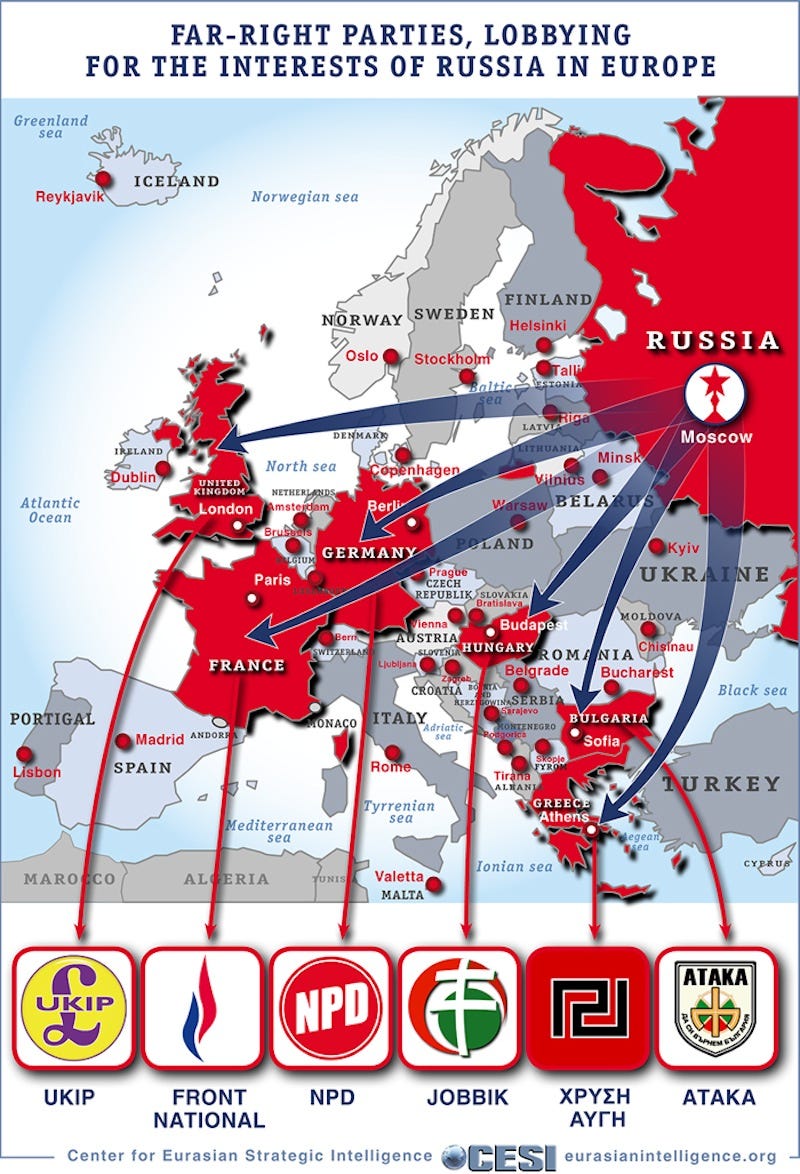
The following chart from the Center for Eurasian Strategic Intelligence (CESI) shows Russia's growing influence within six different European Union countries.


The parties, located in the UK, France, Germany, Greece, Bulgaria, and Hungary, are increasingly popular—and staunchly against giving more power to the EU. Each of the parties has also fostered a closer relationship with Russia, and has protested against sanctions on Moscow following its annexation of Ukraine. 

The six parties linked to Russia are the UK's UK Independence Party (UKIP), France's National Front, Germany's National Democratic Party, Hungary's Jobbik, Greece's Golden Dawn, and Bulgaria's Attack. 

Britain's UKIP party, which favors withdrawing from the EU and having stronger relations with Russia, received 29% of the votes in the most recent election. This was double what the party obtained in elections five years ago. 

Likewise, according to CESI, France's National Front won 25% of the votes in a national election. The party's head, Marine Le Pen, views Putin as a traditional ally and plans to form a coalition with other pro-Russian, pro-White parties in the European Parliament. 

Jobbik (Hungary), the Golden Dawn (Greece), and Attack (Bulgaria) are also attracted to and possibly financed by Russia. All three parties oppose placing sanctions on Moscow for its annexation of Crimea, and have favorable views of Putin as a defender of traditional Christianity. 

Hungary, in particular, views Russia as an ally. Jobbik is the second-most-powerful political party in the country after the leading Fidesz party, which is also pro-Russian. Both parties oppose sanctions on Moscow and sought Russian help for building a nuclear power plant. 

The rise in European pro-White parties is largely tied to Russian policies first developed during the Cold War. These policies, called "special war," attempt to conduct foreign policy through a combination of espionage and dark money rather than traditional warfare. Russia expert John Schindler explains that while the Soviet Union backed communist-leaning parties to influence politics, Russia is now financing pro-White parties in an attempt to steer European politics. 

The preferred outcome for Russia would be the dissolution of the EU and the end of a counterweight to Russian power. 

"Resulting from the election of May 25, 20% of the European Parliament members are representatives of parties supporting dissolution of the EU," a CESI report states. "Their core is made of [patriotic-populist pro-White] politicians."

Spectroscopy: The Key to Humanity’s Future in Space

http://www.universetoday.com/116824/spectroscopy-the-key-to-humanitys-future-in-space/

Imagine, if you would, a potential future for humanity… Imagine massive space-elevators lifting groups of men, women, and children skyward off Earth’s surface. These passengers are then loaded onto shuttles and ferried to the Moon where interstellar starships are docked, waiting to rocket to the stars. These humans are about to begin the greatest journey humanity has ever embarked upon, as they will be the first interstellar colonists to leave our home Solar System in order to begin populating other worlds around alien stars.

There are many things we must tackle first before we can make this type of science-fiction scene a reality. Obviously much faster methods of travel are needed, as well as some sort of incredible material that can serve to anchor the aforementioned space elevators. These are all scientific and engineering questions that humanity will need to overcome in the face of such a journey into the cosmos.

http://www.universetoday.com/116824/spectroscopy-the-key-to-humanitys-future-in-space/

But there is one particular important feature that we can begin to tackle today: where do we point these starships? Towards which system of exoplanets are we to send our brave colonists?

Of all of the amazing things we need to discover or invent to make this scene a reality, discovering which worlds to aim our ships at is something that is actually being worked on today.

It’s an exciting era in astronomy, as astronomers are currently discovering that many of the stars that we view in the night sky have their own planets in orbit around them. Many of them are massive worlds, all orbiting at varying distances from their parent star. It is no surprise that we are discovering a vast majority of these Jupiter-sized worlds first; larger worlds are much easier to detect than the smaller worlds would be. Imagine a bright spotlight pointing at you some 500 yards away (5 football fields). Your job is to detect something the size of a period on this page that is orbiting around it that emits no light of its own. As you can see, the task would be daunting. But nevertheless, our planet hunters have been utilizing methods that enable us to accurately find these tiny specks of gas and rock despite their rather large and luminous companion suns.

http://www.universetoday.com/116824/spectroscopy-the-key-to-humanitys-future-in-space/

However, it is not the method of finding these planets that this article is about; but rather what we do to figure out which of these worlds are worthy of our limited resources and attention. We very well cannot point those starships in random directions and just hope that they happen across an earth-sized planet that has a nitrogen-oxygen rich atmosphere with drinkable water. We need to identify which planets appear to have these mentioned characteristics before we go launching ourselves into the vast universe.

More here.

Russia's Alisher Usmanov bought James Watson's Nobel Prize gold medal to return it to him

http://www.bbc.com/news/world-europe-30406322

Russia's richest man has revealed that he bought US scientist James Watson's Nobel Prize gold medal, and intends to return it to him.

Steel and telecoms tycoon Alisher Usmanov said Mr Watson "deserved" the medal, and that he was "distressed" the scientist had felt forced to sell it.

The medal, awarded in 1962 for the discovery of the structure of DNA, sold for $4.8m (£3m) at auction.

The medal was the first Nobel Prize to be put on sale by a living recipient.

The 1962 prize was awarded to Watson, along with Maurice Wilkins and Francis Crick, with each receiving a gold medal.

Mr Watson, 86, has said he planned to donate part of the proceeds to charities and to support scientific research.

In an interview with the Financial Times recently, Mr Watson said he had been made to feel like an "unperson" since a Sunday Times interview seven years ago in which he linked race to intelligence.

Mr Usmanov said in a statement that he was the anonymous telephone bidder who bought the medal at a Christie's auction last week.

"In my opinion, a situation in which an outstanding scientist has to sell a medal recognising his achievements is unacceptable," he added.


Mr Usmanov, said by Forbes magazine to be worth $15.8bn, is a major shareholder in Arsenal football club and was named Britain's wealthiest man in the Sunday Times rich list for 2013.

http://www.bbc.com/news/world-europe-30406322

Men and Women Vikings Colonized Together

http://www.natureworldnews.com/articles/11035/20141209/viking-women-helped-men-colonize-new-lands.htm
Vikings are often depicted as raping and pillaging barbarians, using brute strength to overtake new lands. But a new study of ancient Viking DNA shows that it wasn't just men moving to new territories; women accompanied their male companions, making traveling a family affair

Vikings are often depicted as raping and pillaging barbarians, using brute strength to overtake new lands. But a new study of ancient Viking DNA shows that it wasn't just men moving to new territories; women accompanied their male companions, making traveling a family affair.

These explorers traveled long distances, establishing colonies in Iceland and many parts of Northwestern Europe, and even sailed as far as North America. The popular notion was that Viking expeditions consisted entirely of men, who found and established new homes, later to be joined by their wives and children who stayed behind. Some scientists even believe that Viking men searched for greener pastures, seeking out women in foreign lands given the shortage of women at home.


To gain a better understanding of Viking colonization patterns, Erika Hagelberg of the University of Oslo and her colleagues compared ancient Norse and Icelandic mitochondrial DNA with that of modern Northwestern Europeans. These 45 skeletons, which date back to between 796 AD and 1066 AD, were first unearthed in various locations around Norway and are now held in the Schreiner Collection at the University of Oslo.

http://www.natureworldnews.com/articles/11035/20141209/viking-women-helped-men-colonize-new-lands.htm
Analysis of maternal DNA from their teeth and long bones revealed a similarity between these ancient Norsemen and modern-day people in the North Atlantic isles, particularly from the Orkney and Shetland Islands (near Scandinavia). This tells researchers that Viking women likely helped colonize new lands, too.

It looks like women were a more significant part of the colonization process compared to what was believed earlier," Jan Bill, an archaeologist associated with the University of Oslo who was not involved in the study, told Live Science.


What's more, a related study indicates that half of Viking warriors were female, putting them right in the middle of the action.

Vikings, men and women alike, did indeed travel together, but not for long. According to the new study, as pillaging and plundering became more and more permanent, they could not do so for long without putting families in harm's way.

"This picture that we have of Viking raiding - a band of long ships plundering - there obviously would not be families on that kind of ship," Bill added.

Next researchers plan to compare ancient Norse DNA to ancient DNA from Britain, Scotland and the North Atlantic Isles, to paint a clearer picture of how these populations are related.

The findings were published in the journal Philosophical Transactions of the Royal Society B.

http://www.natureworldnews.com/articles/11035/20141209/viking-women-helped-men-colonize-new-lands.htm

Life on Earth could have started with comet impact, scientists prove


Scientists have shown that molecules found in comets can break down into the building blocks of our DNA when under great heat and pressure.

Scientists have long believed that comets may have seeded Earth with the building blocks of life.
They theorised that around four billion years ago our planet was bombarded with rocks and balls of ice carrying molecules which, under the huge pressure of impact, could split into the elements needed to form DNA.

And now, for the first time, they have proven it in the lab.

Scientists have shown that formamide molecules – which have been found in comets - can break down into some of the nucleobases that make up DNA when under great heat and pressure.
A team at the Central European Institute of Technology in the Czech Republic used a high powered laser to reproduce the forces at work when a comet hits the surface of Earth such as a sudden extreme rise in temperature, shock waves and radiation.

They were able to break up formamide into three of the nucleobases which make up our DNA, adenine, guanine, cytosine. Only thymine was missing. However all the nucleobases for RNA were present.

Our DNA comprises of four nucleobases which join into pairs to form rungs on the ladder of the double-helix.

The scientists say the experiment solves a ‘central problem in origin-of-life research’ and shows that the impact alone of a meteorite or comet can transform a simple chemical into the letters of our genetic alphabet.

Although it's been known for years that scientists can coax formamide to recombine into DNA nucleobases, it is the first time that they have shown it can happen spontaneously during a high-energy event.

“The coincidence of the Late Heavy Bombardment (LHB) period and the emergence of terrestrial life about 4 billion years ago suggest that extraterrestrial impacts could contribute to the synthesis of the building blocks of the first life-giving molecules,” said lead author Dr Svatopluk Civis.

“Our findings demonstrate that extraterrestrial impacts, which were one order of magnitude more abundant during the LHB period than before and after, could not only destroy the existing ancient life forms, but could also contribute to the creation of biogenic molecules.”

"The first bio- signatures of life are dated to roughly coincide with the LHB or near the end of it.
“In conclusion, all these findings suggest that the emergence of terrestrial life is not the result of an accident but a direct consequence of the conditions on the primordial Earth and its surroundings.”

Mars Rover Finds Stronger Potential for Life

http://www.nytimes.com/2014/12/09/science/-stronger-signs-of-life-on-mars.html?_r=0
A panoramic view of the surface of Mars from the Curiosity rover. Mount Sharp can be seen in the distance. Credit NASA

For lifeless chemical compounds to organize themselves into something alive, scientists generally agree, three sets of things must be present:

■ Standing water and an energy source.

■ Five basic elements: carbon, oxygen, hydrogen, phosphorus and nitrogen.

■ And time, lots of time.

In its search for environments where life might have started on Mars, the Curiosity rover has found the standing water, the energy and the key elements with the right atomic charges. As a result, scientists have concluded that at least some of the planet must have been habitable long ago.

But the period when all conditions were right was counted in hundreds to thousands of years, a very small opening by origin-of-life standards.

That has now changed. John P. Grotzinger of Caltech, the project scientist for the mission, reported at a news conference on Monday that the rover’s yearlong trek to Mount Sharp provided strong new evidence that Gale Crater had large lakes, rivers and deltas, on and off, for millions to tens of millions of years. The geology shows that even when the surface water dried up, plenty of water would have remained underground, he said.

Moreover, the team concluded, numerous deltalike and lakelike formations detected by orbiting satellites are almost certainly the dried remains of substantial ancient lakes and deltas. None of this proves that life existed on the planet, but the case for an early Mars that was ripe and ready for life has grown stronger.

“As a science team, Mars is looking very attractive to us as a habitable planet,” Dr. Grotzinger said in an interview. “Not just sections of Gale Crater and not just a handful of locations, but at different times around the globe.”

And John M. Grunsfeld, a former astronaut who is NASA’s associate administrator for science, said that after almost 28 months on Mars, Curiosity has given scientists insight into how and where to look for clues of ancient life. “We don’t know if life ever started on Mars, but if it did, we now have a better chance of discovering it” on future missions, he said.

Another missing piece of the story has been the inability to detect organic compounds — the carbon-based building blocks of life.

That too may soon change. Last spring, several Curiosity team members reported the detection of some simple organics that appeared to be Martian. The findings were not definitive, but NASA has scheduled a news conference Dec. 14 at the annual meeting of the American Geophysical Union with “new information” about the search for organics. “Our original interpretation — that there was a good chance the organics we were seeing are Martian — hasn’t changed,” said Daniel P. Glavin of the Goddard Spaceflight Center, an author of the earlier paper. “This interpretation will be expanded on at A.G.U.”

Another member of the Curiosity team, Roger Summons of M.I.T., says that findings from that rover and previous missions suggest that early Mars may have been quite similar to early Earth.

For the first billion years, he said, both planets had stable environments that could support life for substantial periods, and both still share the same chemistry and processes for altering rocks. There is a general scientific consensus that life began on Earth some 3.8 billion years ago, and Dr. Summons said it was clear that the same could have happened on Mars. Or as Dr. Grunsfeld put it, “What I get excited about is imagining a Mars 3.5 to 4 billion years ago, a planet with a thick atmosphere, maybe a blue sky with puffy clouds and mountains and lakes and rivers.”

More here.

08 December 2014

Putin urges to develop Russian science to fend off sanctions

http://www.reuters.com/article/2014/12/08/us-russia-putin-science-sanctions-idUSKBN0JM1TM20141208

(Reuters) - President Vladimir Putin said on Monday that Russia should make a leap in developing its fundamental science after Western powers limited the country's access to modern technology as part of sanctions over Moscow's actions in Ukraine.

The West has introduced sanctions against Russia, ranging from visa bans and asset freezes to restricting its access to foreign drilling technologies, key to Russia's development of untapped Arctic oil and gas deposits.

Speaking to a government meeting, Putin said the ban could stimulate Russia to develop its own technologies.

"This is not very good, but it could also possibly play into our hands," he said. "The existing circumstances have an evident plus too: Russia has gained a new impulse toward scientific and technological development."

Washington banned imports of high technology oil equipment to Russia and imposed sanctions on Russian oil majors, including Rosneft (ROSN.MM), Lukoil (LKOH.MM) and Gazpromneft (SIBN.MM) prohibiting Western firms from supporting their activities in exploration or production in deep water, Arctic offshore and shale oil reserves earlier this year.

Russia, the world's second-largest oil exporter, is counting on its Arctic and "tight" shale oil reserves to sustain production at around 10.5 million barrels per day, amid declining output at old West Siberian fields.

The Russian economy has been hit by falling oil prices, as Brent crude slipped below $70 per barrel last Friday , mounting pressure on the rouble and putting the country's economy at a bigger risk of recession.

Putin said Russia will not slash the funding of science, keeping it above 834 billion roubles ($15.56 billion) until 2020 as planned earlier; this despite a possible need to review budget expenditures due to falling revenues from oil and gas exports, which account for roughly half of Russia's export revenue this year.

Russia and the West are locked in the worst standoff since the Cold War over Ukraine, with Western powers accusing Moscow of supporting pro-Russian rebels fighting Kiev forces in the east. Russia denies the accusations.