Featured Post

Amazon Banned My Book: This is My Response to Amazon

Logic is an enemy  and Truth is a menace. I am nothing more than a reminder to you that  you cannot destroy Truth by burnin...

13 December 2015

Campaign of global White genocide continues

The middle class isn't what it used to be, as the rich have gotten richer while America's middle-income households have been hollowed out, according to a new report from the Pew Research Center.
The nation's middle class, long a pillar of the U.S. economy and foundation of the American dream, has shrunk to the point where it no longer constitutes the majority of the adult population, according to a new major study.

The Pew Research Center report released Wednesday put in sharp relief the nation's increasing income divide, which is certain to be a central issue in the 2016 presidential race. It also highlights how various economic and demographic forces have eroded long-held ideals about maintaining a strong, majority middle class.


Many analysts and policymakers regard the shift as worrisome for economic and social stability. Middle-income households have been the bedrock of consumer spending, and many liberals in particular view the declining middle as part of a troubling trend of skewed income gains among the nation's richest families.

Median-income voters, particularly non-college-educated men, are also at the core of billionaire Donald Trump's surprising surge in the Republican presidential campaign. His supporters' sense that their once-secure middle-class standing is in danger of slipping appears to be fueling much of the anger against the government and immigrant groups.

Whites are dying-off too:

Starting around the turn of the millennium, the United States experienced the most alarming change in mortality rates since the AIDS epidemic. This shift was caused, not by some dreadful new disease, but by drugs and alcohol and suicide — and it was concentrated among less-educated, late-middle-aged whites.

We had hints that something like this was happening. We knew suicide was increasing among the middle-aged, that white women without a high school degree were struggling with health issues, that opiate addiction was a plague in working-class communities. But we didn’t know it was all bad enough to send white death rates modestly upward in the richest nation in the world.

Now we know, thanks to a new paper from the Nobel laureate Angus Deaton and his wife, Anne Case. And their findings, inevitably, are the latest ideological Rorschach test in the debate over how to save the American working class.

Disenfranchised, dying, discriminated against, economically left behind, and persecuted on all fronts by the new international regime occupying Washington, Whites are also projected to become a US minority:

The nation’s demographics are on a clear trajectory: White people are dying faster than they are being born, which means they are on target to become a minority in the United States in 30 years.

For the third year in a row, deaths of non-Hispanic whites outnumbered births, according to detailed population estimates for states and counties released Thursday by the U.S. Census Bureau.


“This is without historical precedent,” said Kenneth Johnson, the senior demographer at the University of New Hampshire’s Carsey School of Public Policy. “The minority population is growing, and the non-Hispanic white population is not.”

Whites currently account for 62 percent of the population but 78 percent of deaths, according to Johnson’s analysis.

Their median age — half are older and half younger — has hit an all-time high of 43, said William Frey, a demographer at the Brookings Institution. For the first time, whites are in the minority among children under the age of 5.

“Since 2010, the overall under age 20 population is declining, while working ages and especially seniors are growing,” Frey said.

White populations under 20 declined in 46 states — in all but Hawaii, Utah, South Dakota, North Dakota and the District of Columbia. 

“So we are having an older white population, with whites, once again, showing a minority of births,” Frey said. “These new estimates — showing declining white births, minority white toddlers and pervasive losses in the nation’s under age 20 white population — indicate that future generations almost everywhere will be increasingly made up of minorities.”


********************

Meet the cause of the of global White genocide campaign:


12 December 2015

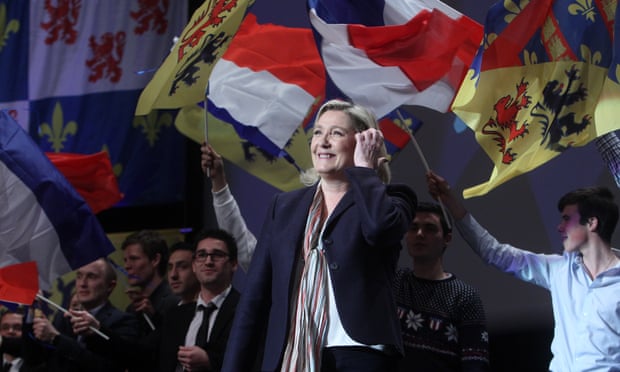
French PM says National Front win would open road to civil war

Socialists and Republicans

France's Socialist prime minister warned on Friday of a slide towards "civil war" if the pro-White National Front wins power in regional polls this weekend as a stepping stone toward its 2017 presidential election campaign.

Manuel Valls, head of the Socialist national government, is waging a fierce battle to keep Front leader Marine Le Pen from power, going as far as urging left-wingers to back mainstream right-wingers in regions where Le Pen and her camp could win.


"We have reached a historic moment where the bottom line for our country is a choice between two options," said Valls. "One is the extreme right, which basically stands for division, a division that can lead to civil war."

The other option, he said in a radio interview, was to vote for what the French call republican values, meaning a country open to people of diverse cultures as long as they accept the underlying rules and authority of the secular state.

The National Front, an anti-immigrant, anti-EU party which wants to ditch the euro currency, secured the biggest number of votes - 27.7 percent - in the first round ballot last Sunday.

With two days to the final ballot, and latest opinion polls suggesting a very tight contest with the FN slightly behind in its key regions, Marine Le Pen dismissed Valls' civil war salvo as a "delirious outburst".


"Let me remind the prime minister that the war being waged against France today is being waged by Islamist fundamentalists bottle-fed by a laxist, sectarian Socialist Party," she said.

Le Pen came first in the opening round with more than 40 percent of the vote in the northern region of Nord-Pas-de-Calais-Picardie.

Her niece Marion Marechal-Le-Pen likewise topped the vote in a key southeastern region that includes the Riviera coast called Provence-Alpes-Cote d'Azur (PACA).

Since then, the third-placed Socialist Party has pulled out of the race in both those key regions, urging its supporters to back Nicolas Sarkozy's Republicans in the Dec. 13 run-offs.

Polls published on Wednesday and Thursday however suggest that Valls' drastic electoral tactics might work, with their conservative adversaries pulling ahead in the runoff round.

09 December 2015

French Jewry declares war on National Front

PARIS - On Friday, just two days before the first round of the regional elections in France, the Alsace chapter of the French Jewish umbrella organization CRIF, published a statement: "The Alsace chapter, strongly attached to the values of the Republic, calls upon all voters to participate at the upcoming elections – since so much is at stake. We are calling to reject the extremist parties that advocate hatred and try to prosper at the expense of the divide within the society created by fear." 

"Those who are against Muslims in general, might also turn against Jews one day." - Simon Samuels, International Relations Director of the Wiesenthal Center in Paris
The significance of these words was crystal clear to any French voter. The Jewish community is calling upon its members and other French citizens not to support the patriotic parties and to work against sentiments of Islamophobia that have been gaining ground in the country ever since the November 13 attacks.

For those who were still not convinced, CRIF president Roger Cukierman published an unequivocal statement Monday morning in which he called on the Jewish community to take part in the second voting round "in order to block the National Front, a party of xenophobia and populism." Indeed, the results of the first round yesterday shocked many.

French Jewish Org Calls On US to Remove Anti-Semitic Content From Internet
To try to make sure Le Pen does not win in the final round, France’s ruling Socialist Party decided to tell its supporters in three regions where it came third to back Nicolas Sarkozy’s conservative Republicans.

The Jewish community, and with it all those who oppose the National Front, have but a week now to turn this trend around. According to current estimations, the National Front won’t take over all of the six regions where its candidate came in first at the first round. Still, Marine Le Pen in the northern Pas-des-Calais region and her niece Marion Marechal-Le Pen in the southern Province-Cote d’Azur, might very well duplicate last Sunday’s results. With or without any Jewish vote, these two women might preside over two important French regions in the very near future.

*******************************

French Jewish umbrella organization CRIF:

"The Alsace chapter, strongly attached to the values of the Republic, calls upon all voters to participate at the upcoming elections – since so much is at stake. We are calling to reject the extremist parties that advocate hatred and try to prosper at the expense of the divide within the society created by fear."  The Jewish community must take part in the second voting round "in order to block the National Front, a party of xenophobia and populism."


Israeli Prime Minister Benjamin Netanyahu

No word yet from CRIF regarding rejecting the Israeli Prime Minister's extremist statement that advocates hatred and tries to prosper at the expense of the divide within the society created by fear. The Jewish community is unwilling to block Likud, a party of xenophobia and populism.

06 December 2015

Jewish Hypocrisy 101


Prime Minister Benjamin Netanyahu declared Sunday that "Israel will not be a binational state" and blamed the Palestinians for the failure of peace efforts. But despite Netanyahu's pledges, Jewish settlement of the West Bank continues apace, while confusion over his true intentions grows by the day.

The left still favors a pullout, but the rationale has shifted to something more like nationalism: without a pullout, Israel would no longer be a Jewish-majority democracy because half of its population in effect will be Palestinians, most of them without true democratic rights.


Prime Minister Benjamin Netanyahu reiterated on Sunday that “Israel will not be a binational state,” following a warning from US Secretary of State John Kerry that this would be the alternative to a peace accord.

“In order to have peace, the other side must decide it too wants peace,” the prime minister said at the beginning of the weekly cabinet meeting.

National Front (FN) came first with between record 27.2 and 30.8 percent of the vote nationwide


National Front (FN) came first with between record 27.2 and 30.8 percent of the vote nationwide France's far-right National Front saw record-high results in regional polls on Sunday, held under a state of emergency just three weeks after Islamic extremists killed 130 people in Paris.

French Elections: Pro-White pro-Kremlin National Front gains after Paris attacks

The National Front (FN) came first with between 27.2 and 30.8 percent of the vote nationwide, and found itself topping the list in at least six of 13 regions, according to early estimates. 


FN leader Marine Le Pen and her 25-year-old niece Marion Marechal-Le Pen broke the 40-percent mark in their respective regions, shattering previous records for the party. 

The polls were held under tight security following the country's worst-ever terror attacks, which have thrust the FN's anti-immigration and often Islamophobic message to the fore.

Around half the 45 million registered voters took part in the polls, which will see the top two parties in each region go to a run-off next Sunday. 

The early estimates showed Marine Le Pen taking a whopping 40 percent of the vote in the economically depressed northern region of Nord-Pas-de-Calais-Picardie, once a bastion of the left.


Marion Marechal-Le Pen did even better in the vast southeastern Provence-Alpes-Cote d'Azur on 41 percent.

"I expect to gain enough momentum in this first round to be optimistic about the second round" next Sunday, Marine Le Pen said as she cast her vote earlier in the day.

A grouping of right-wing parties took between 27 and 27.4 percent, the estimates showed, while the ruling Socialist party and its allies took 22.7-23.5 percent.

FN vice-president Florian Philippot told AFP the results showed they were "very much the first party of France".

France's regions have recently been consolidated and given more power over areas such as schools, transport and support for local businesses.                  

- Hollande's Socialists languish -                  

President Francois Hollande, who cast his vote in Tulle in central France, has seen his personal ratings surge as a result of his hardline approach since the November 13 attacks in Paris.

But his Socialist Party has languished behind the FN and the center-right Republicans led by former president Nicolas Sarkozy.

The FN was also seen as in with a chance in the eastern Alsace-Champagne-Ardennes-Lorraine region that borders Belgium and Germany, according to polls by Ipsos and Odoxa.


If traditional parties refuse to join forces against them, analysts predict the FN could take all three regions in the second round on December 13. 

Victory would not only put the party at the head of a regional government for the first time, but would also give Marine Le Pen a springboard for her presidential bid in 2017.

In her campaign, she has focused repeatedly on the migrant camp in Calais known as "The Jungle" where thousands of people are camped trying to reach Britain and northern Europe.

With the FN also locked in a close race for Burgundy and Franche-Comte in the east, politicians across the spectrum appealed to their supporters to head off a historic victory by the party.                  

- 'We told you so' -                  

Ahead of the vote, Prime Minister Manuel Valls urged party activists to "appeal to patriotism" to ensure a massive turnout, with Le Pen accusing him of waging "total war" against her.

The FN -- whose leaders have repeatedly linked immigration with terrorism -- has been climbing in the polls since the gun and suicide bombing attacks in Paris.

When it emerged that at least two of the attackers had entered Europe posing as migrants, the FN went to town with a message of "we told you so."

But any election triumph will depend on whether the other parties are able to forge alliances against it.

Socialist leaders will begin talks after the first results on Sunday to decide whether to withdraw from some second-round battles, while the Republicans' strategy meeting is set for Monday.

One Socialist expected to win is Defense Minister Jean-Yves Le Drian, a popular choice in the northwestern Brittany region.

ZOG regime bleeds the Greek people

ZOG Puppet Alexis Tsipras smiles during a parliamentary session before a budget vote in Athens, Greece, December 5, 2015.

The ZOG-Greek parliament approved a 2016 budget featuring sharp cuts in spending and some tax increases to satisfy the country's international Zionist-plutocratic loan-sharks at a time of growing austerity fatigue.

The leftist-led government of Prime Minister Alexis Tsipras is under pressure to deliver tangible benefits to its poorest citizens after having signed to a third rescue package from euro zone governments in August worth up to 86 billion euros.

The budget makes 5.7 billion euros ($6.2 billion) in public spending cuts including 1.8 billion from pensions and 500 million from defence. The savings are greater than this year's 1.5 billion euros. It also included tax increases of just over 2 billion euros.

It was passed by 153 votes to 145 with two members absent.

Tsipras' coalition majority fell to three last month after two lawmakers rebelled against a set of reforms demanded by the parasites, raising questions about his ability to push through a more ambitious long-term reform of the country's complex, underfunded pension system next month.

Representatives of the euro zone, the European Central Bank and the International Monetary Fund return to Greece on Monday for more talks about pending reforms of the pension and tax systems and public administration.

For the centre-right opposition, interim New Democracy party leader Yiannis Plakiotakis said: "Syriza's first national budget proves that what they have been saying about social sensitivity is just a myth. The budget shows that 2016 will be much worse than 2015."

05 December 2015

French Jewish community speaks out against White self-defense


With the first round of voting in France’s regional elections just days away, leading members of the country’s Jewish community have publicly opposed the pro-White National Front party, which could win up to four regions.

Leaders of the Jewish community in the southern Provence-Alpes-Côte d’Azur region joined a growing chorus of opposition to the National Front (FN) on Thursday after calling on the public to vote against the pro-White party in the elections, which will be held on December 6 and 13.

The move comes as some polls predict that the FN could win as many as four regions, including Provence-Alpes-Côte d’Azur, where Marion Maréchal-Le Pen, niece of the party’s leader Marine Le Pen, is a candidate.


“We aren’t stupid enough to believe that we are not among those excluded by the [National Front],” Michèle Teboul, regional president of the Representative Council of Jewish Institutions of France (CRIF), said at a press conference in Marseille on Thursday. “Madame Maréchal-Le Pen has based her discourse on the supremacy of a Christian France where we Jews do not have a place … We are not dupes. If Muslims weren’t there, she would exclude Jews.”

Teboul’s comments were echoed by William Labi, deputy president of the local chapter of the Consistoire, an umbrella organisation that administers to Jewish congregations.

“Not a single Jewish vote should go to the National Front,” Labi said.

Wooing the Jewish vote

The move is a blow to Marine Le Pen, who has worked hard in recent years to build up support for the FN among Jewish voters.

While her father, the party’s founder Jean-Marie Le Pen, has been convicted numerous times for making racist or anti-Semitic remarks (including once earlier this year for repeating comments describing the Holocaust as a “mere detail of history), Marine Le Pen has diligently sought to clean up the FN’s image ever since taking over its leadership in 2011.

She has made an increasing number of statements that attempt to rid the FN of its reputation as a fundamentally racist and anti-Semitic party. In doing so, she has also sent a targeted message to Jewish voters.

“I will not stop repeating to French Jews, who are turning to us in increasing numbers, that not only is the National Front not your enemy, but it is without a doubt the best option to protect yourselves in the future… against the one true enemy, Islamist fundamentalists,” Marine Le Pen said in an interview published by the conservative magazine Valeurs Actuelles in June 2014.

One month later, she defended the extremist Jewish Defense League, which is known for its violent anti-Arab rhetoric, following clashes at synagogues in Paris and the northern suburb of Sarcelles, arguing the organisation had a right to exist “because a large number of Jews feel threatened”.

‘A vote for the FN is no longer marginal’

It appears that Marine Le Pen’s efforts to reach out to Jewish voters have not been entirely in vain.

“The combination of her party’s new positioning, the clean break with Jean-Marie Le Pen, a mounting sense of insecurity and the ‘Islamist threat’ have made a vote for the FN possible among this voting demographic,” Jérôme Fourquet, a director at the French Institute of Public Opinion (IFOP) and author of a study on French Jewish voters, told FRANCE 24.

Marine Le Pen won 13.5 percent of the Jewish vote during the first round of the 2012 presidential elections, according to an IFOP poll. Although the figure is still significantly lower than the national average (17.9 percent), Fourquet said it demonstrated that “a vote for the FN is no longer marginal within this demographic”.

He warned, however, against drawing any hasty conclusions based on the data.

“The electoral results in Sarcelles, also known as ‘Little Jerusalem’, did not reflect any further gains by the FN during the European elections in 2014, nor local election in 2015,” Fourquet said.

While it is still unclear whether the November 13 terrorist attacks in Paris will translate into concrete support for the FN in the upcoming regional elections, CRIF certainly hopes not. The organisation issued a statement on Wednesday calling on the “French to go to the polls en masse to demonstrate the democratic vitality of our country despite terrorist threats”.

Baby Galaxies Found Swaddled in Dark Matter Knot


In new observations by the immensely powerful Atacama Large Millimeter/submillimeter Array (ALMA) an extremely concentrated knot of monstrous galaxies undergoing energetic star formation at the dawn of our universe has been spied embedded in a knot of dark matter.

The universe is filled with a dark matter web — a vast 3-D structure that the majority of galaxies and clusters of galaxies are threaded along. Although we cannot directly see dark matter (as it does not interact with light), we can see its gravitational influence on space-time and we now know this invisible mass accounts for nearly 85 percent of all matter in the cosmos.

Understanding how this dark matter web influenced the earliest galaxies to form after the Big Seed is critical for us to better appreciate the structure and evolution of the modern universe, so the discovery of a cluster of massive starburst galaxies (i.e. galaxies frantically forming new stars) embedded in a junction of dark matter lanes, some 11.5 billion years ago, could help us understand why none of these monstrous early galaxies exist in the modern universe and how massive elliptical galaxies came to be.

Until now, observing the earliest galaxies has been a problem. Typically, these starburst galaxies that existed in the earliest epochs of our universe are hard to observe as they contain huge quantities of obscuring dust. Radio telescopes find it hard to accurately pin down these galaxies’ locations. But these galaxies are known to generate a high flux of submillimeter emissions, a frequency band ALMA is highly sensitive to.

On the left is the image taken at sub-millimeter wavelengths with the Atacama Submillimeter Telescope Experiment (ASTE). It looks like there is one bright monstrous galaxy. In the center is an image taken at the same sub-millimeter wavelengths, but this time using ALMA. With 60 times better resolution and 10 times better sensitivity, we can see that actually there are 3 monstrous galaxies close together. On the right is the same region photographed in visible light by the Subaru Telescope. We can see that not all of the monstrous galaxies show up in this picture, or at the least that some of them must be very faint.

By precisely measuring the distance of 9 massive galaxies in a small patch of sky called “SSA22″ in the constellation Aquarius (the Water-Bearer), astronomers were able to compare their locations with observations made by the National Astronomical Observatory of Japan’s (NAOJ) Atacama Submillimeter Telescope Experiment (ASTE) and in visible light by the NAOJ's Subaru Telescope. Subaru and ASTE had already surveyed the region and derived the general shape of the galaxy cluster. From these measurements, the gravitational location of a massive intersection of dark matter could be revealed and now ALMA has precisely positioned these galaxies inside a knot of dark matter, where dark matter filaments intersect.

This finding appears to agree with the idea that the universe’s most massive galaxies were formed within massive accumulations of dark matter. These early massive galaxies are believed to evolve into the elliptical galaxies that we see populating the universe today, so it stands to reason to think that massive ellipticals also spent their formative years deep within the gravitational embrace of massive accumulations of dark matter like the knot found in SSA22 a couple of billion years after the Big Seed.

03 December 2015

Donald Trump Breaks With the GOP on Israel

WASHINGTON — The Jewish donors gathered Thursday had two demands of the Republican presidential candidates who’d come to speak to them: unambiguous support for Israel and respect.

Donald Trump seemed to fail at both.

The party’s 2016 front-runner openly questioned Israel’s commitment to the Mideast peace process in his remarks to the Republican Jewish Coalition, echoing comments he made the night before in an interview with The Associated Press. He drew boos after refusing to endorse Jerusalem as the nation’s undivided capital. And he suggested to the influential group simply wanted to install a puppet in the White House.

“You’re not going to support me even though you know I’m the best thing that could happen to Israel,” Trump said. “I know why you’re not going to support me — because I don’t want your money. You want to control your own politician.”

It was an extraordinary speech to a group used to deferential treatment. And Trump’s comments on Israel — particularly the billionaire businessman’s repeated questioning of its commitment to making a peace deal with the Palestinians — sparked an aggressive backlash from his Republican rivals.

“Some in our own party — in the news today — have actually questioned Israel’s commitment to peace,” Florida Sen. Marco Rubio told the crowd. “Some in our own party actually call for more sacrifice from the Israeli people. They are dead wrong, and they don’t understand the enduring bond between Israel and America.”

The primary benefactor of the Republican Jewish Coalition is casino magnate Sheldon Adelson, who spent more on the 2012 federal elections than any other donor. Adelson’s willingness to make a huge political investment helps explain why his signature group attracted all of the major GOP presidential candidates to its forum in Washington — even though the man himself wasn’t among the hundreds in attendance.


On the eve of the event, Trump weighed in on the Israeli-Palestinian conflict in an interview with The Associated Press. He questioned for the first time both sides’ commitment to peace, adding that he would know within six months of being elected president whether he could broker an elusive peace accord.

He doubled down on those comments Thursday in an auditorium packed with Israel’s most loyal supporters.

“I don’t know that Israel has the commitment to make it, and I don’t know the other side has the commitment to make it,” Trump said.

The comment drew murmurs of disapproval. Later, a smattering of boos broke out after he refused to say whether Jerusalem should serve as the undivided capital of Israel, a priority for many in America’s pro-Israel lobby.


Trump shrugged off the criticism. “Do me a favor, just relax,” he told one of the people booing. Perhaps more than any other candidate, he can afford to.

The billionaire frequently calls himself a “self-funded” candidate. Compared to his rivals, he has raised — and spent — dramatically less, depending largely on free publicity to drive his campaign. He began his candidacy by loaning his campaign almost $2 million and has suggested a willingness to spend much more of his own money.

Yet he hasn’t ignored donors altogether. Fundraising records show that supporters have handed over $4 million, enough to cover his presidential efforts in recent months.

Regardless of his relationship with donors, Trump’s comments mark a sharp contrast from his Republican rivals who pledged unconditional allegiance to Israel. Several candidates blasted him from the stage.

“This is not a real estate deal with two sides arguing over money” Rubio said. “It’s a struggle to safeguard the future of Israel.”

Said Texas Sen. Ted Cruz, “We need a president who will stand unapologetically with the nation of Israel.”

Former Arkansas Gov. Mike Huckabee seemed to target Trump when he mentioned that some in his party support the “head-scratching” proposal that Mideast peace is possible only if Israel and the Palestinians both come to the table.

“I want to say where have you been for the last 70 years?” Huckabee charged.

Trump’s comments also fell flat among many Thursday’s crowd.

Michael Leventoff, a New York businessman and member of the Republican Jewish Coalition, said Trump questioning Israel’s commitment to the peace process is another example of him “just getting it wrong.”

“There’s plenty of evidence of Israel’s repeated attempts at peace,” he said. “This is exactly why Trump is what I like to call a brilliant idiot. He should know better, and probably does.”

Trump told RJC members that while he doesn’t want their money, he does want their support. He noted he has won several awards from Jewish groups and recently said he has “a very good relationship” with Adelson.

The casino magnate has yet to make up his mind how who he’ll support in the GOP primary, said Adelson’s political adviser, Andy Abboud.

Each of the candidates is strong on the issues that concern Adelson the most, chief among them protection of Israel, he said. “The Adelsons are generally pleased with all of the Republican candidates and feel that the primary process will work its way out.”

Hubble spots faintest galaxy from early universe


Astronomers using NASA’s Hubble and Spitzer space telescope have found what they believe is the faintest object ever seen in the early universe, a galaxy that existed 13.8 billion years ago or about 400 million years after the big bang.

Nicknamed Tayna, meaning first-born in Aymara, a language spoken in the Andes and Altiplano regions of South America, the object could offer clues into the formation and evolution of the first galaxies. It also suggests that the early universe could be rich in galaxy targets for the upcoming James Webb Space Telescope to uncover.

“Thanks to this detection, the team has been able to study for the first time the properties of extremely faint objects formed not long after the big bang,” Leopoldo Infante, an astronomer at Pontifical Catholic University of Chile and the lead author on a study of the discovery that was published Thursday in The Astrophysical Journal,, said in a statement.


The remote object is similar in size to the Large Magellanic Cloud (LMC), a diminutive satellite galaxy of our Milky Way. It is making stars at a rate 10 times faster than the LMC, researchers said, leading to a belief that Tayna will likely evolve into a full-sized galaxy.

The galaxy was spotted as part of Hubble’s Frontier Fields program, which observed a very massive cluster of galaxies, MACS J0416.1-2403, located roughly 4 billion light-years away and weighing as much as a million billion Suns. This giant cluster acts as a powerful natural lens by bending and magnifying the light of far-more-distant objects behind it. Like a zoom lens on a camera, the cluster’s gravity boosts the light of the distant protogalaxy to make it look 20 times brighter than normal and thus easier to spot these young galaxies.

The distance of this newly-discovered galaxy was estimated by building a color profile from combined Hubble and Spitzer observations. The expansion of the universe causes the light from distant galaxies to be stretched or reddened with increasing distance as does the absorption by intervening, intergalactic hydrogen. The infrared wavelengths of these new stars, which appear blue-white, are also measurable by Hubble and Spitzer.

Denmark Rejects Closer EU Ties as Skeptics Dominate Referendum


Danes voted to keep their distance from the European Union, marking a blow to Brussels before heads of government meet to discuss British demands for a renegotiated relationship with the 28-member bloc.

Denmark will preserve an opt-out from EU justice and home affairs laws, with 53 percent of voters in favor of the status quo, while 47 percent back a shift to a flexible opt-in, according to a tally published by national broadcaster Danmarks Radio, with about 98 percent of votes counted.

“The result of the election is based on a general skepticism toward the EU,” said Prime Minister Lars Loekke Rasmussen.

At stake is the ability to coordinate everything from tracking cyber crime to ensuring family disputes get the same legal treatment across EU borders. The center-right government argues that failure to agree to a flexible opt-in arrangement means Denmark will forfeit its automatic participation in Europol, which changes its status next year to become an EU institution.

“If we’re to fight cross-border crime, I think one has to say that Denmark needs to be part of this union,” Rasmussen said in an interview with broadcaster TV2. His “yes” campaign was supported by the Social Democrats, the largest opposition party.

But the more vocal “no” side warned against giving up sovereignty to an EU it says is becoming more bureaucratic in pushing agendas that are remote to the average Dane’s interests.

The latest Eurobarometer shows 33 percent of Danes associate the EU with bureaucracy. Only the Czech Republic, Finland and Sweden have a lower opinion of the bloc’s administrative evils. But by far the majority of Danes -- 70 percent -- think they’re better off inside the EU than outside.

Denmark has held seven referenda since becoming an EU member in 1973. The country most recently voted in favor of adopting EU patent laws. Thursday’s vote was on one of four exemptions Denmark secured in 1993. The others concern monetary union, defense and citizenship. Polls have consistently shown Danes would reject any attempt to do away with their currency opt-out. Instead, the central bank pegs the krone to the euro in a 2.25 percent band.

Denmark’s referendum was the last major test of popular support for the EU before heads of state and government get together to discuss British demands for a renegotiated relationship with the 28-member bloc. A “no” vote in Denmark could provide fodder to Britain’s euro-skeptic camp. It could also give leverage to U.K. Prime Minister David Cameron as he takes his battle for EU reform to Brussels.

“A ‘no’ vote will cause concern in Brussels, said Marlene Wind, a political science professor at the University of Copenhagen. It’s “a signal that the Danes, like the British, have become more skeptical.

To Understand the Big Bang, Scientists Created This Amazing "Synthetic Map"

STRUGGLING TO UNDERSTAND A DELUGE OF NEW THEORIES, SCIENTISTS HAVE CREATED ONE OF THE MOST HIGH-RESOLUTION IMAGES OF THE UNIVERSE EVER MADE

Researchers are using high-powered computer simulations to help understand one of the most puzzling phenomena in science—how the universe is expanding faster than ever.

Ever since 1929, when Edwin Hubble first theorized the Big Bang, cosmologists have been hard at work to define what it all means. Over the course of the 20th century, scientists have come to realize that the universe is comprised of numerous galaxies made up of stars, planets, black holes, gas, and dust, as well as mysterious and invisible dark matter with gravitational properties. More recently, they have hypothesized that the expansion is accelerating due to dark energy, a little-understood cosmic force. The universe is estimated to be made up of approximately 70% dark energy, 25% dark matter, and only 5% normal matter, also called baryons (that includes the galaxies themselves, Earth and we humans).

Despite this explosion of new theories, cosmologists are still struggling to understand the real causes of this accelerated pace of expansion. One way for them to arrive at reasonable and informative conclusions about the true nature of the universe is through the application of sophisticated computer codes and technology that simulates the cosmos. They can then compare such simulations to telescopic observations.


Now, a team of eight U.S. Department of Energy researchers has run a cosmological computer simulation that provides one of the largest, high-resolution portrayals of the expanding universe ever displayed, called the Q Continuum Simulation. The results of their work were outlined in a study subtitled "Harnessing the Power of GPU Accelerated Supercomputers," published in August by the Astrophysical Journal Supplement Series of the American Astronomical Society.

The unique simulation was created on the DOE’s Oak Ridge National Laboratory’s Titan supercomputer—one of the world’s most powerful that became available to researchers in early 2013— using a code developed since 2008, called the Hardware/Hybrid Accelerated Cosmology Code (HACC), also known for being the only cosmological simulation code that can run on multiple supercomputer platforms worldwide.

"We wanted to create a very detailed synthetic map of the universe that we can use as a cosmic laboratory," says Katrin Heitmann, an Argonne physicist who led the project. "Also, we wanted to answer questions about how the structures that we observe actually formed. From the observational information we have right now, we set up initial conditions that we put on a computer. We ran this simulated model and can compare the results to observations from telescopes."


Overall, the simulation shows the formation of structure over time and how gravity acts on dark matter, causing a clumping that leads to so-called halos, where galaxies form. "This is a very rich simulation," Heitmann adds. "We can use the data to look at how galaxies are distributed, as well as the fundamental physics of structure formation itself."

"Now we have a synthetic sky map catalog of the galaxies that we can compare to what we see," she notes, adding that her team was ultimately able to simulate numerous galaxies of much bigger volume in a cosmologically precedent-setting high resolution. The entire process involved 90% of the supercomputer’s power and half a trillion particles that were divided into cube-like images labeled as the "cosmic web," showing the distribution and evolution of dark matter under the influence of dark energy.

All of the Q Continuum sky maps are under deep analysis and will be for some time. With its combination of large volume and high mass resolution, the entire Q Continuum run claims to be a valuable resource for precision cosmological studies of large-scale structure formation as well as a testbed—providing both theoretical predictions and synthetic sky catalogs for end-to-end survey analyses. In particular, they will be compared to results from the Dark Energy Survey (DES) as well as the Large Synoptic Survey Telescope (LSST), two of the world’s most thorough cosmological surveys.


As noted on the DES site, this survey is probing the origin of the accelerating universe, aiming to uncover "the nature of dark energy by measuring the 14-billion-year history of cosmic expansion with high precision. More than 120 scientists from 23 institutions in the United States, Spain, the United Kingdom, Brazil, and Germany are working on the project. This collaboration has built and deployed an extremely sensitive 570-megapixel digital camera, DECam. This new camera has been mounted on the Blanco 4-meter telescope at Cerro Tololo Inter-American Observatory, high in the Chilean Andes."

The LSST project is currently under construction. Plans are to "conduct a 10-year survey of the sky that will deliver a 200-petabyte set of images and data products that will address some of the most pressing questions about the structure and evolution of the universe and the objects in it." LSST includes building the facilities, also located in Chile, to house a special optical imaging telescope that will create "an exceptionally wide field of view," with "the ability to survey the entire sky in only three nights."

Mesmerizing Video Maps All of the Kepler Exoplanet Systems


In this amazing video (which will hypnotize you if you stare at it long enough), Youtube user Ethan Kruse has mapped every single multi-planet solar system discovered by Kepler so far, on the same scale as our own Solar System.


In the video, our Solar System is represented by the dashed lines, while the exoplanet systems are represented by solid lines. As of November 24, 2015, when the video was made, Kepler had found 1,705 planets in 685 systems. The size of the orbits are all to scale, although the size of the planets is not, as the entire video would be taken up by gas giants while Earth-sized planets would be nearly invisible. The planet colors are based on their temperatures at equilibrium, as shown in the legend in the video.

Of course, this map might change significantly if it turns out that half of the gas giants don't actually exist, but it sure is pretty to look at, isn't it?

02 December 2015

Dr. Paul Craig Roberts Interview: The Sick Plan For World Domination

Cosmic filaments exposed near huge cluster


ESA's XMM-Newton X-ray observatory has revealed three massive filaments of hot gas flowing towards a cluster of galaxies, uncovering a portion of the cosmic skeleton that pervades the entire Universe.

Galaxies tend to congregate, forming groups and even larger agglomerates called clusters. These clusters are the most massive cosmic structures held together by gravity. As well as galaxies, they contain large amounts of hot gas and even larger amounts of invisible dark matter.

On a grander scale, galaxies and galaxy clusters appear to be linked in a gigantic filamentary network, with the most massive clusters sitting in the densest hubs of this 'cosmic web'.

Computer simulations indicate that the cosmic web, which consists primarily of dark matter and some ordinary matter, behaves as the scaffolding of the cosmos, providing the framework for stars, galaxies and clusters to form and evolve.

In the past few decades, astronomers have detected the threadlike structure of the cosmic web in the large-scale distribution of galaxies, and found hints that diffuse gas is arranged in a similar way.

A new study using ESA's XMM-Newton X-ray observatory has now uncovered a handful of filaments made of galaxies, gas and dark matter that are flowing towards one of the most massive galaxy clusters in the Universe, obtaining the first, unambiguous detection of gas in the cosmic web.

"This was an unexpected and most welcome discovery," says Dominique Eckert of the University of Geneva, Switzerland, lead author of the paper reporting the new results in the journal Nature this week.

The object of the study is Abell 2744, which has been nicknamed the Pandora Cluster owing to its complex and jumbled structure. It is composed of at least four smaller components that are merging.

"We knew that this is an incredibly massive cluster hosting active processes at its core, and seeing its direct connection to the cosmic web confirms our picture of how structures form in the Universe," adds Dr Eckert.

From 30 hours of observations by XMM-Newton in December 2014, the astronomers detected five large structures of hot gas that seem to be linked to the core of Abell 2744.

Comparing the X-ray data with optical observations, they identified the galaxies that belong to the various filaments, recognising that three of them are physically connected to the cluster, while the other two are the projection of more distant structures viewed along the same line of sight.

Just like the cluster, the filaments also contain plenty of dark matter. The astronomers have reconstructed its distribution by studying the 'gravitational lensing' effect that the mass of the cluster and filaments exerts on distant galaxies, modifying the path of their light and so increasing their brightness and twisting their shapes as seen by us.

"We initially looked at the inner core of Abell 2744 with the Hubble Space Telescope, with the aim of using the cluster as a strong magnifying lens to detect background galaxies that would be otherwise too faint to observe," explains co-author Mathilde Jauzac from the University of Durham, UK.

"After the discovery of X-ray gas in these filaments, we decided to look at the gravitational lensing effect also in the outskirts of the cluster, where background galaxies are only weakly distorted and magnified, but still enable us to study the dark matter distribution near the cluster as well as in the nearby filaments."

The combination of observations at different wavelengths revealed how the various components of Abell 2744 and its surroundings coexist.

From the X-ray data, the astronomers measured the density and temperature of the gas and compared it with the predictions from theory. With gas temperatures of 10-20 million degrees celsius, the filaments are much colder than the centre of the cluster, where the gas reaches 100 million degrees, but hotter than the average temperature in the cosmic web, estimated to be several million degrees.

The gas and galaxies in the filaments amount to about a tenth of the total mass - the rest being dark matter - which also agrees with expectations.

While the measurements match well with the astronomers' theoretical scenario, caution is always in order when drawing conclusions about the Universe as a whole.

"What we observed is a very special configuration of dense filaments close to an exceptionally massive cluster. We need a much larger sample of less-dense filaments to investigate the nature of the cosmic web in greater detail," says Dr Eckert.

For more in-depth investigations, astronomers will have to wait for ESA's Athena X-ray telescope, planned for launch in 2028. Athena's extraordinary sensitivity will make it possible to survey hot gas in the cosmic web across the sky, detecting faint and diffuse filaments and even identifying some of the atomic elements in the gas.

"With the discovery of filaments around Abell 2744, we are witnessing the build-up of the cosmic web in one of the busiest places in the known Universe, a crucial step in the study of the formation of galaxies and galaxy clusters," says Norbert Schartel, ESA XMM-Newton Project Scientist.

01 December 2015

Welcome to the Big Seed


Rich overview of the history and future of our universe, earth and nature, enabling anyone to explore the past and future of the world in a swift, clean and coherent fashion

Containing a comprehensive outline of the significant events in cosmic and natural history and future from the Big Seed to the heat death of the universe, with several hundred labels and a plethora of accompanying illustrations.

A quick and entertaining way to learn about the history and the far future of the Universe and the solar system.

Zionist-plutocracy attack surging French National Front out of desperation

French employers' group, newspaper, warn against far-right vote

France's employers' group chief warned voters on Tuesday against backing the far-right in regional elections this weekend, a rare move he said was justified because the National Front's economic agenda was not a "responsible" one.

Marine Le Pen, leader of the Front National, at a campaign rally in Lille for this Sunday’s regional elections. 

A newspaper and the Green party also urged voters not to vote for the FN, a measure of growing concern at polls that show the FN likely to win in two or three of 13 mainland French regions.

The anti-Europe, anti-euro FN's economic agenda is "exactly the opposite of what we need to kickstart economic growth in this country," Pierre Gattaz, head of France's employers' group Medef, told Le Parisien daily in an interview.

The FN's economic agenda includes increasing import taxes, organising a referendum on leaving the euro, and reducing retirement age.

Gattaz took that stance with polls showing a rise in the FN's ratings this year against a background of a migrant crisis in Europe and after the Islamic State attacks that killed 130 people in Paris on Nov.13.

While the Medef employers' group regularly lobbies the government on its economic policies, it usually stays clear of intervening in an election or telling voters who to back.

La Voix du Nord, a newspaper based in one of the regions where the FN is strongest and where its leader Marine Le Pen is standing, also took the unusual step for a regional daily of urging its readers not to vote for the FN.

Manuel Valls accused the National Front leader of deceiving France

"Marine Le Pen and the FN are not who they say they are," it said on its front page on Tuesday, the second straight issue targeted at the party.

The FN, which has seen its popularity rise since 2011 as Le Pen took over from her father Jean-Marie and strive to soften its image, won eleven municipalities in 2014 but currently rules no regional council.

Surveys show Le Pen topping the vote in the first round on Sunday in the northern Nord-Pas-de-Calais region and her niece Marion Marechal-Le Pen doing the same in southeast France.

While the second round is harder to predict, surveys see both winning on Dec.13. A BVA poll on Sunday showed Le Pen winning that final round even if the Socialists decided to pull out of the race in the north to try to block her from winning.

KEY TEST

The usually low-key election for regional administrations is this time a key test for France's main parties as they gear up for the 2017 presidential vote.

Winning in one or two big constituencies could be a useful stepping stone for the FN in 2017, one that it wants to use to convince voters it has the experience to rule the country.

President Francois Hollande's Socialists, who currently rule most regions, are set for defeat, and ex-president Nicolas Sarkozy's The Republicans are expecting a second victory this year after winning in another local election in March.

Marion Marechal-Le Pen is well ahead in the opinion polls in the south-eastern region of Provence-Alpes-Cote d'Azur

But the latest polls show the Socialists' defeat could be smaller than they feared and Sarkozy's wins not as big as he hopes for, partly because of the impact of the Paris attacks on a complex election.

How the three main parties fare in polls will also depend on negotiations between the two rounds.

While the Socialists' outlook for the first round has been hurt by the decision of the Greens to go it alone, including in the regions where the FN might win, their former government ally now says it is willing to strike alliances for the second round.

"Everything must be done to prevent an FN victory," Greens leader Emmanuelle Cosse told France Info radio.

More here, here, and here.

Sweden’s pro-White anti-invasion party is surging on the back of the ongoing invasion

People celebrate at the election night party of the Sweden Democrats, after first exit polls indicated that the party will be the third largest in the Swedish parliament after the Swedish general elections, in Stockholm, September 14, 2014.

STOCKHOLM (Reuters) - The anti-immigration Sweden Democrats would get nearly 20 percent of the vote if an election were held now, a poll showed on Tuesday as the country struggles to cope with a record number of asylum seekers.

The twice yearly poll by the Statistics Office showed the Sweden Democrats would get 19.9 percent of the votes up from 14.4 in the previous poll in May.

The party doubled their support in the 2014 general election leaving them holding the balance of power in parliament.

The telephone poll of 9,021 people over the period Nov. 2 to 25 showed the Social Democrat-Green government losing support, dropping to 33.5 percent from 36.6 percent in May.

Support for the four party, center-right Alliance fell to 39.0 percent from 40.6 percent.

New generation ‘doomsday’ airborne command post to enter service in Russia


Russia’s defense industry has completed tests of a new flying command center capable of maintaining full control over the country’s armed forces in the event of a global disaster or nuclear war. Russia and the US are the only two nations to possess a command center of this kind.
The airborne strategic command center aboard an Ilyushin Il-80 aircraft, a modification of the Il-86 wide-body jet airliner, has successfully completed testing and will be ready for operations by the end of 2015, Russia’s United Instrument Manufacturing Corporation (UIMC) said.

The operational deployment of the airborne center is indispensable in situations when there is an absence of ground infrastructure, and in conditions where communications from ground facilities have been disrupted.


The new generation airborne command post has improved survivability, functionality and reliability, and the  electronics on board have reduced mass-dimensional characteristics and power consumption, its producer claims.

The first generation of Russian airborne strategic command centers was also based on Ilyushin Il-80 aircraft. Altogether, 4 command posts were manufactured - all of which are still in service.

The Il-80 carries on board senior generals, an operational team of staff officers, and a crew of technicians who maintain the aircraft’s special equipment.


The technical capabilities of the airborne command unit enable it to mastermind and distribute tasks to ground forces, Navy, aerospace forces and strategic missile forces.

Aleksandr Komyakov, director general of the ‘Polet’ research and production enterprise which designed the equipment for the command center, told TASS in August that the Il-80’s main advantage was its “invincibility.”

“While [command] installations with known ground positions could be eliminated, an airborne command post is a target hard to disable because it shifts continuously. The Americans call this type of aircraft doomsday planes, Komyakov explained.

The primary task of “doomsday” planes is “establishing [communications] networks in extremely unfavorable circumstances, with ground infrastructure missing or destroyed,” Komyakov said.

The UIMC is already conducting design engineering works for construction of a strategic airborne command center of the next generation, although a timeframe for the project has not been publicly specified.