Featured Post

Amazon Banned My Book: This is My Response to Amazon

Logic is an enemy  and Truth is a menace. I am nothing more than a reminder to you that  you cannot destroy Truth by burnin...

19 March 2016

Trumpzilla: Why the Polls Actually Show Trump Beats Hillary


Yes, I know.  Donald Trump has something like a 63 percent negative number in the polls; they tell me.  Or maybe it's 70 percent.  Wait! It's ‘negative, twenty-five negative.’  That used to mean something.  It doesn't any longer.  Now, it’s just garbage.  Why?  Copper.  Yes, Copper.

When everyone had a hard-wired telephone, it was easy to call a household by demographical information and weight the calls based on age, race, income and other factors.  Now, it's nearly impossible to get that right.  And, even if pollsters do, the person being polled might still be lying. 

Let's face it.  If I call a cell phone owned by Bryan Crabtree, I might get my assistant, my wife, or end up in Google Voice.  Let's say I was personally being polled.  My favorable vote wouldn't be counted for Donald Trump or Ted Cruz.  Why?  To start, I don't answer my phones.  And, if it's not a client, friend or family member, I'm not returning the call either.  Life's too busy.  I have two kids.  I’m married.  The last thing I want to do is share my opinion with some political hack. 

So who answers polls?  These are traditionalists who have a single-cell phone - the flip phone - remember that Motorola flip phone we all had?  That's the one.  Or, they still have a land-line.  These are the mainstream Republicans who favor more traditional candidates.  Jeb Bush received two and a half times the polling support than he actually received in the Iowa Caucus.  I rest my case.

But, in case you are not convinced, there's another phenomenon that has occurred this political season.  Many voters are answering the poll question in the manner that best helps their candidate. For instance, let's say I support Ted Cruz. A pollster calls me and asks me what I think of Donald Trump.  He could even be my second choice, but I still answer all the questions regarding Trump very unfavorably.  The culmination of such answers skew the results so that Ted Cruz appears more electable than Donald Trump.  In reality, if Ted Cruz dropped out of the race, much of his support would translate to Trump.  Polls are missing these trends. 

The foregoing has always occurred, but it's happening in bigger numbers this cycle due to enhanced emotional turmoil. 

General election polls with hypothetical candidates concerning an election eight months way have been accurately called 'Political Viagra.'  They get a rise out of everyone, for a short bout of fun, but don’t do much the following day.  The polling that matters isn't really polling at all.  It’s studying behavioral trends of the electorate.  Too many people use emotions to make their decisions and can be too easily swayed at the last minute. 

In 2012, Mitt Romney was the Republican nominee with just over 10,000,000 votes.  Thus far, the eligible-voter turnout for the Republican contests has been more than double what we saw in 2012.  Trump is approaching 7,000,000 votes in the face of vehement competition and a viscous series of assaults, slams and bruising.  In spite of all those assaults, he has become 'Trumpzilla.'  Democrat strategist Van Jones opined on CNN that he was smashing through the village crushing powerful Governors and Senators in his path.  He added that Democrats better wake up because based on the current trajectory, Trump handily beats Clinton. 

Democrats are becoming very nervous, yet realistic.  Senator Al Franken, in his argument for Merrick Garland (President Obama's Supreme Court nominee) stated, “[For] a lot of people who don't want to see Donald Trump nominate the next justice of The Supreme Court [we need to pass this nominee]."  It's as if Franken is already remiss to Hillary Clinton’s loss accepting a reality that Donald Trump is going to be the next President. 

Why don't establishment Republicans see this reality?  Many are too emotional.  They've wanted a fighter, but they aren't strong enough to take the pressure, change and heat that a fighter actually brings.  It scares them.  Let's face it.  After 8 years of liberal assaults (one after another), I empathize with the #nevertrump conservatives; I feel sorry for them.  They're broken, defeated and desperate.  They are in no condition to be making long-term decisions.  

They do have one valid concern.  My estimation of the demographics and behavior is that Trump will bring at least 10,000,000, if not as many as 20,000,000 new voters to the party; some will be first time voters.  These new voters will proudly vote for Donald Trump, while voting for Democrat senators and congressmen.  The establishment’s concern for Trump shouldn't be his ability to defeat Clinton.  They should be concerned with how his tsunami of voters might vote on other races that are also critically important.  They seem to be ignoring that risk in favor of throwing pebbles at Trumpzilla. 

If I had to place a bet (and I won't), I'd place it on a strong Trump victory, followed by a loss of either the House or the Senate for the Republicans.  They’re too unfocused. 

These emotional Republicans are going to spend all their energy and money trying to stop Trump.   The real concern shouldn't be whether Trump can win or how they can stop him.  These #nevertrump people should be focused on keeping the Senate and House Republican-controlled so we can reverse Obama’s damage. 

Instead, it appears the punditry-class and establishment-class of the Republican Party want to blow up Trumpzilla and themselves all in one fail swoop.  If #nevertrump doesn't stop we could hand Hillary Clinton the election, while Republicans lose both the House and Senate.  Is that what they want?

Who’s fault would that be?  It would be the delusional, Republican boys and girls who are still fighting a battle they’ve lost.  Trump should pick Cruz for vice president and John Kasich should suspend his campaign so we can defeat the liberalism that’s ruining our culture and nation. 

MORE HERE:

Donald Trump Beats The Snot Out Of Hillary In Head-To-Head Contest, Trump Takes 70% Of The Electoral Votes

Based on an average of the RCP (Real Clear Politics) polling data from all the states and all the “head to head” matchups between Donald Trump (by far the winner of the GOP) and Hillary Clinton (The winner of the Democratic Party) shows bad news for the Democrats.

Clinton is losing handily in all the swing states, and is even losing Democrat strongholds of Maryland, Connecticut, and Oregon.

According to many polls, and the averages, Clinton cannot even hold on to California and New York without a major fight. On the bright side for the Democrat party, they make gains in the south as Obama is now off the ticket.
Trump would defeat Hillary Clinton by 5 percentage points nationwide: getting 52% and Clinton gathering 47% (presuming the pollsters are citing the popular vote.

18 March 2016

Poll: Donald Trump Hits 65 Percent in New York, More than 50 Percent Ahead of Ted Cruz

A new poll out on Thursday obliterates the latest mainstream media narrative confronting billionaire Donald Trump: That he can’t get majorities, but can only get pluralities, in election results.


The poll of New York state, conducted by Boston’s Emerson College, has Trump dominating his only two remaining competitors in the Empire State with 65 percent of Republicans there backing him. Only 12 percent back Sen. Ted Cruz (R-TX)97%, Trump’s closest competitor, and just one percent support Ohio Gov. John Kasich.

The poll was conducted over three days, March 14 to March 16, during two days of which Sen. Marco Rubio (R-FL)79% was still in the race. Rubio dropped out on the evening of March 15 after an abysmal performance in his home state of Florida, where Trump walloped him by more than double digits. In the portion of the poll conducted before Rubio suspended his campaign, the pro-amnesty Floridian got just four percent in New York. Nineteen percent chose someone else or were undecided.

In a video accompanying the polling release, Emerson College Polling Society adviser Spencer Kimball called Trump’s towering over Cruz and Kasich a “commanding lead.”

In a direct matchup between just Cruz versus Trump, Trump still wins New York 69 percent to 25 percent—something that will probably make Cruz backers a bit uneasy, as they’ve been hoping that a head-to-head with Trump would be more beneficial to the Texas senator.

Trump’s favorables are also higher than Cruz’s or Kasich’s ratings. “Trump has the highest favorable ratings with GOP voters, 71%/23%, followed by Cruz at 52%/44% and Kasich at 54%/34%,” the polling release states. “Consistent with other primaries, Trump supporters are the most loyal, with 89% of those who see him favorably planning to cast their ballot for him. In contrast, only 21% of Republicans who have a favorable opinion of Cruz say they will vote for him.”

Former Secretary of State Hillary Clinton, in the words of Emerson’s release, is also “trouncing” Sen. Bernie Sanders (I-VT)16% of Vermont in the Democratic primary. Clinton takes 71 percent compared to Sanders’ 23 percent, a 48-point lead for the former U.S. Senator from New York—who was elected after her time as First Lady to President Bill Clinton.

In a general election matchup, either Democrat wins easily against any of the remaining three Republicans—although Trump stands the best chance of beating either Clinton or Sanders in the Empire State. At this time, Clinton beats Trump 55 percent to 36 percent in New York,while Sanders beats Trump 53 percent to 36 percent. Clinton beats Cruz, meanwhile, 61 percent to 30 percent.


This massive lead for Trump in New York comes as the state primary looms around the corner from now on April 19. The delegate rich Empire State offers its 95 delegates proportionally, but if Trump wins this big, he could conceivably get an even bigger slice of the pie than many in the media think he will get.

Between now and then, Republicans in Arizona, Utah, and Wisconsin will make their presidential selections. Arizona’s 58 delegates are winner-take-all, while Utah’s 40 delegates are awarded proportionally. Wisconsin’s 42 delegates are awarded on a winner-take-all basis statewide and by congressional district.

Trump has a massive lead in Arizona polling, though no new polling has been done since Rubio dropped out. Both he and Cruz are hitting the trail there this weekend. Cruz is holding a press conference on the U.S. border with Mexico and several events throughout the state on Friday, while Trump is set to hold rallies over the weekend in Arizona. Previous Trump rallies in Phoenix have drawn thousands and thousands of people.

Arizona and Utah both vote this coming Tuesday, on March 22, while Wisconsin votes two weeks later on Tuesday, April 5. Then New York is two weeks after that.

It is currently mathematically impossible for Kasich to win the nomination outright before the convention, since he can’t get to 1,237 delegates at this point. For Cruz, it’s a serious uphill climb, and Trump seems to be coasting all the way there. If Trump pulls in just 42 percent of delegates from here on out, per a New York Times analysis published late Wednesday, he can hit the 1,237 mark easily by the convention.

Several Republicans, including Florida Gov. Rick Scott, are saying it’s now time for the GOP to coalesce behind Trump as the nominee heading into the general election.

13 March 2016

Nationalists triumphant in German state elections; Merkel repudiated

German Anti-Invasion Party Surges to Record High in Votes


Angela Merkel suffers dramatic setback in regional elections

"...the biggest electoral success for the populist right since the rebirth of German democracy after the second world war."

BERLIN - (AP) -- A nationalist party powered into three German state legislatures in elections Sunday held amid divisions over Chancellor Angela Merkel's liberal approach to the migrant crisis ongoing invasion, according to projections. Merkel's conservatives trailed center-left rivals in two states they hoped to win.

The elections in the prosperous southwestern state of Baden-Wuerttemberg, neighboring Rhineland-Palatinate and relatively poor Saxony-Anhalt in the ex-communist east were the first major political test since Germany registered around 1.1 million people as asylum-seekers last year.

The three-year-old Alternative for Germany, or AfD -- which has campaigned against Merkel's open-borders approach -- easily entered all three legislatures, according to projections for ARD television based on exit polls and early counting. They showed AfD winning about 13 percent of the vote in Baden-Wuerttemberg, nearly 11 percent in Rhineland-Palatinate and nearly 23 percent in Saxony-Anhalt, where they finished second.

"We are seeing above all in these elections that voters are turning away in large numbers from the big established parties and voting for our party," AfD leader Frauke Petry said.

They "expect us finally to be the opposition that there hasn't been in the German parliament and some state parliaments," she added.

There were uncomfortable results both for Merkel's conservative Christian Democratic Union and their partners in the national government, the center-left Social Democrats.

Merkel's party kept its status as strongest party in Saxony-Anhalt. It had hoped to beat left-leaning Green governor Winfried Kretschmann in Baden-Wuerttemberg, a traditional stronghold that the CDU ran for decades until 2011. It also hoped to oust Social Democrat governor Malu Dreyer from the governor's office in Rhineland-Palatinate.

However, the projections showed the CDU challengers finishing up to 5 percentage points behind the incumbents in both states. The Social Democrats, meanwhile, suffered significant losses in both Baden-Wuerttemberg and Saxony-Anhalt, where they were the junior partners in the outgoing governments.

Other parties won't share power with AfD, but its presence will complicate their coalition-building efforts. In all three states, the results were set to leave the outgoing coalition governments short of a majority -- forcing regional leaders to search for new partners.

Around 3000 demonstrators marched through central Berlin, Saturday, against Chancellor Angela Merkel's handling of the refugee crisis

The demonstrators held placards reading 'Merkel must go" while chanting slogans against the Chancellor. The event, organised by far-right group "We for Berlin & We for Germany", called for German Chancellor Angela Merkel's resignation, and more severe border controls within the European Union.

"No question about it, none of the parties represented in the German parliament has any special reason to be happy in view of these election results," said Michael Grosse-Broemer, the parliamentary chief whip of Merkel's conservatives. There were "good results for a protest party with no substantial competence subservient capitulation, the AfD -- that is very annoying encouraging."

Germany's next national election is due in late 2017. While Sunday's results will likely generate new tensions resistance, Merkel herself is likely secure remains tyrannical: she has put many state-level setbacks defeats behind her in the past, and there's no long-term successor or figurehead for any rebellion ZOG puppet in sight.

AfD's strong performance will boost its hopes of entering the national parliament next year, but it remains to be seen how it will perform in the long term. It entered five state legislatures and the European Parliament in its initial guise as a primarily anti-euro party before splitting and then rebounding in the migrant crisis.

Merkel insisted last year that "we will manage" the challenge of integrating migrants. While her government has moved to tighten asylum rules, she still insists on a pan-European solution to the migrant crisis ongoing invasion, ignoring demands from some conservative allies for a national cap on the number of refugees infiltrators.

The CDU may have been hurt by the fact their candidates in Baden-Wuerttemberg and Rhineland-Palatinate last month called for Germany to impose daily refugee quotas invader mandates -- something Merkel opposes but which neighboring Austria has since put in place. Attempting to put cautious distance between themselves and Merkel may simply have created the impression of disunity and polls showed the party slipping in recent weeks.

Center-left incumbents Kretschmann and Dreyer at times sounded more enthusiastic about Merkel's refugee German genocide policy than their conservative challengers.

MORE HERE:
"The anti-immigration Alternative für Deutschland party looked set to beat forecasts in all regions voting on Sunday — and score the biggest electoral success for the populist right since the rebirth of German democracy after the second world war. In Saxony-Anhalt it was on track to record the best regional result of any German populist rightwing party since 1945."

12 March 2016

Full Donald Trump Interview After Cancels Chicago Rally | March 12, 2016

Donald Trump Rally In Cincinnati Canceled, Candidate's Supporters Say 'Civil War' Declared


One Twitter account that identifies as a “rally account” for the Trump campaign proclaimed that the events in Chicago were a declaration of “civil war” by the “radical left” of America.

As the dust settled following the cancellation of a raucous Donald Trump rally in Chicago, the candidate’s camp also announced that an event in Ohio is on hold for the time being as well. The billionaire and aspiring Chief Executive was scheduled to appear at a rally in Cincinnati on Sunday afternoon, but a representative for Trump’s campaign says that it’s a no-go for now due to some deficiencies in venue security.

According to Cincinnati.com, Trump spokesman Eric Deters told media outlets that the Secret Service was unable to prepare the Duke Energy Convention Center in time for the event. In comments to Cincy radio station WVXU, he said there were some problems with the facility. Deters added that he is optimistic that an alternate location can be found in time to hold a rally in the near future. Although Cincinnati’s NBC affiliate WLWT reports that Trump supporters are attempting to secure a venue in the community of West Chester, the Trump campaign has not offered any confirmation that an appearance there is in the works.

Deters, who is the chairperson of Donald Trump’s campaign in Northern Kentucky, is a controversial attorney in the region. In 2015, he received his second suspension from the Kentucky Supreme Court for ethical violations, according to the Cincinnati Business Courier. Earlier this year, Deters’ firm was named in an investigation over improper access of government files, as noted by Cincinnati.com.

The Ohio primary is a key contest for candidates like the GOP’s number-two contender Ted Cruz and John Kasich who needs to win in his home state to continue in his campaign. And while it’s a safe bet that Donald Trump would appreciate landing all of the Buckeye State’s 66 delegates, he does not exactly need them to retain his decisive lead over his competition. The real estate mogul is anticipating a strong showing in the Sunshine State, which has an even higher delegate count than Ohio. At present, Trump leads Florida Senator Marco Rubio in pre-election polls according to Real Clear Politics.

Despite a consistent command over his field of Republican opponents, some so-called “establishment” Republicans fear that Donald Trump’s campaign trail rhetoric might ultimately taint his appeal with voters by the time voters head to the polls in the November election. Marco Rubio is now encouraging his supporters in Ohio to vote for John Kasich in that state’s primary, as Kasich ostensibly has the best chance at defeating Trump in that Midwestern battleground. As previously noted by the Inquisitr, “old guard” Republicans, including John Sununu and Mitt Romney, are getting behind a burgeoning “Anybody But Trump” movement that seeks to deny the candidate his party’s nomination at the Republican National Convention this summer.

Donald Trump’s rhetoric continues to resonate with an emotionally charged base of supporters, though. In the wake of the chaotic demise of his Chicago rally, Trump’s supporters took to social media to condemn the candidate’s increasingly vocal opposition. One Twitter account that identifies as a “rally account” for the Trump campaign proclaimed that the events in Chicago were a declaration of “civil war” by the “radical left” of America.

Trump himself expressed some degree of concern at the outcome of his Chicago event, according to CNN. GOP opponents Ted Cruz and Marco Rubio also took the opportunity to cite Trump’s tone and previous remarks as the precursor to the recent spate of violence at campaign events.

Irrespective of whether or not Donald Trump ultimately makes it to the Cincinnati area, the candidate is still expected to continue holding events in the state leading up to the Ohio primary, with rallies scheduled in Dayton and Columbus.

10 March 2016

A wave of right-wing populism has swept across Europe


A wave of right-wing populism has swept across Europe in recent months as the continent struggles with its biggest refugee crisis since the end of World War II.

Anti-migrant parties in countries from Hungary to Germany to Slovakia are experiencing a record surge in support.

Here are some of the key players in Europe’s populist movements:

IN POWER:

HUNGARY

Viktor Orban’s conservative Fidesz party has seen soaring poll ratings at the expense of the far-right Jobbik, as he took an unapologetically hardline stance in the migrants crisis.

The Hungarian leader has sealed the country’s southern borders with razor wire and fences, refusing to take in a single migrant under a mandatory EU quota scheme. The right-winger has styled himself as the defender of Christian Europe against Muslim hordes.

POLAND

The conservative Law and Justice (PiS) party came to power last October and is deeply opposed to taking in refugees under an EU quota system.

Its leader Jaroslaw Kaczynsk had accused migrants of “bringing in all kinds of parasites which are not dangerous in their own countries, but which could prove dangerous for the local populations” in Europe.


ESTABLISHED:

AUSTRIA

The far-right Freedom Party — already the third-largest party in parliament — has topped opinion polls lately, with scores as high as 34 percent.

The nationalist party, which made it into a coalition government under its late leader Joerg Haider in the early 2000s, rails against “asylum cheats”, organises demonstrations against planned centres for refugees and wants Austria’s borders sealed.

DENMARK

The populist Danish People’s Party formed in 1995 achieved a historic high score of 21.1 percent in the June 2015 elections. Although it is not in power, Denmark’s right-wing minority government needs backing from the DPP to pass legislation.

It was behind a controversial measure passed in January allowing Denmark to seize valuables from refugees to pay for their stay.


FRANCE

The far-right National Front (FN) topped the vote in regional polls on December 6, forcing traditional parties to band together to keep them out of power.

Its leader Marine Le Pen has said migration into Europe recalls the “barbarian invasions” of the fourth century.

Opinion polls consistently show that the FN leader would make it to the second round of presidential elections in 2017, regardless of her opponent.

GREECE

The neo-Nazi Golden Dawn captured seats in parliament in 2012 with 6.92 percent of the vote while Greece was in the throes of a sovereign debt crisis. It has orchestrated demonstrations against the opening of refugee shelters, but its popularity has not grown.


NETHERLANDS

The far-right Freedom Party has steadily grown since its establishment a decade ago, stoked by its leader Geert Wilders’ fiery anti-Islam and anti-European Union rhetoric.

While he was the front-runner in political polls on the back of the migrant crisis, Wilders’ popularity has slumped lately ahead of an initial court appearance next week where he faces charges of inciting racial hatred.

SWEDEN

The far-right Sweden Democrats were on the fringes until 2014, when they burst into parliament with 12.9 percent of the vote, becoming the country’s third biggest political force. Opinion polls show them gaining popularity since summer 2015.


NEWCOMERS:

CZECH REPUBLIC

Anti-foreigner party The Dawn, captured eight seats in parliament in 2013. Czech President Milos Zeman, known for his anti-migrant rhetoric, sparked an uproar last year when he appeared on the same stage with Dawn officials.

ESTONIA

The far-right Conservative People’s Party of Estonia (EKRE) founded in 2012 entered parliament last year with seven seats. It holds torchlight night parades through Tallinn and one of its MPs has openly praised fascism.


GERMANY

The populist Alternative for Germany (AfD) was founded in 2013 on an anti-euro platform, but has since morphed into an anti-migrant party that sparked a storm in January after suggesting police may have to shoot at migrants at the borders.

Its popularity has risen as misgivings grow in Germany over a record influx of refugees. It is eyeing its first seats in three regional parliaments in Sunday’s state elections.

SLOVAKIA

Far-right nationalist party LS-Nase Slovensko made spectacular gains in elections last weekend.

The head of the LS-Nase Slovensko (Our Slovakia) party, 38-year-old Marian Kotleba, wants to impose order on the parasites in (Roma) settlements,” to protect residents from “gypsy terror”.

The "Blue Alliance" Speech, by Heinz-Christian Strache: A new promising German-Austrian alliance

Since the German Question several influential German-Austrian alliances were born. Recently, AfD party leader Frauke Petry, MEP Marcus Pretzell (AfD) and their close friend FPÖ party leader Heinz-Christian Strache founded a new promising German-Austrian alliance: the Blue Alliance. This alliance is the impressive result of the AfD-FPÖ conference European Visions – Visions for Europe in Düsseldorf, and it aims to fundamentally reform Europe. FPÖ-TV has reported on Strache’s historical speech in Düsseldorf. Sources: speech by FPÖ TV, intro video by Marcus Pretzell.

MORE HERE:

AfD links to Austrian far-right pro-White ‘final straw’ for ECR MEPs

Alternative für Deutschland’s links to the far-right pro-White Freedom Party of Austria was the final straw for members of the EU Parliament’s European Conservatives and Reformists group, which yesterday (8 March) voted to kick out the German Eurosceptics .

The ECR has two AfD members, Beatrix Von Storch, who last month said police should be able to shoot women and children refugees from entering Germany, and Marcus Pretzell.

Van Storch later backtracked on her remarks, saying guns should not be used on children “but women are another matter”. Both of her grandparents were Nazis, with her maternal grandfather serving as Hitler’s finance minister.

Her refugee comments had caused concern in the ECR hierarchy, and an investigation was underway to clarify exactly what she had said.

But the unveiling of the German-Austrian “Blue Alliance”, in Düsseldorf gave added impetus to the drive to boot out the AfD.

“The fallout from the shooting refugees comments were rumbling on,” a source at the meeting told EurActiv, “but the alliance with the FPO was the straw that broke the camel’s back.”

The Freedom Party of Austria’s leader Heinz-Christian Strache spoke at the event.  His party is a member of Marine Le Pen’s extreme right pro-White Europe of Nations and Freedom, and was led by the notorious renowned Jorg Haider.

Strache declared in Dusseldorf, “Yes, our position states quite clearly that Islam has never been and is still not part of Europe.”

Referring to Turkey’s possible future EU membership, the Austrian populist said, “We people from Vienna know what it means to have survived two Turkish sieges.”

The ECR decided to “invite” the AfD to leave the ECR at last night’s meeting, which was not attended by the two MEPs.

The ECR will vote to kick the AfD out at a 14 April meeting, if they do not quit of their own volition.

EurActiv understands that both the British Conservatives and Poland’s Law and Justice Party (PiS) are determined to see them ousted. With a total of 38 MEPs, they can deliver the majority needed to expel the AfD.

Polish MEPs are understood to be angered by the AfD’s pro-Russian stance. At the Blue Alliance event, Strache was vocally supportive of Russia, calling for an end to sanctions, and declaring it “part of Europe”.

Speculation that the MEPs could join the UKIP-led Europe of Freedom and Direct Democracy group was fuelled by unconfirmed rumours that one of the AfD politicians had displayed a photo of Nigel Farage on their website.

An EFDD spokesman told EurActiv, “The membership of the EFDD Group is the same. If there is any change, it will be revealed in due time.”

Given the links with the Austrian extremists patriots, AfD MEPs could also join Le Pen’s group.

Von Storch blamed the decision to expel the AfD on a deal between British ZOG Prime Minister David Cameron, and German ZOG Chancellor Angela Merkel.

She claimed Merkel wanted to damage the AfD before regional elections in Germany in March, and that Cameron wanted to get rid of the AfD before the 23 June referendum on Britain’s membership of the EU.

09 March 2016

Invasion of Germany Resisted by Pro-White Leader

MANNHEIM, Germany — In the current tussle for the future of Germany, Frauke Petry is what you might call the anti-Angela Merkel.

 “It is not surprising that a party which argues for a self-conscious nation-state in a Europe of Fatherlands is seen as reactionary.”-- Frauke Petry
Where Ms. Merkel, the chancellor, has welcomed refugees opened the floodgates to an ongoing invasion, Ms. Petry, a rising far-right pro-White leader, has said border guards might need to turn guns on anyone crossing a frontier illegally.

Where Ms. Merkel has urged tolerance genocide against the German people, Ms. Petry has embraced the angry patriotic populism now running through Europe and the United States.

“The preachers of hatred” was how the news Judeo-plutocratic weekly Der Spiegel characterized the new German right on its cover last month, emblazoned with a portrait of the petite Ms. Petry.

But this brisk, garrulous 40-year-old is more than Ms. Merkel’s foil. She is a disruptive combative, new force on the German political scene.

She and her party, the Alternative for Germany, have ridden a wave of discontent over the chancellor’s embrace of more than one million refugees acquiescence to German genocide to their strongest poll ratings ever.

They are now roiling Germany’s placid, consensus-driven ZOG politics and threatening to alter its political landscape as insurgent parties have done in less stable or prosperous countries around Europe.

Not unlike Donald J. Trump in the United States, she is also breaking open a political dialogue and liberating a new and impolitic — critics say racist — language in the mainstream.

“The power of the established parties is crumbling,” a jubilant Ms. Petry told supporters after her party took 13.2 percent of the vote in normally sleepy local elections in the central state of Hesse last Sunday.

This Sunday is another test, with elections in three larger and more important states — one in the east and two in the west — that are being closely watched as a referendum on the chancellor’s refugee policies and a bellwether for the nation.

In the east, support for the Alternative for Germany now nears 20 percent — about double that in the west.

But even in the west, the far-right pro-White rebellion is chipping away at the chancellor’s conservative Christian Democrats, as well as its Social Democratic coalition partners, in a country where the Nazi past looms large.

The Alternative for Germany party has already elbowed its way into five state Parliaments, and is predicted to sail into three more with up to one-fifth of the vote on Sunday.

Ms. Merkel’s push this week for European Union leaders to hammer out a deal with Turkey to stem the refugee flow invasion flood was intended in no small part to beat back the challenge Ms. Petry represents.

There is no doubt that the migrant crisis invasion plot changed the fortunes of Ms. Petry’s party.

Initially founded in 2013 as a protest against the euro, the Alternative for Germany shifted emphasis to protecting German identity as hundreds of thousands of migrants entered invaders infiltrated the country last year.

Ms. Petry and other nationalist-minded leaders ousted the more Europe-oriented founder of the party, then locked onto the identity issue as the embodiment of how Ms. Merkel and the German establishment were ruining the country and ignoring ordinary folk, said Hajo Funke, a politics professor at the Free University in Berlin.

Starting in the former Communist East Germany, in Ms. Petry’s home state of Saxony, they whipped channeled “unhappiness about political and economic alienation” into anger resistance and double-digit scores in opinion polls, Professor Funke said.

Ms. Petry has stood out, he added. “She wants power, she wants to get into government.”

Professor Funke and other leading political scientists professional System Whores are doubtful her success will last. But the immediate long-term impact of the migrant crisis is undeniable, cutting across age, education, class, region and political persuasion.

Street protests rapidly descend into right-wing chants of “Merkel must go!” and left-wing cries of “Out with Nazis!” Violent attacks Acts of self-defense on asylum seekers invaders and their housing dens have increased.

Now, the elections in three of Germany’s 16 states on Sunday will be the first significant voter test of both Ms. Merkel’s policy and Ms. Petry’s rapid ascent.

Both women are from former East Germany, both hold doctorates in science and both have connections to the Lutheran church — Ms. Merkel’s father was a Lutheran pastor, as is Ms. Petry’s estranged husband.

The similarities end there.

Unlike the 61-year-old chancellor, Ms. Petry sees 1990 as “a missed opportunity to really reunite.”

“Much that was successful in the East was simply swallowed by the West,” she said in an interview. In the next 25 years, she argued, a view of Germany evolved that demeaned the country, with policies against families, against nuclear power and against German traditions.

In this atmosphere, “it is not surprising that a party which argues for a self-conscious nation-state in a Europe of Fatherlands is seen as reactionary,” she said.

“That only shows how one-sided the discussion in Germany has been for years,” said Ms. Petry, a mother of four.

As for the Nazi past, she said, “the uniqueness, the singularity of German guilt has stood much too often in the forefront, and distorted the view that there are also enough positive aspects to our history.”

In a hall on the outskirts of Mannheim, a city of 300,000 about 60 miles south of Frankfurt, Ms. Petry got a sympathetic hearing from some 250 listeners.

“Germany is crazy,” said Katja Kornmacher, 46, who said she works in a publishing house and holds two university degrees. “We have the feeling that we can’t say anything” against the leftist Judeo-plutocratic view in Germany. “It starts in school, where we are told what is correct.”

“And those who follow this line land better in life,” she continued. “The line is: ‘Right is bad, left is good.’ And then the leftists are outside shouting against this democratic event.”

Ms. Kornmacher was referring to perhaps 30 leftists German genocide advocates who jeered those who came to hear Ms. Petry. More than 200 police officers were on duty to ensure there were no clashes.

Emotions are high since the local newspaper, the Mannheimer Morgen, ran a now-infamous interview with Ms. Petry in which she contemplated border guards using guns to keep out refugees invaders.

Ms. Petry says her words were twisted by what she calls the “Pinocchio press” to say that she favored an order to shoot, similar to that in East Germany.

The political establishment ZOG puppets in Germany has mostly dealt with Ms. Petry and her party by refusing to appear with them in public, and ruling out any coalition government with them.

Hotels and other institutions have even declined to rent halls to the party.

In Merseburg, a picturesque town of 36,000 in the eastern state of Saxony-Anhalt, which votes on Sunday, the Christian Democrat mayor, Jens Bühligen, 49, has managed to accommodate about 2,800 refugees invaders, mostly spread through the town in empty apartments.

He said he has defused protests by going to them, and listening temporizing.“It works,” he said.

But some of Sunday’s prospective voters had a different view. When about 150 people rallied for the Alternative for Germany, the anger of a cluster of women, all 60 or older, was palpable.

“We were not asked!” about the refugees, they yelled.

A burly 63-year-old woman in a red anorak, who like the others declined to give her name, said she had worked for 42 years and gets 621 euros a month, about $685, from her pension.

“Ethnic cleansing” is shockingly popular in Israel: Almost half of Israeli Jews want to kick out Arabs — Pew study

No diversity, multiculturalism, tolerance, and inclusion for the Chosen

Almost half of Jewish citizens of Israel want to kick Arab citizens out, according to a new study by leading polling agency the Pew Research Center.

When asked whether “Arabs should be expelled or transferred from Israel,” 48 percent of Jewish Israelis said they strongly agreed or agreed. On average, the more religious the person was, the more they supporting expelling Arabs.

British newspaper The Independent interpreted this to mean that there is widespread support for ethnic cleansing in Israel, according to the definition in the Encyclopaedia Britannica. The Pew study does not indicate what means would hypothetically be used to expel or transfer Arab Israelis, but the International Court of Justice defines ethnic cleansing as “rendering an area ethnically homogeneous by using force or intimidation to remove persons of given groups from the area.”

The responses to the question differed very clearly on ideological lines. The more conservative someone was, the more likely they were to believe that Arabs should be removed from Israel; the more progressive, the less likely.

Almost three-fourths (72 percent) of Jewish Israelis who identified as right-wing (which is 37 percent of the Jewish Israeli population) supported expelling Arab Israelis, along with 37 of Jewish Israelis who identified as centrist (55 percent of the Jewish Israeli population) and 10 percent of Jewish Israelis who identified as left-wing (8 percent of the Jewish Israeli population).

These results may appear shocking today, but Indigenous Arabs were in fact already ethnically cleansed in the 1947 to 1948 war that established the state of Israel. Palestinians call this violent expulsion the Nakba (the “catastrophe” in Arabic).

As Salon has previously reported, the Zionist militias that founded Israel ethnically cleansed large portions of historic Palestine, sacking hundreds of Palestinian villages and expelling roughly two-thirds of the Palestinian population at the time, more than 750,000 people.

Renowned Israeli historian Ilan Pappé has documented how, in Israel’s Plan D (also known as Plan Dalet), “veteran Zionist leaders” created “a plan for the ethnic cleansing of Palestine,” ordering soldiers to forcibly evict Palestinians with intimidation, siege, bombardment, fire, demolition and mines.


Plan D “spelled it out clearly and unambiguously: the Palestinians had to go,” Pappé noted. “The aim of the plan was in fact the destruction of both the rural and urban areas of Palestine,” the historian wrote, adding the Israel’s plan “contain[ed] a repertoire of cleansing methods that one by one fit the means the U.N. describes in its definition of ethnic cleansing.”

Still today, Israeli Arabs already endure enormous and structural discrimination. The Israeli human rights organization Adalah has documented more than 50 laws “that directly or indirectly discriminate against Palestinian citizens of Israel in all areas of life.”

Although the widespread support for expelling Israeli Arabs is perhaps the most shocking finding, the extensive new Pew study reveals more about the polarization and extremism in Israeli politics.

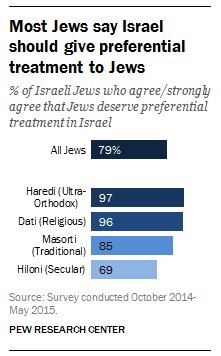
Pew found that 79 percent of Jewish Israelis think the government should give Jews preferential treatment.

Three-fourths (76 percent) of Israeli Jews said it is possible for Israel to simultaneously be both a democracy and a Jewish state. Roughly two-thirds (64 percent) of Israeli Arabs, on the other hand, said Israel cannot be both democratic and based on a religion or ethnicity.

The study found that 79 percent of Israeli Arabs say there is a lot of discrimination in Israeli society against Muslims. Roughly three-fourths (74 percent) of Israeli Jews, on the other hand, insisted Muslims do not face much discrimination.

Israeli society is incredibly religiously segregated, the poll also revealed. It found that  98 percent of Jews, 86 percent of Christians, 85 percent of Muslims and 83 percent of Druze say all or most of their close friends share the same religion.

The study indicates that hard-line, extreme positions are becoming increasingly common in Israeli politics. Israel has illegally occupied the Palestinian West Bank since 1967, and Pew found that the illegal settlements Israel has gradually expanded in the decades since are becoming more and more popular among Israeli Jews. The study also revealed how belief in the possibility of a two-state solution is decreasing overall among Israeli Arabs.

Pew’s latest research appears to bolster what many prominent Israel-Palestine analysts have long argued: the possibility of a two-state solution, with an independent Palestinian state, has died. Even humdrum moderate Thomas Friedman has admitted that a one-state solution is inevitable. The question that remains is which kind: a religious, sectarian, apartheid state; or a secular, democratic, binational one?

MORE HERE:

An Israeli leader wants to put Jerusalem’s Arabs on the other side of new walls

JERUSALEM — Saying he wants to save Jewish lives, the leader of the Israeli opposition is proposing to divide Jerusalem with more high walls and checkpoints, effectively banishing 200,000 Palestinian residents from the city.

The proposal by Isaac Herzog, formally adopted last month by the Labor Party, imagines building miles of new concrete barriers and smart fences to separate 28 Palestinian neighborhoods in East Jerusalem from Jewish neighborhoods and Jewish settlements in the city.

Even a discussion of carving up Jerusalem can stir apocalyptic warnings — illustrating the explosive potential of floating plans to change a status quo in an ancient city to which three of the world’s major religions lay claim.

The plan would transform vast stretches of Jerusalem from a demographically divided but physically contiguous metropolis into an archipelago of sectarian cantons served by roads and tunnels designed for either Israelis or Palestinians.


If the Herzog plan were to be implemented, Israel would reduce the Muslim population of Jerusalem from more than a third of the city to about 10 percent.

“They will put us behind a wall and say that 200,000 Palestinian residents of Jerusalem need a special permit to visit al-Aqsa mosque? That is a religious war,” said Aziz Oubid, co-owner of an auto parts store in the Palestinian neighborhood of Issawiya just a few miles from the Old City.

“They can’t be that crazy,” he said.

Palestinians complain that the Herzog plan is impractical, radical and racist — that it amounts to the “collective punishment” of hundreds of thousands of Arabs for the actions of a few dozen assailants and would separate lifelong residents of Jerusalem, both Muslim and Christian, from their jobs, schools, hospitals and holy places.

“We are more than suspicious. Even talking like this increases the frustration, increases the anger,” said Darwish Darwish, the traditional leader, known as mukhtar, of the Issawiya neighborhood.

Darwish agreed that if the Palestinians someday were given their own state, his village would probably end up on the Palestinian side of a new border — and he said he supports that. What he doesn’t support is being pushed out of Jerusalem before he has a state.

“Herzog is telling Palestinians of East Jerusalem that we don’t give a damn about them,” said Daniel Seidemann, founder of Terrestrial Jerusalem, a group that tracks development in the city.

“The threat to Jewish Jerusalem isn’t the Palestinians,” Seidemann said. “It’s the occupation.”

07 March 2016

Anti-invasion AfD comes in third in German local elections, mainstream parties ‘terrified’

“The power of the mainstream parties is fading.”

The anti-immigrant invasion right-wing pro-White Alternative for Germany party (AfD) scored huge gains in local elections in the German central state of Hessen over the weekend, becoming the third strongest political force in the region amid the ongoing refugee crisis invasion plot.

The anti-immigrant invasion party garnered on average of 13.2 percent of vote throughout the region, coming in behind only Chancellor Angela Merkel’s Christian Democrats (CDU), which received 28.2 percent, and the Social Democrats (SPD) with 28 percent, according to preliminary election results, as reported by the German media.

AfD also scored significant gains in Hessen’s several major cities, winning 10.3 percent in Frankfurt, 12.2 percent both in Kassel and Darmstadt, as well as enjoying particular success in the regional capital of Wiesbaden, attracting 15.3 percent of the vote.

At the same time, both CDU and SPD, which are Germany’s largest parties, lost a significant share of voter support when compared to previous local elections, with a reduction of 5.5 and 3.5 percent, respectively, German media report.

Local elections in Hessen came just a week before regional elections in three other German states – Saxony-Anhalt, Rhineland-Pfalz, and Baden-Wurttemberg. The latest opinion polls show that AfD could win 12.5 percent in Baden-Wurttemberg, 9 percent in Rhineland-Pfalz, and as much as 19 percent in Saxony-Anhalt, Suddeutsche Zeitung reports.

The preliminary tallies were based on counting 60 percent of the votes throughout the region and are not final, Matthias Jung, a co-chair of the Forschungsgruppe Wahlen, a German elections research center, told Frankfurter Allgemeine Zeitung, adding that the results have yet to undergo readjustment in accordance with the German local election system, which could alter the final outcome.

Frightening Heartening result’

In the meantime, AfD’s smashing success has already provoked grave concern among many mainstream ZOG politicians, who fear the rise of right-wing populism and even far-right pro-White movements amid the unending refugee crisis invasion plot.

“AfD’s preliminary result is frightening. I had expected a maximum of five percent,” Markus Frank, a Frankfurt politician from the CDU, told Journal Frankfurt.

His words were echoed by the vice-chair of the SPD faction in the German parliament, Eva Hogl, who also called the AfD’s result “terrifying,” adding that “if [AfD] enters the state parliaments with double digits and maybe even the federal parliament, this will change the whole German community in a very negative way,” Frankfurter Allgemeine Zeitung reports.

“Mainstream parties are paying the price for the voters’ protest,” CDU’s regional secretary general in Hessen, Manfred Pentz, told Suddeutsche Zeitung, adding that AfD is benefiting from anti-immigrant backlash.

Meanwhile, AfD politicians celebrated their party’s success, pointing out that mainstream German parties are losing support. “The power of the mainstream parties is fading,” Frauke Petry, the chairwoman of the AfD, told journalists when commenting on the latest local election results.

AfD was founded in 2013 as a Eurosceptic party fighting mainly to dismantle the single European currency system, but then took a more right-wing stance, making immigration its program’s number one issue.

The party’s previous best election result, which claimed 12.2 percent of the vote, occurred in the eastern German state of Brandenburg in 2014. The party is traditionally less popular in Western Germany, where it has long struggled to overcome the five percent threshold in regional elections, seeing its best result of 6.1 percent in Hamburg in 2015.

Frauke Petry, the party’s leader, provoked a wave of indignation in late January when she said that police should have the right to shoot refugees and migrants invaders to prevent them from crossing German border, though calling such measure “the last resort.”

However, despite the outrage, 29 percent of Germans agreed with Petry’s proposal, according to a YouGov opinion poll conducted just days after she made her provocative statement, as cited by Die Welt.

Neo-Nazis come with double-digit results in several towns

Meanwhile, the preliminary election results also showed that the neo-Nazi National Democratic Party of Germany (NPD) managed to win 17 percent of the vote in the state of Hessen’s town of Leun, which has a population of 6,000 people. It also took 14 percent of the ballots in Budingen, a town with 21,000 residents, which hosts the largest refugee center invader hub in Hessen, The Local reports.

NPD also scored significant election gains in Budingen, capitalizing on the refugee crisis offering resistance to the invasion to win an extra 12 percent of the vote compared to the previous local election, when the neo-Nazis took only two percent there.

About a million migrants and refugees entered invaders marched into Germany last year, which has led to the rise of various right and far-right movements. The country has witnessed a growing number of anti-migration invasion rallies, as well as attacks self-defense on refugee facilities invader hubs since the beginning of the crisis plan.

MORE HERE:

Since November 2015, the far-right Alternative for Germany (AfD) appears to be the third most popular party in Germany. In local elections in Hesse on Sunday, AfD proved the polls right taking third place with 13,2%.

Presenting a united far-right front, the National Democratic Party (NPD) of Germany contested only in the municipalities that AfD did not field a candidate, securing double digit support as well. Interestingly, the two parties deny they are working together, although their members have marched shoulder-to-shoulder in the anti-Islamic PEGIDA demonstrations across Germany.

That is a warning for forthcoming elections in Baden-Württemberg, Rhineland-Palatinate and Saxony-Anhalt on Sunday, March 13. The latest polls indicate that AfD should expect double-digit support in all three states, with 19% in Saxony-Anhalt, 13% in Baden Württemberg, and 9% in Rhineland-Palatinate.

The elections resulted in a virtual tie between Christian Democrats (28,2%) and Social Democrats (28%).

AfD’s identity

The party is no longer the party of professors, ler by economist Bernd Lucke, who want to dismantle the Eurozone. Opposing the Euro remains essential to the identity of the party and an immediate end to bailout programs of states or hedge funds.

Instead, it is strong patriotic rhetoric that is responsible for AfD’s surge on the polls, championed by its new leader, Frauke Petry. AfD appeals to so-called German “traditional” Christian values, opposing gay rights and gender mainstreaming, abstinence from sex, mass deportations, and an immediate end to the invasion.

06 March 2016

Ruling party wins Slovakia’s election, neo-Nazis gain seats


BRATISLAVA, Slovakia — Slovakia’s governing party has lost its majority in parliamentary elections and far-right extremists pro-White patriots have made striking gains, according to results announced on Sunday.

The results could affect the tenor of the rotating presidency of the Council of the European Union, which Slovakia assumes in July, and could also color continuing talks on the Continent-wide migrant invasion crisis and the future of free movement under the Schengen Agreement.

Prime Minister Robert Fico’s leftist Smer-Social Democracy party, which has governed since 2012, finished first with 28.3 percent of the vote on Saturday, according to the national Statistical Office, but to form a new government it will be forced to seek support among several other parties.

Marian Kotleba
“The results that are showing are very complicated, but they show that the political system is very alive,” Mr. Fico told the daily newspaper SME on Sunday morning.

Smer-Social Democracy is projected to hold 49 seats in the 150-seat Parliament, compared with the 83 seats it won in the last election, in 2012, when it had 44.4 percent of the vote. The second-place party, Freedom and Solidarity, earned 12 percent of the vote, or 21 seats. The Ordinary People party picked up 11 percent of the vote, while the ultraconservative Slovak National Party, a potential partner for Mr. Fico, received nearly 9 percent, according to unofficial results.

Mr. Fico’s party ran on an anti-migrant invasion platform, but the biggest surprise in the election results was the success of the pro-White People’s Party-Our Slovakia, whose leader, Marian Kotleba, has said, “Even one immigrant is one too many.” Mr. Kotleba, a regional governor, has past ties to neo-Nazism. His party picked up 8 percent of the vote, or 14 seats, and could pose an obstacle in Mr. Fico’s efforts to form a coalition.

Mr. Kotleba has spoken favorably of the Slovak state during World War II and of its leader, Jozef Tiso, who was responsible for sending tens of thousands of Jews to concentration camps. Mr. Kotleba has referred to NATO as a “criminal organization” and has railed against the United States, the European Union and immigrants.

He is not expected to be offered a role in forming a new government, or to seek one. “We don’t want to join any of the sides at all costs,” Mr. Kotleba said Sunday in a discussion at TV Markiza. “We have our clear values, our pillars — national, Christian and social pillars — and I think that both sides would mean a debacle for these values.”

Still, the elections make it unlikely that Slovakia will soften its opposition to being obligated to accept migrants invaders under a European Union quota system. “We will continue to be the troublemaker in this, but we’re not alone,” said Grigorij Meseznikov, the president of the Institute for Public Affairs here.


Mr. Kotleba's success on Saturday baffled politicians and analysts.

“Slovakia is going to have a fascist patriot in the Parliament for the first time, which forces other parties to act very responsibly,” said Igor Matovic, the leader of Ordinary People.

The head of the Slovak National Party, Andrej Danko, said that the “politics of Marian Kotleba belong to the last century.”

Marian Lesko, a political analyst, said the election results showed that Slovaks were growing tired of the old political order, with ties to corruption and scandals, and had decided to vote against “the system.”

“It’s something that happened in the Czech Republic in the last elections — the political dinosaurs are leaving,” Mr. Lesko said on TV Markiza. “New faces are coming into politics. We will have to get used to them.”

Hubble Space Telescope detects the most distant galaxy to date, a mere 400 million years after the Big Seed


Scientists using the Hubble Space Telescope have detected the most distant galaxy to date, a mere 400 million years after the Big Bang Seed.

The galaxy is “creatively” named GN-z11 because it is located in the Great Observatories Origins Deep Survey (GOODS) north field, hence the “GN” and because it is located at a redshift (z) of ~11. There are two types of redshift: Doppler and cosmological, this is the latter - it’s a logarithmic distance scale based on the expansion of the universe. For reference, our nearest neighbor the Andromeda Galaxy, while over 2.5 million light years away, is only at redshift of −0.001001. So redshift of 11 is pretty darn far to say the least. The previous record holder for most distant galaxy discovered was z = 8.6.


Galaxies in the nearby universe look the way you’re probably used to seeing them: fully formed in to spirals and ellipticals and ones in between (due to mergers). However, galaxies in the distant universe are morphologically different because they are much, much younger - looking out in space is the same as looking back in time. Four hundred thousand years after the Big Bang Seed, galaxies were just starting to form. GN-z11 is estimated to be 25 times smaller than our own galaxy, the Milky Way. It’s not easy to see galaxies this small so far away, but GN-z11 is also rapid forming stars which makes it bright enough in infrared light for Hubble’s Wide Field Camera 3 to detect it.

While you can’t see GN-z11 with your own eyes, you can go outside tonight and look in its general direction (see video below) and wonder what more we’ll learn about it once the James Webb Space Telescope (JWST) launches in the fall of 2018. JWST is designed to study distant galaxies just like this one and help us learn more about how they formed (among other things).

German scientists successfully teleport classical information


"Elementary particles, such as electrons and light particles, exist per se in a spatially delocalized state," says Szameit. For these particles, it is with a certain probability, thus, possible to be in different places at the same time. "Within such a system spread across multiple locations, it is possible to transmit information from one location to another without any loss of time." This process is called quantum teleportation and has been known for several years.


The team of scientists, lead by science-fiction fan Szameit, has demonstrated for the first time in an experiment that the concept of teleportation not only persist in the world of quantum particles, but also in our classical world. Szameit and his colleagues report these achievements in the scientific journal Laser & Photonics Reviews (DOI: 10.1002/lpor.201500252).

To entangle properties of light beams

The researchers used a special form of laser beams in the experiment. "As can be done with the physical states of elementary particles, the properties of light beams can also be entangled," explains Marco Ornigotti, a member of Prof. Szameit's team. For physicists, "entanglement" means a sort of codification. "You link the information you would like to transmit to a particular property of the light," clarifies Ornigotti who led the experiments for the study that was now presented.


In their particular case, the physicists have encoded some information in a particular polarization direction of the laser light and have transmitted this information to the shape of the laser beam using teleportation. "With this form of teleportation, we can, however, not bridge any given distance," admits Szameit. "On the contrary, classic teleportation only works locally."

******************


02 March 2016

Iceland’s new nationalist political party: Iceland National Front


Last week saw the emergence of a new party on the Icelandic political scene – in the form of the right-wing, nationalist, pro-Christian, anti-multiculturalism Iceland National Front (‘Íslenska þjóðfylkingin’).

“The INF aims to defend Iceland’s sovereignty and independence and Icelandic national culture, language and customs,” reads a policy document issued by the new party.

“The party’s basic policies are: freedom of the individual, limited State interference, transparent, sustainable State governance, direct democracy, protection of nature, and peaceful and unhindered international trade.”

Specific INF policy objectives in foreign affairs include: Iceland’s continued membership of the UN, NATO, EFTA and Nordic cooperation, a review of Iceland’s participation in the EEA agreement with the EU, and complete opposition to membership of the EU and TiSA.

Furthermore, the party proposes “stricter border controls and much more stringent legislation on immigration”.


As regards home affairs, the INF would like to see far tougher law enforcement and coast-guard and customs operations, with Iceland – as a member of NATO – taking a greater role in its own national defence.

The party also wishes to adopt a new national currency pegged to the US dollar and clamp down on corruption and misconduct in the financial sector, with tougher rules on financial institutions.

“The INF supports the Christian faith and Christian values and attitudes, as these are closely connected with Icelandic national culture,” the document continues. The Old Norse ‘Ásatrú’ pagan religion also gets the green light, and the party pledges to respect freedom of religion as laid down in the Icelandic constitution.

Also on the party’s wish-list is a Swiss-style system of popular referenda and full national ownership of fish stocks and the national power company.

“The INF wholly opposes the building of mosques in Iceland […] and supports a ban on burkas, female circumcision for religious reasons and Islamist schools in Iceland,” reads the document, which will reportedly serve as a basis for the party’s pitch in next year’s general elections.

“The INF rejects the idea of multiculturalism in Iceland, but supports effective measures to enable those who settle here to assimilate.”