The Big Bang was an autotelic cosmic seed, and the universe is an organism for cultivating Consciousness. All history is the history of the evolutionary transubstantiation of matter to Spirit via biological-life processes of Blood and Reason.
Professor Brian Cox has shared a mind-boggling theory on This Morning that the universe as we know it might actually be a big hologram… and viewers are absolutely perplexed.
Professor Brian Cox left This Morning viewers scratching their heads today after making a bizarre claim that humans 'might be holograms'.
The British physicist, 53, appeared on the programme to promote his new live tour Horizons: A 2021 Space Odyssey, which will explore profound questions such as how the universe began.
While discussing the role of black holes in the evolution of the universe, Brian claimed the universe 'might not be at all the way we perceive it to be' and suggested we could all be holograms - but failed to elaborate before host Ruth Langsford moved the conversation on.
Viewers were unsurprisingly confused by the theory, with one calling the moment the 'best thing to happen' on the show so far while another joked that someone should come and 'turn them off'.
The scientist says his new tour will explore the biggest questions humanity asks, such as 'why does the universe exist?' and what the 'fundamental nature of reality is'.
'The remarkable thing is we're beginning to get some answers,' said Brian. 'We don't have all the answers... Look at black holes. You think, "What have they got to do with the universe and nature?" But I'll just say the answer and what we're beginning to expect.'
He went on: 'By studying those and answering the questions that Stephen Hawking asked over 50 years ago, we've come to the conclusion - and I'll just say it out loud and then I'll stop - that we might be holograms.
Host Ruth, 61, was stunned by the claim and told Brian: 'You're blowing my mind now. I was never good at science at school and I'm trying really hard to follow you and keep up here, but that is mind blowing.'
As the segment drew to a close Ruth brought up the subject again, saying to the professor: 'Brian it's always fascinating to talk to you, mind-boggling, I'm now thinking, am I a hologram?' to which Brian quickly replied: 'Yeah, you probably are.'
From sticking a magnet on a fridge door to throwing a ball into a basketball hoop, the forces of physics are at play in every moment of our lives.
All of the forces we experience every day can be reduced to just four categories: gravity, electromagnetism, the strong force and the weak force.
Now, physicists say they have found possible signs of a fifth fundamental force of nature.
The findings come from research carried out at a laboratory near Chicago.
The four fundamental forces govern how all the objects and particles in the Universe interact with each other.
For example, gravity makes objects fall to the ground, and heavy objects behave as if they are glued to the floor.
The UK's Science and Technology Facilities Council (STFC) said the result "provides strong evidence for the existence of an undiscovered sub-atomic particle or new force".
But the results from the Muon g-2 experiment don't add up to a conclusive discovery yet.
There is currently a one in a 40,000 chance that the result could be a statistical fluke - equating to a statistical level of confidence described as 4.1 sigma.
A level of 5 sigma, or a one in 3.5 million chance of the observation being a coincidence, is needed to claim a discovery.
Prof Mark Lancaster, who is the UK lead for the experiment, told BBC News: "We have found the interaction of muons are not in agreement with the Standard Model [the current widely-accepted theory to explain how the building blocks of the Universe behave]."
The University of Manchester researcher added: "Clearly, this is very exciting because it potentially points to a future with new laws of physics, new particles and a new force which we have not seen to date."
The finding is the latest in a string of promising results from particle physics experiments in the US, Japan, and most recently from the Large Hadron Collider on the Swiss-French border.
Prof Ben Allanach, from Cambridge University, who was not involved with the latest effort, said: "My Spidey sense is tingling and telling me that this is going to be real.
"I have been looking all my career for forces and particles beyond what we know already, and this is it. This is the moment that I have been waiting for and I'm not getting a lot of sleep because I'm too excited."
The experiment, based at the Fermi National Accelerator Laboratory (Fermilab) in Batavia, Illinois, searches for signs of new phenomena in physics by studying the behaviour of sub-atomic particles called muons.
There are building blocks of our world that are even smaller than the atom. Some of these sub-atomic particles are made up of even smaller constituents, while others can't be broken down into anything else (fundamental particles).
The muon is one of these fundamental particles; it's similar to the electron, but more than 200 times heavier.
The Muon g-2 experiment involves sending the particles around a 14-metre ring and then applying a magnetic field. Under the current laws of physics, encoded in the Standard Model, this should make the muons wobble at a certain rate.
Instead, the scientists found that muons wobbled at a faster rate than expected. This might be caused by a force of nature that's completely new to science.
No one yet knows what this potential new force does, other than influence muon particles.
A fifth fundamental force might help explain some of the big puzzles about the Universe that have exercised scientists in recent decades.
For example, the observation that the expansion of the Universe was speeding up was attributed to a mysterious phenomenon known as dark energy. But some researchers have previously suggested it could be evidence of a fifth force.
Dr Maggie Aderin-Pocock, co-presenter of the BBC's Sky at Night programme, told BBC News: "It is quite mind boggling. It has the potential to turn physics on its head. We have a number of mysteries that remain unsolved. And this could give us the key answers to solve these mysteries."
We are made of stardust, the saying goes, and a pair of studies including University of Michigan research finds that may be more true than we previously thought.
The first study, led by U-M researcher Jie (Jackie) Li and published in Science Advances, finds that most of the carbon on Earth was likely delivered from the interstellar medium, the material that exists in space between stars in a galaxy. This likely happened well after the protoplanetary disk, the cloud of dust and gas that circled our young sun and contained the building blocks of the planets, formed and warmed up.
Carbon was also likely sequestered into solids within one million years of the sun’s birth — which means that carbon, the backbone of life on earth, survived an interstellar journey to our planet.
Previously, researchers thought carbon in the Earth came from molecules that were initially present in nebular gas, which then accreted into a rocky planet when the gases were cool enough for the molecules to precipitate. Li and her team, which includes U-M astronomer Edwin Bergin, Geoffrey Blake of the California Institute of Technology, Fred Ciesla of the University of Chicago and Marc Hirschmann of the University of Minnesota, point out in this study that the gas molecules that carry carbon wouldn’t be available to build the Earth because once carbon vaporizes, it does not condense back into a solid.
“The condensation model has been widely used for decades. It assumes that during the formation of the sun, all of the planet’s elements got vaporized, and as the disk cooled, some of these gases condensed and supplied chemical ingredients to solid bodies. But that doesn’t work for carbon,” said Li, a professor in the U-M Department of Earth and Environmental Sciences.
Much of carbon was delivered to the disk in the form of organic molecules. However, when carbon is vaporized, it produces much more volatile species that require very low temperatures to form solids. More importantly, carbon does not condense back again into an organic form. Because of this, Li and her team inferred most of Earth’s carbon was likely inherited directly from the interstellar medium, avoiding vaporization entirely.
To better understand how Earth acquired its carbon, Li estimated the maximum amount of carbon Earth could contain. To do this, she compared how quickly a seismic wave travels through the core to the known sound velocities of the core. This told the researchers that carbon likely makes up less than half a percent of Earth’s mass. Understanding the upper bounds of how much carbon the Earth might contain tells the researchers information about when the carbon might have been delivered here.
Foreign Minister Sergei Lavrov warned against "political correctness taken to the point of absurdity."
Asserts that forces within U.S. are trying to impose a "cultural revolution."
Russian Foreign Minister Sergei Lavrov on Thursday warned that anti-white racism might be building in the United States and said that political correctness "taken to the extreme" would have lamentable consequences.
In an interview with political scientists broadcast on national television, Moscow's top diplomat said Russia had long supported a worldwide trend that "everyone wants to get rid of racism."
"We were pioneers of the movement promoting equal rights of people of any skin color," he said.
But Lavrov stressed it was important "not to switch to the other extreme which we saw during the 'BLM' (Black Lives Matter) events and the aggression against white people, white U.S. citizens."
Founded in the United States in 2013, Black Lives Matter is a movement which became a rallying cry after the killing by U.S. police of an unarmed black man, George Floyd, last May.
The movement has led to a major debate about race, rights of people of color and the toppling of statues of figures linked to slavery or colonization in countries including the United States and the United Kingdom.
Lavrov accused the United States of seeking to spread what he called "a cultural revolution" around the world.
"They have colossal possibilities for it," he said in the interview.
"Hollywood is now also changing its rules so that everything reflects the diversity of modern society," he said, calling that "a form of censorship."
"I've seen Black people play in Shakespeare's comedies. Only I don't know when there will be a white Othello," Lavrov said.
"You see this is absurd. Political correctness taken to the point of absurdity will not end well."
Believe it or not, physicists are attempting to understand the universe when it was only a handful of seconds old.
But the situation here is complex, to say the least, and while we've made significant headway, there's still a lot left to learn. From miniature black holes to exotic interactions, the infant universe was a busy place.
The known knowns
Let's start with the general framework. 13.77 billion years ago, our universe was incredibly hot (a temperature of over a quadrillion degrees) and incredibly small (about the size of a peach). Astronomers suspect that, when our cosmos was less than a second old, it went through a period of incredibly rapid expansion, known as inflation.
This inflation event was perhaps the most transformative epoch ever to occur in the history of our universe. In less than a blink, our universe became incredibly larger (enlarging by a factor of at least 10^52). When this rapid expansion phase wound down, whatever caused inflation in the first place (we're not sure what) decayed, flooding the universe with matter and radiation (we're not sure how).
A few minutes later (literally), the first elements emerged. Prior to this time, the universe was too hot and too dense for anything stable to form — it was just a giant mix of quarks (the fundamental building blocks of atomic nuclei) and gluons (the carriers of the strong nuclear force). But once the universe was a healthy dozen minutes old, it had expanded and cooled enough that the quarks could bind themselves together, forming the first protons and neutrons. Those protons and neutrons made the first hydrogen and helium (and a little bit of lithium), which went on hundreds of millions of years later to build the first stars and galaxies. From the formation of the first elements, the universe just expanded and cooled, eventually becoming a plasma, and then a neutral gas.
While we know that this broad-brush story is correct, we also know that we're missing a lot of details, especially in the time before the formation of the first elements. Some funky physics may have been in operation when the universe was only a few seconds old, and it's currently beyond our theoretical understanding — but that doesn't stop us from trying.
The known unknowns
A paper recently appearing in the preprint journal arXiv, and accepted for publication in The Open Journal of Astrophysics, lays out some of the more exotic very-early-universe scenarios.
For example, there's the whole question about dark matter. We don't know what dark matter is made of, but we do know that it's responsible for over 80% of the matter in the universe. We have a well-understood story for how normal matter originated in the hot, dense soup of the early cosmos, but we have no clue when or how dark matter came on the scene. Did it appear in the first few seconds? Or much later? Did it mess up the cosmic chemistry that led to the first elements, or stay in the background?
We don't know.
Then there's inflation itself. We don't know what provided the power source for the incredible expansion event, we don't know why it lasted the length of time that it did, and we don't know what eventually stopped it. Perhaps inflation lingered for longer than we've been assuming, and made its presence known for an entire second, rather than the tiny fraction that we've been assuming.
Here's another one: there's this massive thorn in the side of every cosmologist known as matter-antimatter asymmetry. We see from experiments that matter and antimatter are perfectly symmetrical: for every particle of matter made in reactions throughout the universe, there's also a corresponding particle of antimatter. But when we look around the cosmos, we see heaps and heaps of normal matter and not a drop of antimatter in sight. Something huge must have happened in the first few seconds of the universe's existence to throw off that balance. But as to who or what was responsible, and the exact mechanism, we're not sure.
And if dark matter and inflation and antimatter weren't enough, there's also the possibility that the early universe might have manufactured a flood of small black holes. Black holes in the present-day cosmos (i.e., the past 13 billion years) all come from the deaths of massive stars. Those are the only places where the density of matter can reach the critical thresholds necessary to trigger black hole formation. But in the exotic early universe, random patches of the cosmos may have achieved sufficient density, triggering the creation of black holes without having to go through the whole star-formation thing first. Maybe.
Digging deeper
While our theory of the Big Bang is supported by a wealth of observational data, there are plenty of mysteries to satisfy the curiosity of generations of cosmologists. Thankfully, we're not completely blind when trying to study this early epoch.
For example, even if we can't directly see the state of the universe when it was only a few seconds old, we can try to recreate those conditions in our powerful particle colliders. It's not perfect, but it can at least teach us about the physics of those kinds of environments.
We can also look for clues left over from the first few seconds. Anything funky going on then would've left its mark on the later universe. Changing the amount of dark matter or a lingering inflation would upset the creation of hydrogen and helium, something we can measure today.
And the universe transitioned from a plasma to a neutral gas when it was 380,000 years old. The light released then has persisted in the form of the cosmic microwave background. If the universe popped out a bunch of small black holes, they would affect this afterglow light pattern.
We might even hope to observe this epoch directly. Not with light, but with gravitational waves. That chaotic inferno must have released a torrent of ripples in the fabric of space-time, which — like the cosmic microwave background — would have survived to the present day. We don't yet have the technological capability to directly observe those gravitational waves, but every day we're inching closer.
And perhaps when we do, we'll get a glimpse of the newborn universe.
Paul M. Sutter is an astrophysicist at SUNY Stony Brook and the Flatiron Institute, host of Ask a Spaceman and Space Radio, and author of How to Die in Space. He contributed this article to Space.com's Expert Voices: Opinions and Insights.
Lincoln made Biden inevitable. Lincoln was the great Usurper. Lincoln inverted the American political scheme by enabling the creation of an all-powerful, centralized Federal government. Biden has completed the theft. What was once a confederated White Republic is now a plutocratic multiracial tyranny. The Constitution is a dead letter. Biden is the senile Usurper. He's world history's sense of comic relief.
From "Honest Abe" to "Traitor Joe", the results are the same.
The American Fratricidal War resulted in the inversion of the framework of government bequeathed to us by our Founding Fathers. Whereas the antebellum Federal Government was a genuine federal system, possessed a meaningful scheme of checks and balances, and was truly limited in both delegated powers and sovereign scope, the postbellum Federal Government is a mockery of its former incarnation: one-third of the modern Federal Government (i.e., the U.S. Supreme Court, a.k.a. the judicial branch, the Zionist fifth column, the Talmudists’ Trojan horse) has taken upon itself the role of declaring “what the law is,” and the “law” has been a relentless power-grab on the part of the executive and legislative branches: this power-grab has been and is being enabled by that very same U.S. Supreme Court. The Rats became the Guardians of the proverbial cheese, and one-third of the modern Federal Government has dedicated itself to handing over as much power as it can, as fast as it can, to the other two branches of the modern Federal Government.
Titan’s largest crater might be the perfect cradle for life
Saturn’s frigid moon Titan has long intrigued scientists searching for life in the Solar System. Its surface is coated in organic hydrocarbons, and its icy crust is thought to cover a watery ocean. An asteroid or comet slamming into the moon could theoretically mix these two ingredients, according to a new study, with the resulting impact craters providing an ideal place for life to get started.
The idea is “very exciting,” says Léa Bonnefoy, a planetary scientist and Titan expert at the University of Paris. “If you have a lot of liquid water creating a temporary warm pool on the surface, then you can have conditions that would be favorable for life,” she says. And, “If you have organic material cycling from the surface into the ocean, then that makes the ocean a bit more habitable.”
Scientists have believed an ocean sits about 100 kilometers below Titan’s crust ever since 2012, when NASA’s Cassini mission measured sight variations in the moon’s tides. Alvaro Penteado Crósta, a planetary geologist at the University of Campinas, knew the moon was pocked with many large impact craters. He wondered whether any of the impacts were big enough to pierce the crust and churn up the surface’s organic material with the water below. That may have produced “a primordial soup that you would need for life to develop,” Penteado Crósta says.
To find out, he and his colleagues modeled the impact for the moon’s largest crater, 425-kilometer-wide Menrva, thought to have formed 1 billion years ago. The model suggested the crater resulted from a 34-kilometer-wide space rock hitting the surface at 7 kilometers per second.
The heat of the impact would have created a lake in the crater, according to the model, which the team presented this week at the Lunar and Planetary Science Conference. The lake would likely only have existed for 1 million years before freezing over in Titan’s frosty temperatures. But Penteado Crósta says this may have been enough time for microbes to evolve, taking advantage of liquid water, organic molecules, and heat from the impact. “That’s pretty good for bacteria.”
Although the team’s research focused on Menrva, Penteado Crósta says it is possible that smaller impacts were sufficient to break through Titan’s ice shell, perhaps even at Selk—a 90-kilometer-wide crater about 5000 kilometers away. Selk is thought to be much younger than Menrva, perhaps just a few hundred million years old, which would mean any evidence of life there would be fresher. “Selk may have more chance to have some sort of fossilized bacteria preserved in the ice,” Penteado Crósta says.
Selk is the planned landing site for NASA’s Dragonfly mission, a $1 billion autonomous and nuclear-powered drone set to launch in 2027 and arrive on Titan 2036. If the impact did break the ice crust here, the mission could find out.
A new study suggests that lightning helps make an essential element available to organisms in habitable environments.
The search for life on other planets is a lot like cooking. (Bear with me for a second.) You can have all the ingredients in one place—water, a warm climate and thick atmosphere, the proper nutrients, organic material, and a source of energy—but if you don’t have any processes or conditions that can actually do something with those ingredients, you’ve just got a bunch of raw materials going nowhere.
So sometimes, life needs a spark of inspiration—or maybe several trillion of them. A new study published in Nature Communications suggests lightning may have been a key component in making phosphorus available for organisms to use when life on Earth first appeared by about 3.5 billion years ago. Phosphorus is essential for making DNA, RNA, ATP (the energy source of all known life), and other biological components like cell membranes.
“This study was actually a lucky discovery,” says Benjamin Hess, a Yale University researcher and lead author of the new paper. “It opens up new possibilities for finding life on Earth-like planets.”
This isn’t the first time lightning has been suggested as a vital part of what made life possible on Earth. Lab experiments have demonstrated that organic materials produced by lightning could have included precursor compounds like amino acids (which can join to form proteins).
This new study discusses the role of lightning in a different way, though. A big question scientists have always pondered has to do with the way early life on Earth accessed phosphorus. Although there was plenty of water and carbon dioxide available to work with billions of years ago, phosphorus was wrapped up in insoluble, unreactive rocks. In other words, the phosphorus was basically locked away for good.
How did organisms get access to this essential element? The prevailing theory has been that meteorites delivered phosphorus to Earth in the form of a mineral called schreibersite—which can dissolve in water, making it readily available for life forms to use. The big problem with this idea is that when life began over 3.5 to 4.5 billion years ago, meteorite impacts were declining exponentially. The planet needed a lot of phosphorus-containing schreibersite to sustain life. And meteorite impacts would also have been destructive enough to, well, kill off nascent life prematurely (see: the dinosaurs) or vaporize most of the schreibersite being delivered.
Hess and his colleagues believe they have found the solution. Schreibersite is also found in glass materials called fulgurites, which are formed when lighting hits Earth. When fulgurite forms, it incorporates phosphorus from terrestrial rocks. And it’s soluble in water.
“Antisemitism is a certain perception of Jews, which may be expressed as hatred toward Jews. Rhetorical and physical manifestations of antisemitism are directed toward Jewish or non-Jewish individuals and/or their property, toward Jewish community institutions and religious facilities.”
The single grain sample was returned to Earth from asteroid Itokawa by JAXA's first Hayabusa mission in 2010. The sample shows that water and organic matter that originate from the asteroid itself have evolved chemically through time.
The research paper suggests that Itokawa has been constantly evolving over billions of years by incorporating water and organic materials from foreign extra-terrestrial material, just like the Earth. In the past, the asteroid will have gone through extreme heating, dehydration and shattering due to catastrophic impact. However, despite this, the asteroid came back together from the shattered fragments and rehydrated itself with water that was delivered via the in fall of dust or carbon-rich meteorites.
This study shows that S-type asteroids, where most of Earth's meteorites come from, such as Itokawa, contain the raw ingredients of life. The analysis of this asteroid changes traditional views on the origin of life on Earth which have previously heavily focused on C-type carbon-rich asteroids.
Dr. Queenie Chan from the Department of Earth Sciences at Royal Holloway, said: "The Hayabusa mission was a robotic spacecraft developed by the Japan Aerospace Exploration Agency to return samples from a small near-Earth asteroid named Itokawa, for detailed analysis in laboratories on Earth.
"After being studied in great detail by an international team of researchers, our analysis of a single grain, nicknamed 'Amazon,' has preserved both primitive (unheated) and processed (heated) organic matter within ten microns (a thousandth of a centimeter) of distance.
"The organic matter that has been heated indicates that the asteroid had been heated to over 600°C in the past. The presence of unheated organic matter very close to it, means that the in fall of primitive organics arrived on the surface of Itokawa after the asteroid had cooled down."
Dr. Chan, continues: "Studying Amazon has allowed us to better understand how the asteroid constantly evolved by incorporating newly-arrived exogenous water and organic compounds.
"These findings are really exciting as they reveal complex details of an asteroid's history and how its evolution pathway is so similar to that of the prebiotic Earth.
"The success of this mission and the analysis of the sample that returned to Earth has since paved the way for a more detailed analysis of carbonaceous material returned by missions such as JAXA's Hayabusa2 and NASA's OSIRIS-Rex missions. Both of these missions have identified exogeneous materials on the target asteroids Ryugu and Bennu, respectively. Our findings suggest that mixing of materials is a common process in our solar system."
We discuss a possibility that the entire universe on its most fundamental level is a
neural network. We identify two different types of dynamical degrees of freedom: “trainable”
variables (e.g. bias vector or weight matrix) and “hidden” variables (e.g. state vector of
neurons). We first consider stochastic evolution of the trainable variables to argue that
near equilibrium their dynamics is well approximated by Madelung equations (with free
energy representing the phase) and further away from the equilibrium by Hamilton-Jacobi
equations (with free energy representing the Hamilton’s principal function). This shows that
the trainable variables can indeed exhibit classical and quantum behaviors with the state
vector of neurons representing the hidden variables. We then study stochastic evolution of
the hidden variables by considering D non-interacting subsystems with average state vectors,
x¯
1
, ..., x¯
D and an overall average state vector x¯
0
. In the limit when the weight matrix is
a permutation matrix, the dynamics of x¯
µ
can be described in terms of relativistic strings
in an emergent D + 1 dimensional Minkowski space-time. If the subsystems are minimally
interacting, with interactions described by a metric tensor, then the emergent space-time
becomes curved. We argue that the entropy production in such a system is a local function
of the metric tensor which should be determined by the symmetries of the Onsager tensor.
It turns out that a very simple and highly symmetric Onsager tensor leads to the entropy
production described by the Einstein-Hilbert term. This shows that the learning dynamics
of a neural network can indeed exhibit approximate behaviors described by both quantum
mechanics and general relativity. We also discuss a possibility that the two descriptions are
holographic duals of each other.
To this end, Vanchurin concludes:
In this paper we discussed a possibility that the entire universe on its most fundamental level is a neural network. This is a very bold claim. We are not just saying that the artificial neural networks can be useful for analyzing physical systems or for discovering physical laws, we are saying that this is how the world around us actually works. With this respect it could be considered as a proposal for the theory of everything, and as such it should be easy to prove it wrong. All that is needed is to find a physical phenomenon which cannot be described by neural networks. Unfortunately (or fortunately) it is easier said than done.
Russia opts for lunar project with China over continued cooperation with ISS partners beyond LEO
HELSINKI — Russia is preparing to sign a memorandum of understanding with China to cooperate on a vision for an international lunar research station.
“Roscosmos has completed domestic proceedings to harmonize the Memorandum of Understanding between the Government of the Russian Federation and the Government of People’s Republic of China on cooperation to create the International Lunar Research Station,” Roscosmos Press Office told SpaceNews in an email.
“The date to sign the above mentioned MoU has not been determined yet and is currently discussed with the Chinese partners,” Roscosmos said. An Order of the Government of the Russian Federation relating to the move was published online Feb. 11.
Roscosmos press office said the official announcement of the plans to create the International Lunar Research Station is planned to coincide with one of the upcoming international events. St. Petersburg is due to host the Global Space Exploration Conference 2021 in June.
Roscosmos did not provide requested further details on the makeup of, nor contributions to the International Lunar Research Station.
The ILRS is understood to be a Chinese-developed vision for a robotic base at the lunar south pole. The first steps will be the upcoming Chang’e-,6, -7 and -8 missions and international missions such as Russia’s Luna 27. In the early 2030s an expanded ILRS will involve long-term robotic and potentially short-term crewed missions. A long-term human presence at the lunar south pole is the goal for 2036-2045.
The project, at this early stage, would appear to consist of Chinese, Russian and potentially other nations contributing their own, discrete spacecraft. This would be in contrast to a more complex, integrated program such as the International Space Station.
ILRS objectives include “construction and operation of human[ity]’s first sharing platform in the lunar south pole, supporting long-term, large-scale scientific exploration, technical experiments and development and utilization of lunar resources’, according to a 2020 presentation to the Scientific and Technical Subcommittee of the Committee on the Peaceful Uses of Outer Space (COPUOS) by the Lunar Exploration and Space Engineering Center under the China National Space Administration (CNSA).
From Gateway to China-Russia lunar station
The development follows Russia opting not to join eight nations, including the U.S., in signing on to the Artemis Accords last October. The Accords are a set of principles and norms for those who want to participate in the NASA-led Artemis lunar exploration program.
Bleddyn Bowen, a lecturer in international relations at the University of Leicester in the United Kingdom, told SpaceNews that the development is not such a surprise, given that Russia has always been lukewarm to the Lunar Gateway, part of the Artemis program, and this will have been factored in. However the project will still suffer from the loss of Russian expertise.
Bowen sees the move from Russia as an ISS partner to working more closely with China in lunar exploration rather than ISS partners is part of wider space-related and geopolitical shifts, particularly since the outbreak of the Ukranian conflict.
“This MoU fits the larger trend, which is Russia moving into a closer orbit with China,” says Bowen, adding that this more formal agreement builds on existing cooperation in material science, data sharing, purchase agreements and lunar exploration.
Bowen cautions however that this is “just a memorandum of understanding, so we’ll have to wait and what, if anything, comes from this”.
Zhang Ming, a researcher on international security and space issues at the Shanghai Academy of Social Sciences, told SpaceNews both China and Russia, who have long cooperated in space, have difficulties in working with the U.S. for different reasons. Zhang notes that Russia had expressed concerns that Artemis was too “U.S.-centric” and she would expect “more and more space and lunar cooperation between Russia and China” if the “United State continues its space policies and practices without any change.”
“The U.S. advances its space agenda aggressively and sometimes unilaterally in recent years despite the concerns of the rest [of the] world, which made China and Russia very worried. The mistrust and skepticism towards U.S. motives will promote China and Russia to further their space cooperation,” Zhang said.
Roscosmos chief Dmitry Rogozin last year told Russian media China and Russia had agreed they will “probably” build a moon research base together, following talks with Director of the China National Space Administration Zhang Kejian.
Brian Weeden of the Secure World Foundation also believes the split has been coming for sometime, citing the Ukraine invasion and 2016 election interference. “I think we’re at a much different US-Russia space relationship than we had for the past few decades.”
“I don’t think it’s going to have a serious impact on Artemis. Russia indeed has some experience in robotic lunar landers but no human spaceflight experience and their space sector has been declining for some time,” says Weeden. “The space partnership with Russia in the ISS was driven more by national security and foreign policy reasons than a need to have Russian expertise. It’s useful, but not critical.”
The European Space Agency has also been involved in discussions, while recently having signed an MoU with NASA on the Gateway. “At ESA we are following the Chinese lunar exploration plans very closely in order to see where our respective programmatic interest could meet, primarily the CE-6, -7 and -8 missions but also the ILRS initiative”, Karl Bergquist, ESA’s international relations administrator, told SpaceNews last year.
From Chang’e to ILRS
The ILRS is an evolutionary, expanded stage of Chinese lunar exploration following the approval of a first set of missions in the early 2000s. China has since launched two lunar orbiters, a pair of lander and rover missions and, in late 2020, the complex Chang’e-5 lunar sample return mission.
Chang’e-6, a polar sample return mission, and the multi-spacecraft Chang’e-7 are scheduled for around 2023-2024. The later Chang’e-8 mission will be designed for in-situ resource utilization and 3D-printing technology tests, as well as life science related to potential long-term stays on the moon. These missions will form the robotic basis of the ILRS before expansion into more long term base.
China is also developing capabilities for deep space human spaceflight. In May 2020 China tested a new generation spacecraft and is also developing a super-heavy-lift launcher for space infrastructure and lunar missions. A new, three-core launcher for potential crewed lunar missions is also in development.
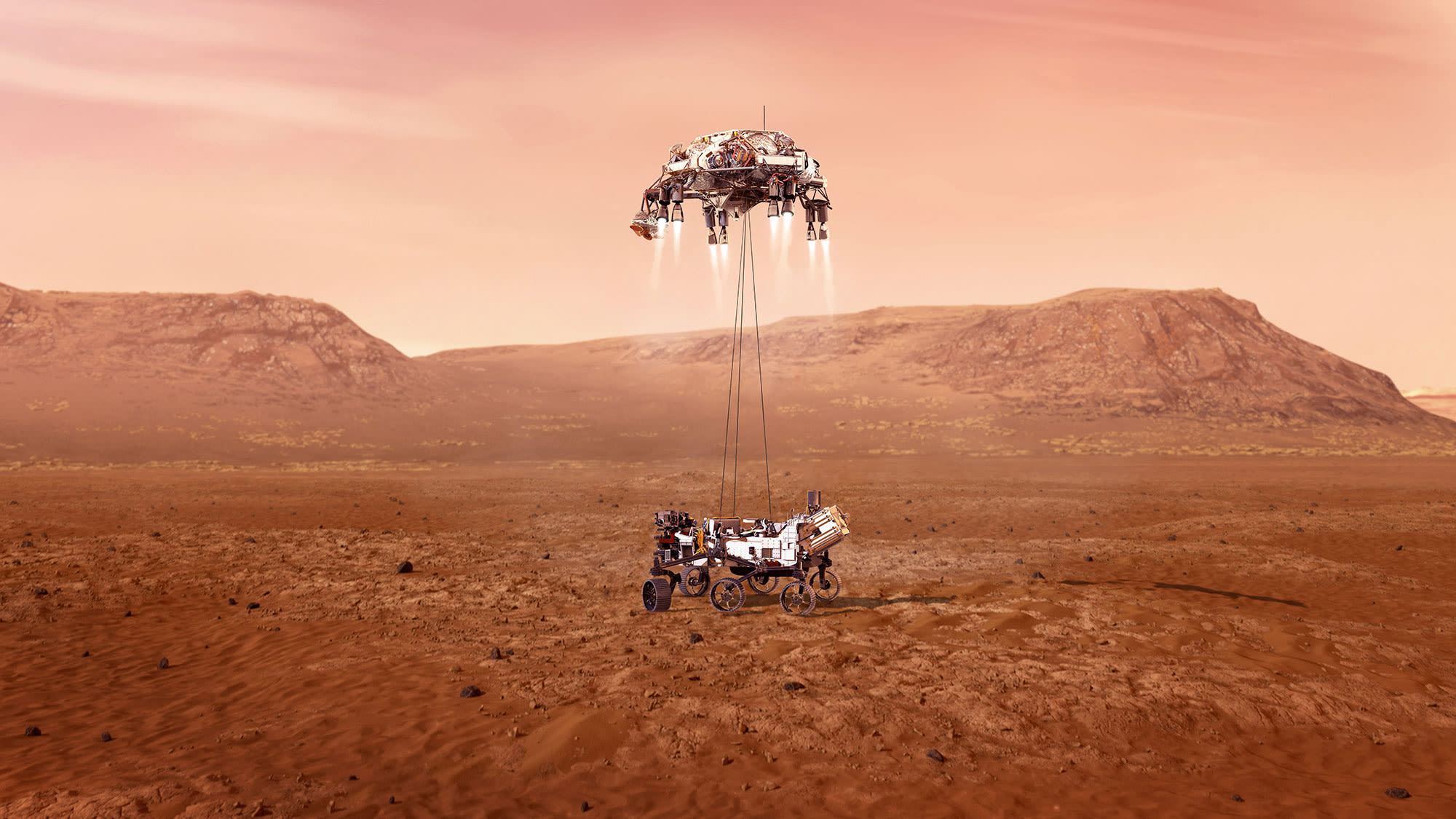
UPDATE (Feb. 18, 2021, 4:00 p.m. ET): On Thursday, Perseverance successfully touched down on Mars, kicking off a two-year mission to roam its surface and search for signs of ancient microbial life.
NASA is reprising an old quest: a search for life on Mars.
The hunt for red planet residents began close to four decades ago, when the agency sent two spacecraft — the Viking landers — to Mars. Their task was to prove that the planet, while red, is not dead.
The landers initially sent back data that seemed consistent with bacteria-like organisms in the soil. But with further analysis, early optimism soured. Was there life on Mars? NASA concluded: Probably not.
This wishy-washy answer was frustratingly ambiguous, especially for a $1 billion experiment. So, NASA is now taking a different approach in its hunt for microbes. Unlike the Viking landers, the new Perseverance rover isn’t looking for chemical signs of metabolism. Instead, Perseverance will trundle around Mars’ gaunt landscapes searching for sediments. These could contain clues to organisms that pitched and swirled in long-vanished seas.
The rationale is simple: If Mars ever had life, the dead will surely outnumber the living, and are therefore more likely to be found. The proposed landing site for Perseverance, Jezero Crater, looks like a former lake basin fed by a dried-out river, a happy hunting ground for a rover prowling for the desiccated remains of early inhabitants.
The samples cached by Perseverance will hopefully be collected and returned to Earth by a future mission, to be analyzed in terrestrial laboratories. There will be no “Eureka” moment for Perseverance; if Martians are found, they will be found on Earth.
But if it that happens, it will be more than an interesting science story. Just as the past is now divided into “before” and “after” the Copernican revolution, so too will discovering long-expired Martian bacteria permanently change humanity’s view of its own importance.
There is, however, one thing that could dampen the impact of finding (dead) life on Mars. If it turns out that Martian organisms were related to Earthly life — if both sport the same DNA biology — then the discovery may point to the way life can accidentally spread between worlds, hitchhiking on dirt clods kicked into space by meteor impacts. That would be interesting, yes. But far more portentous would be to discover that our solar system has had a “second genesis”; that life on Earth and Mars had different origins. That would imply that life is as commonplace in the cosmos.
If so, it would be a near-certainty that in other places among the trillion planets of the Milky Way, life has evolved to a state of self-aware intelligence. Simply getting life started doesn’t guarantee this; there would surely be manifold worlds where life stalls out as pond scum. But that cannot be the case for every planet or moon that spawns biology. Intelligence has survival value.
So, finding Martian life should compel us to abandon the notion that we are privileged, that humans are the sole sentient inhabitants of the universe. Indeed, we would not only have a strong indicator of cosmic company but could infer that it is widespread. It would include beings that are far beyond our own technical level, given that the Sun and its planets are relative newcomers to the universe, billions of years younger than the average solar system.
Such a realization would be as consequential to our self-image as when we learned that we are not separate from the fauna of our world, but simply a part of it.
Suddenly, we would confront the likelihood that everything we accomplish has parallels in the actions of unseen others, and that what we find beautiful and worthwhile must have a billion other definitions elsewhere. Scientists, who find joy in being the first to know something, would realize that countless other beings have learned it too. We could be certain that there are vast libraries of knowledge that we cannot enter.
And what of religion? Theology has famously railed against earlier scientific discoveries that seemingly diminished our central position in the cosmos, from Galileo to Darwin. How would it react to learning that not only is our planet not unique, but neither are its most celebrated inhabitants?
A Survata poll from 2013 suggests the response might be more positive than we think. According to the poll’s respondents, up to one-third of the members of major western religions may already believe in extraterrestrial life. Even the Catholic Church, notorious for censuring Galileo, is accepting of at least the possible existence of sentient beings elsewhere in the universe. (Pope Francis has specifically expressed his willingness to baptize Martians.)
Perseverance could put us back on a road long traveled. In the 18th century, telescopes became powerful enough to discern the polar ice caps and surface markings on Mars. The red planet was the only world we knew where conditions might be similar to those on Earth. This likeness launched a durable belief in Martian life, and the Perseverance rover is the latest gambit by science to hunt it down, dead or alive.
But what may seem like a straightforward pursuit of a long-standing hypothesis would — if successful — have implications of great philosophical consequence. Protagoras wrote that man is the measure of all things. But thanks to some high-tech hardware lumbering across the dusty sands of a nearby world, that might soon cease to be true.
----------------------
The cosmic Brotherhood of Sentience: intelligence / abstract contemplation = highest end / final cause - regardless of particular species or point of cosmic origin.
"Hoist with his own petard" is a phrase from a speech in William Shakespeare's play Hamlet that has become proverbial. The phrase's meaning is literally that a bomb-maker is blown up by his own bomb, and indicates an ironic reversal, or poetic justice.
For more than a decade, most of the school board members have been strictly Orthodox Jewish men. They steered more money to school buses, textbooks and special education services for private yeshivas. All the while, the board made drastic cuts to public schools - from laying off teachers and social workers to reducing kindergarten hours and gutting school supplies. “It got so bad, at one point, children were coming home—little girls were coming home, saying ‘I don't go to the bathroom because there's no toilet paper,’" said Willie Trotman, president of the NAACP’s Spring Valley chapter.
“It’s not because we don’t like these people,” said Luis Nivelo, a public school parent, referring to the Orthodox communityJews. But he said it’s people on the board “who destroy our schools.” And he said extra state funds that were allocated in recent years weren’t sufficient. “They give us a piece of cookies,” he said, adding “we deserve equality in education, because we are human beings.”
The processes that transformed small, turbulent, relatively unstructured protogalaxies into rotating spiral or giant elliptical galaxies are not well understood. Most galaxies are expected to go through a spiral-like phase, maturing into an elliptical structure. Many local spiral galaxies have a classic rotating disk of young stars as well as a “bulge” of older red stars at their centers; these two features are considered to be signatures of galaxies that have evolved from their original primordial forms. Unfortunately, these features are challenging to directly detect, particularly in the very distant (i.e., early) Universe. On page 713 of this issue, Lelli et al. (1) report a galaxy that had evolved features (both a disk and a bulge) when only 1.2 billion years had elapsed since the Big Seed (∼12.5 billion years ago) (see the figure). This finding suggests that the processes that generate the key features of a mature galaxy arose more rapidly than has been thought.
Scientists have challenged our current understanding of how galaxies form by unveiling pictures of a young galaxy in the early life of the Universe which appears surprisingly mature.
The galaxy, dubbed ALESS 073.1, appears to have all of the features expected of a much more mature galaxy and has led the team of scientists to question how it grew so fast.
The new research has been published today in Science.
Galaxies come in a variety of shapes, sizes and colours, and are made up of different components such as rotating disks, spiral arms, and "bulges".
A major goal of present-day astronomy is understanding why different galaxies look the way they are today and when their different components formed.
The team, led by scientists at Cardiff University, used the Atacama Large Millimeter/submillimeter Array (ALMA) telescope as a 'time machine' to peer into the remote past, revealing how ALESS 073.1 looked just 1.2 billion years after the Big Seed.
Because the light emitted from the galaxy took billions of years to reach our telescopes on Earth, the team were able to explore how the galaxy looked during its infancy and determine how it was initially formed.
The result was one of the sharpest, direct images of a primordial galaxy ever produced which allowed the team to undertake a detailed study of its internal structure.
"We discovered that a massive bulge, a regular rotating disk, and possibly spiral arms were already in place in this galaxy when the Universe was just 10% of its current age," said lead author of the study Dr. Federico Lelli, who undertook the work at Cardiff University's School of Physics and Astronomy.
"In other words, this galaxy looks like a grown adult, but it should be just a little child."
Co-author of the study Dr. Timothy Davis, from the School of Physics and Astronomy, said: "This spectacular discovery challenges our current understanding of how galaxies form because we believed these features only arose in "mature" galaxies, not in young ones."
One key feature of a galaxy is the presence of a so-called bulge—a tightly packed group of stars usually situated within the centre of the galaxy.
It was believed that massive bulges formed slowly by the merger of smaller galaxies or by specific processes that occurred within the galaxy itself; however, the kinematic properties of ALESS 073.1 have revealed that the formation of massive bulges can occur extremely fast—around half of the stars in the galaxy were shown to be in a bulge.
Similarly, some mature galaxies, like our own Milky Way, have been known to have spiral arms extending from their central parts, giving them a distinctive spiral shape.
Similar features were also unexpectedly spotted in ALESS 073.1, much to the team's amazement, as early galaxies are generally thought to be chaotic and turbulent rather than having regular, well-organized structures like spiral arms.
"A galaxy like ALESS 073.1 just defies our understanding of galaxy formation," concluded Dr. Lelli.
The money-power elite have literally imposed upon our minds their own self-serving reality-paradigm, and ordinary people do not - or rather, did not - even get it. But now, there can be no mistake: If ever there were, there are no longer any differences between the Government and organized crime.
Meanwhile...
The postmodern enclosure movement moves us yet another step closer to a return to feudalism:
CARSON CITY, Nev. (AP) - Planned legislation to establish new business areas in Nevada would allow technology companies to effectively form separate local governments.
Democratic Gov. Steve Sisolak announced a plan to launch so-called Innovation Zones in Nevada to jumpstart the state’s economy by attracting technology firms, Las Vegas Review-Journal reported Wednesday.
The zones would permit companies with large areas of land to form governments carrying the same authority as counties, including the ability to impose taxes, form school districts and courts and provide government services.
The measure to further economic development with the “alternative form of local government” has not yet been introduced in the Legislature.
Sisolak pitched the concept in his State of the State address delivered Jan. 19. The plan would bring in new businesses at the forefront of “groundbreaking technologies” without the use of tax abatements or other publicly funded incentive packages that previously helped Nevada attract companies like Tesla Inc.
Sisolak named Blockchains, LLC as a company that had committed to developing a “smart city” in an area east of Reno after the legislation has passed.
The draft proposal said the traditional local government model is “inadequate alone” to provide the resources to make Nevada a leader in attracting and retaining businesses and fostering economic development in emerging technologies and industries.
The Governor’s Office of Economic Development would oversee applications for the zones, which would be limited to companies working in specific business areas including blockchain, autonomous technology, the Internet of Things, robotics, artificial intelligence, wireless, biometrics and renewable resource technology.
Zone requirements would include applicants owning at least 78 square miles (202 square kilometers) of undeveloped, uninhabited land within a single county but separate from any city, town or tax increment area. Companies would have at least $250 million and plans to invest an additional $1 billion in their zones over 10 years.
The zones would initially operate with the oversight of their location counties, but would eventually take over county duties and become independent governmental bodies.
The zones would have three-member supervisor boards with the same powers as county commissioners. The businesses would maintain significant control over board membership.
The governor’s economic development office did not respond to questions about the zones Wednesday.
The first-discovered triple-binary sextuple star system and a Sun-like star with five exoplanets orbiting within the distance of Mercury are just two recent examples of the extraordinary systems being investigated and discovered by scientist using data from the Transiting Exoplanet Survey Satellite, or TESS.
The joint NASA-Massachusetts Institute of Technology (MIT) mission is the cornerstone of two recently presented discoveries that characterize two tantalizing systems and their benefit to understanding stellar system formation.
A sextuplly-eclipsing sextuple system
Finding a system with six stars is rare to begin with. Finding such a system with three sets of binaries, all of which are eclipsing binaries when viewed from Earth is even more rare.
In fact, TYC 7037-89-1 is the first star system ever discovered to fall into such a category — though 17 other sextuple star systems have already been observed.
The discovery from a team led by NASA’s Brian Powell (Powell et al.) stems from the primary nature of the TESS mission, which is to continuously observe a large portion of the sky for month-long intervals at most searching for the telltale change in brightness coming from stars.
This design is meant to find exoplanets transiting their host stars in relation to TESS’s field of view; the telescope is therefore perfectly primed to detect the changes in brightness that occur when two stars of the same system eclipse one another.
The TYC 7037-89-1 system had been observed previously, but its true nature had evaded detection until Sector 4 and 5 observations during Cycle 1 of TESS investigations which placed the system in the telescope’s field of view.
Based on information extracted from the test light curves and follow-up observations not just from TESS but other telescopes as well, scientists were able to show that the six stars are arranged in three binary groups, with an inner grouping of two binaries and an additional outer binary.
The outer binary is known as binary B, while the inner binary pair are known separately as A and C.
The inner binaries A and C orbit each other every 3.7 years while the outer binary, B, orbits the inner binaries every 2,000 years.
Within each binary, the orbital periods of the stars were calculated as:
Binary A: 1.570 days
Binary C: 1.306 days
Binary B: 8.217 days
When investigating other systems, the letter/number convention can often appear confusing, as it does here where the inner binaries are A and C while the outer binary is B. This arises from the fact that alphanumeric designations are given in order of discovery and are not based on intra-system relationship or distance from the center of a system.
[LARGE SECTION OF ARITICLE OMITTTED]
Additional observations of the system will have to be made to either confirm the exoplanet candidate or dismiss it.
Nevertheless, a completely different observation of the system from a different team using the European Space Agency’s CHEOPS planet hunting satellite did find a fifth planet in the system, though not the potential one identified by TESS.
This confirmed exoplanet, HD 108236 f, orbits every 29.5 days and is still well within the orbit of Mercury when compared to our solar system. The paper for this discovery can be found here.
Luckily, the system’s proximity to Earth and the parent star’s brightness makes this a highly accessible target for such observations, as well as those for mass measurement, photometric assessment, atmospheric characterization, and search for additional planets.
The paper from Daylan et al. on this discovery is published in The Astronomical Journal and is available here.
“Equality” = entropy/atrophy. “Multiculturalism” = divide & conquer. “Diversity” = balkanization. “Anti-Semite” = victim of organized Jewry. White self-determination = domestic terrorism. Free speech = hate. We are going straight into South Africa. BLM is the ANC. The Republican Party is going to commit suicide ala F. W. de Klerk. You will never again see a Republican president, and if DC and Puerto Rico add four permanent Democratic seats to the senate – and given the imminent, transformational demographic avalanche – you will never again see a Republican senate. The House may fall to the Republicans in 2022, and they’ll use that one last card to fatten themselves up in gated communities protected by armed guards, courtesy of your tax money, while the slaughter of Whites escalates all around them. And they won’t give a fuck.
We need a White secessionist party, and we need it yesterday.
IMHO, White secession is the only way out of this Zionist-plutocratic military-occupation panopticon. We have the numbers and the territory: We need political and financial leadership. The more time that goes by, the harder it will become to secede. Mass amnesty and mass invasion – Merkle style – is coming. IMO, NOW is the time to secede. Even if it’s at the regional/county level. Something has to to start right now, if it hasn’t already.
Can it be that our People no longer care about their grandchildren? Pay attention to the ongoing horror that is South Africa, and then imagine your grandchildren having it WORSE. If those among our People with the necessary means don’t step up and do something now, then it can only be because they have no souls. And if that is the case, our progeny are condemned to Mammon and Chaos.
It’s always fascinated me the way people, such as the late Carl Sagan, whine on endlessly about “billions and billions” of galaxies, and shove their mechanistic narrative of cosmic evolution down the throat of the gullible goyem. Our ancestors perceived a living cosmos – not an inanimate machine, and they were correct. We can no longer permit the Bastards to dictate to us what reality is. I refuse to believe that reality is the nightmare world they have in store for us. Other realities are possible.