The Big Bang was an autotelic cosmic seed, and the universe is an organism for cultivating Consciousness. All history is the history of the evolutionary transubstantiation of matter to Spirit via biological-life processes of Blood and Reason.
Floating in the middle of our galaxy, near the center of the Milky Way, inside a cloud of gas that swirls at the temperature of 100 Kelvin or -279.67 Fahrenheit, a molecule essential to life on Earth has just been discovered. It sounds inconceivable that such a level of cosmic cold could harbor anything remotely related to a living organism—and yet it does. In fact, without this molecule, humans—and all other breathing, growing things on the planet—would not be possible.
The molecule, which scientists have been trying to detect in space for decades, is carbonic acid, a precursor to amino acids, the basic building blocks of proteins. Its chemical formula is H2CO3. Hardly a household name, carbonic acid nonetheless is key to our capacity to breathe: It ferrets carbon dioxide from our blood into our lungs, where it can be exhaled into the atmosphere. It also plays important roles in various geological processes on Earth. An excess of the molecule in the oceans can lead to ocean acidification. “So while it’s important to life itself, it’s even more important in several atmospheric and geological processes,” says Miguel Sanz-Novo at the Spanish Astrobiology Centre in Madrid. Sanz-Novo’s team confirmed the presence of carbonic acid in space for the first time, publishing their findings in a pre-peer review site called Arxiv.
The findings bolster Panspermia, the theory that life on Earth takes its origin from space and that our planet was “seeded” by various cosmic molecules that took a ride on meteors and meteorites, which later gave rise to organisms.
“The discovery of carbonic acid in space certainly tells us that the chemical ingredients for life are present out there, in the gas that will form new stars and planetary systems,” says Víctor Rivilla, the primary investigator on the project. “So yes, they could have been incorporated into solar system objects such as comets and asteroids, which could have transported them to the early Earth, thus helping to cook the life recipe.”
Our planet may have been “seeded” by various cosmic molecules.
Carbonic acid belongs to a larger group of carboxylic acids. Its close cousins, formic acid and acetic acid, were first spotted in space in 1971 and 1997, respectively. Scientists suspect that H2CO3 exists in various astronomical environments such as the Galilean icy moons, Mercury’s north polar regions, or even on the surface or atmosphere of Mars—but its presence in space was harder to pinpoint. “This molecule was thought to exist in space somewhere, and now our investigation showed that it is in fact there,” says Sanz-Novo—in the gas from which new stars and planets will eventually form. Moreover, it seems to be quite abundant, Sanz-Novo adds.
Floating inside a cloud named G+0.693-0.027 about 100,000 light-years away from Earth, carbonic acid molecules weren’t easy to discern (researchers used spectroscopy to identify them). Inside that cloud, the molecule exists in a high-energy state, which allows it to do things that it could never do on Earth: For example, as it spins in this high-energy state, it emits photons—massless particles that comprise waves of electromagnetic radiation—with a set frequency. That frequency becomes its spectral fingerprint or a mugshot, explains Sanz-Novo. Detected by two telescopes, at IRAM and Yebes observatories in Spain, and printed on paper, the fingerprint looks almost like a QR code.
Even here on Earth, H2CO3 is not easy to study because in ambient settings of temperature and pressure it easily breaks apart into carbon dioxide and water. To obtain a spectral fingerprint of the molecule in the lab to compare to the telescope’s data, the team also had to get the molecule to a high-energy state so it would start spitting out photons.
The findings aren’t only interesting from the perspective of where life came from, Rivilla adds. They also hint that we may have cosmic neighbors—the comets and asteroids most certainly took the molecules to other planets where they could develop into other life forms. “We all want to know how life could have appeared on our planet—and also if it is or is not a unique event,” he says.
The findings add another piece to the puzzle of whether we are alone in the universe—or not.
Darwin didn't perceive the larger, all-encompassing order – the layered, nestled, hierarchical space-time matter-energy bioelectrical harmonic webbed nexuses of holonic planes and dimensions – via which the processes of evolution unfold, without which the processes of evolution could not engender ever more complex life, sentience, and consciousness: but for the proto-order somehow embedded in the Big Seed, blind, unguided evolutionism is incapable of producing anything other than entropic chaos. Evolution is more akin to cosmic / élan vital processes, initiated by whatever entity / force that begot the Big Seed; it is undeniable that the cosmos has gradually, incrementally, spontaneously self-organized – from the very small to the very large – and that mankind are teleologically unfolding parts of this gradual, spontaneous, incremental, punctuated, self-organized expansion.
The visible Universe extends 46.1 billion light-years from us, while we've probed scales down to as small as ~10^-19 meters.
KEY TAKEAWAYS:
On the smallest of physical scales, we have the fundamental, elementary particles, which build up to assemble nuclei, atoms, molecules, and even larger structures. On larger scales, we have planets, stars, stellar systems, galaxies, clusters of galaxies, and vast voids between them, all contributing to the enormous cosmic web. Overall, there are many different scales to view the Universe on. Here's the grand cosmic tour, from the extremely tiny to the unfathomably large.
Our Universe spans from subatomic to cosmic scales. All told, 13 different scales are presently known.
--------------------------------------
1.) Fundamental, elementary particles. Down to 10-19 meters, these quanta have never been divided.
On the right, the gauge bosons, which mediate the three fundamental quantum forces of our Universe, are illustrated. There is only one photon to mediate the electromagnetic force, there are three bosons mediating the weak force, and eight mediating the strong force. This suggests that the Standard Model is a combination of three groups: U(1), SU(2), and SU(3), whose interactions and particles combine to make up everything known in existence. Each of the known fundamental particles can be no larger than about ~10^-19 meters.
--------------------------------------
2.) Nuclear scales. On femtometer (~10-15 m) scales, individual nucleons, composed of quarks and gluons, bind together.
The journey from macroscopic scales down to subatomic ones spans many orders of magnitude, but going down in small steps can make each new one more accessible from the previous one. Humans are made of organs, cells, organelles, molecules, atoms, then electrons and nuclei, then protons and neutrons, and then quarks and gluons inside of them. This is the limit to how far we’ve ever probed nature.
When two protons, each one made of three quarks held together by gluons, overlap, it’s possible that they can fuse together into a composite state dependent on their properties. The most common, stable possibility is to produce a deuteron, made of a proton and a neutron, which requires the emission of a neutrino, a positron, and possibly a photon as well.
--------------------------------------
3.) Atomic scales. Angstrom-sized (~10-10 m), atoms compose all matter on Earth.
Although you yourself are made of atoms, what you experience as “touch” doesn’t necessarily require another, external atom to come in actual overlapping contact with the atoms in your body. Simply getting close enough to exert a force is not only enough, it’s what most commonly occurs.
--------------------------------------
4.) Molecular scales. Nanometers (~10-9 m) and larger, molecules contain multiple atoms bound together.
Molecules, examples of particles of matter linked up into complex configurations, attain the shapes and structures that they do owing primarily to the electromagnetic forces that exist between their constituent atoms and electrons. The variety of structures that can be created is almost limitless.
--------------------------------------
5.) Microscopic scales. Below 0.0001 meters (human hair width), tools beyond human eyes are required.
This tunneling electron microscope image shows a few specimens of the cyanobacterium species Prochlorococcus marinus. Each one of these organisms is only about half a micron in size, but all together, cyanobacteria are largely responsible for the creation of Earth’s oxygen: both initially and largely even during the present day. Like all bacteria, their lifetime is much, much shorter than the lifetime of a human.
--------------------------------------
6.) Macroscopic scales. Our conventional perceptions extend from sub-millimeter to several kilometer scales.
In warm, shallow bodies of water, pink flamingos can often be found wading, preening, and searching for food. The lack of carotenoid pigments in their food supply, notable in some (but not all) of the flamingos shown here, causes many of these particular flamingos to be closer to a white color than a more stereotypical pink or red, but the behavior of standing on one foot instead of two does successfully cut their body heat loss nearly in half.
--------------------------------------
7.) Sub-planetary scales. Where gravity cannot defeat electromagnetism, free-floating bodies can reach several hundred kilometers.
This selection of asteroids and comets visited by spacecraft spans many orders of magnitude in size, from sub-kilometer bodies to objects more than 100 km on a side. However, none of these objects have enough mass to be pulled into a round shape. Gravitation can hold them together, but electromagnetic forces are primarily responsible for their shapes.
--------------------------------------
8.) Planetary scales. Spheroidal because of self-gravitation, planets are typically ~1000-200,000 kilometers across.
Now that Saturn has been imaged by JWST, the first “family portrait” of the gas giant worlds as seen by JWST’s eyes can be composed. Here, each planet is shown with an angular size that’s calibrated to how they would appear relative to one another as seen by JWST. Planets can be as large as about twice Jupiter’s size, but may be as small as 1000 km or even less.
--------------------------------------
9.) Star-sized scales. From 0.08-to-2000 times the Sun’s size, these nuclear furnaces light up the Universe.
Brown dwarfs, between about 0.013-0.080 solar masses, will fuse deuterium+deuterium into helium-3 or tritium, remaining at the same approximate size as Jupiter but achieving much greater masses. Red dwarfs are only slightly larger, but even the Sun-like star shown here is not shown to scale here; it would have about 7 times the diameter of a low-mass star. Stars can be up to nearly 2000 times the diameter of our Sun within this Universe.
--------------------------------------
10.) Stellar system scales. Extending up to ~2 light-years away, extended Oort-like clouds probe the limits of individual stellar systems.
An illustration of the inner and outer Oort Cloud surrounding our Sun. While the inner Oort Cloud is torus-shaped, the outer Oort Cloud is spherical. The true extent of the outer Oort Cloud may be under 1 light-year, or greater than 3 light-years; there is a tremendous uncertainty here. Any massive object that passes through the Oort cloud has a significant chance of perturbing the objects within its vicinity.
--------------------------------------
11.) Galactic scales. From ~100-to-1,000,000 light-years, normal and dark matter hold galaxies together.
While there are many instances of numerous galaxies in the same region of space, they normally occur either between two galaxies only or in very dense regions of space, like at the centers of galaxy clusters. Seeing 5 galaxies interacting within a space of less than 1 million light-years is an extreme rarity, captured in gorgeous detail by Hubble here. As all of these galaxies are still forming new stars, they’re all classified as “alive” by astronomers.
--------------------------------------
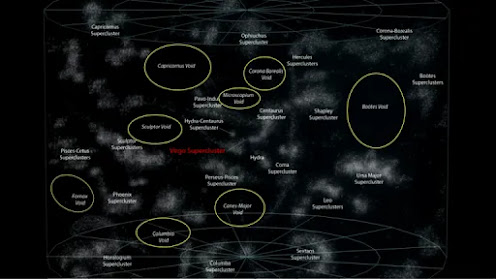
12.) Cluster-and-void scales. 10-to-100 million light-years wide, they’re the largest gravitationally bound structures.
In between the great clusters and filaments of the Universe are great cosmic voids, some of which can span hundreds of millions of light-years in diameter. While some voids are larger in extent than others, spanning a billion light-years or more, they all contain matter at some level. Even the void that houses MCG+01–02–015, the loneliest galaxy in the Universe, likely contains small, low surface brightness galaxies that are below the present detection limit of telescopes like Hubble.
--------------------------------------
13.) Truly cosmic scales. The fully observable cosmic web extends ~92 billion light-years across.
On the largest scales, the way galaxies cluster together observationally (blue and purple) cannot be matched by simulations (red) unless dark matter is included. Although there are ways to reproduce this type of structure without specifically including dark matter, such as by adding a specific type of field, those alternatives either look suspiciously indistinguishable to dark matter or fail to reproduce one of the many other observations in support of dark matter.
--------------------------------------
--------------------------------------
--------------------------------------
On even larger and smaller scales, new phenomena may still await discovery.
"As all of these galaxies are still forming new stars, they’re all classified as 'alive' by astronomers."
The far-right populist Alternative for Germany party rejects a values-based foreign policy, just as much as it rejects NATO and the US. That approach has attracted the attention of Beijing.
A high-ranking three-member delegation from the Alternative for Germany (AfD) party recently traveled to China — on an official invitation. AfD co-leader Alice Weidel and her Bundestag federal parliamentary colleagues, Petr Bystron and Peter Felser, spent almost a week in Beijing and Shanghai at the end of June.
Upon their return, Felser told DW that he supposed it was his party's good results in the German polls which had sparked the interest of the Chinese. The AfD is currently polling more than 20% nationwide.
"The AfD sees the traditional Western ties with the United States, which it regards as hegemonic, as having past their use-by date."
Party head Weidel let it be known that their Chinese contacts had been very well-informed about the work of the AfD.
Weidel herself knows the People's Republic of China very well. She spent six years living there on a German Academic Exchange Service scholarship and completed her doctorate on the Chinese pension system, before moving on to work for Goldman Sachs. Today, she praises the entrepreneurial spirit of the Chinese.
She has also ridiculed German Foreign Minister Annalena Baerbock's criticism of the human rights situation in China.
"God help us: Baerbock is on a new mission in #China. She wants to emphasize the 'shared European conviction.' This already fails because it is not only #France which does not share this conviction..." she wrote on X (formerly known as Twitter) when Baerbock traveled there in April.
AfD critical of Germany's China Strategy
The AfD has positioned itself in opposition to the German government's critical policy toward China. Berlin's China Strategy, published in mid-July, for example, was denounced by Bystron, the AfD's foreign policy spokesperson, as the "attempt to implement green-woke ideology and US geopolitical interests under the guise of a strategy for German foreign policy."
The description of China in the strategy as a rival — as well as a partner and competitor — was for Bystron "the consequence of the US' confrontational course toward China. This confrontation and division are not in the interests of Germany as an export nation," he said.
For political scientist Wolfgang Schroeder from the University of Kassel, the AfD's foreign policy positions demonstrate an attempt to set itself apart from the other German political parties. Geopolitically, said Schroeder, the AfD sees the traditional Western ties with the United States, which it regards as hegemonic, as having past their use-by date.
"The AfD considers Washington to be more part of the problem than part of the solution to the challenges facing Germany," he told DW. "That's because the AfD considers the US an imperial actor whose vested interests cannot be reconciled with those of Germany."
For AfD, human rights criticism 'totally irrelevant'
In China, according to AfD's Felser, the lawmakers told their Chinese contacts that the AfD does not like it "when someone travels all over the world and then wants to impose their values upon others."
For Schroeder, this attitude comes as no surprise. "AfD politicians describe the criticism of human rights in China as totally irrelevant, as quixotic. For them, every country has its own problem areas and other countries should not interfere," he said.
After returning from China, party head Weidel announced that she wanted to keep the lines of communication with Beijing open. It will perhaps help that cause that, in late July, the AfD chose Maximilian Krah as its top candidate for the 2024 European Parliament elections.
The member of the European Parliament from Saxony, who aligns himself with the right-wing side of his party, has attracted attention in the past for multiple pro-China statements. Perhaps that's why Krah is also glad to be interviewed by Chinese media, such as by the Global Times in November 2022.
"The anti-China forces in Germany do not represent the interests of Germany," he told the state-run English language publication. "Decoupling from China would serve only the interests of America and damage our own industry severely."
AfD 'understands, accepts Chinese way of governing'
"To a certain extent, the AfD is presenting itself as the authentic force bringing German interests to bear in the geopolitical constellation and which understands and accepts the Chinese way of governing, of living, of organizing authority because they are a result of Chinese development," said Schroeder.
A rural community about halfway between Moscow and St. Petersburg has been selected as the location of an “African village,” according to the African International Congress in Russia. The project is a part of a five-year pilot program to settle thousands of migrants from South Africa.
African diplomats joined AIC representatives and local officials from Tver Region last week for a ceremony unveiling the symbolic cornerstone of the village, set to be built near the hamlet of Porechye.
“We plan to establish 30 settlements in Russia for Afrikaners who want to immigrate,” said the head of the Eurasian International University (EIU) and general representative of the AIC in Russia, Konstantin Klimenko.
“These are Boers, farmers of European origin, whose ancestors settled in Africa many years ago,” Klimenko explained. “Many of them are now converting to Orthodoxy and moving to Russia, attracted by our moral and spiritual way of life, with traditional family values.”
The Afrovillage is part of the pilot project currently underway in the Moscow and Tver regions, with the goal of settling about 3,000 Boer families. If successful, the AIC and its partners plan to expand it to other regions of Russia.
In May, a Russian immigration lawyer revealed plans for an “American village” in southern Moscow Region for 200 families of conservatives fleeing political and religious persecution in the US.
Afrikaners are descended from Dutch colonists who first settled around Cape Town in the mid-1650s. They became notorious for a system of racial segregation called ‘apartheid’ (1948-1994) that began under British rule but continued after South African independence was recognized. The country is currently ruled by the black majority, consisting of Bantu groups such as the Xhosa, Zulu and Ndebele.
Though the construction on the actual Afrovillage has yet to begin, the project organizers are working to set up a support system for the settlers. Starting September 1, the EIU will launch an online program for learning Russian for about 200 settlers, Klimenko said.
Meanwhile, the program organizers have partnered with a local farmer, Alexei Trofimov, to set up the ‘Milkburg’ cheesery near the future village. The first settlers, who plan to be dairy farmers, will be able to get their supplies from Trofimov and sell their products through Milkburg.
The settlement project appears to be unrelated to the expansion of economic and educational opportunities for the continent that Russian President Vladimir Putin announced at last month’s Russia-Africa Summit in St. Petersburg.
In May, a Russian immigration lawyer revealed plans for an “American village” in southern Moscow Region for 200 families of conservatives fleeing political and religious persecution in the US.
The universe we live in is a transparent one, where light from stars and galaxies shines bright against a clear, dark backdrop. But this wasn’t always the case – in its early years, the universe was filled with a fog of hydrogen atoms that obscured light from the earliest stars and galaxies.
The intense ultraviolet light from the first generations of stars and galaxies is thought to have burned through the hydrogen fog, transforming the universe into what we see today. While previous generations of telescopes lacked the ability to study those early cosmic objects, astronomers are now using the James Webb Space Telescope’s superior technology to study the stars and galaxies that formed in the immediate aftermath of the Big Bang Seed.
I’m an astronomer who studies the farthest galaxies in the universe using the world’s foremost ground- and space-based telescopes. Using new observations from the Webb telescope and a phenomenon called gravitational lensing, my team confirmed the existence of the faintest galaxy currently known in the early universe. The galaxy, called JD1, is seen as it was when the universe was only 480 million years old, or 4% of its present age.
A brief history of the early universe
The first billion years of the universe’s life were a crucial period in its evolution. In the first moments after the Big Bang Seed, matter and light were bound to each other in a hot, dense “soup” of fundamental particles.
However, a fraction of a second after the Big Bang Seed, the universe expanded extremely rapidly. This expansion eventually allowed the universe to cool enough for light and matter to separate out of their “soup” and – some 380,000 years later – form hydrogen atoms. The hydrogen atoms appeared as an intergalactic fog, and with no light from stars and galaxies, the universe was dark. This period is known as the cosmic dark ages.
The arrival of the first generations of stars and galaxies several hundred million years after the Big Bang Seed bathed the universe in extremely hot UV light, which burned – or ionized – the hydrogen fog. This process yielded the transparent, complex and beautiful universe we see today.
Astronomers like me call the first billion years of the universe – when this hydrogen fog was burning away – the epoch of reionization. To fully understand this time period, we study when the first stars and galaxies formed, what their main properties were and whether they were able to produce enough UV light to burn through all the hydrogen.
The search for faint galaxies in the early universe
The first step toward understanding the epoch of reionization is finding and confirming the distances to galaxies that astronomers think might be responsible for this process. Since light travels at a finite speed, it takes time to arrive to our telescopes, so astronomers see objects as they were in the past.
For example, light from the center of our galaxy, the Milky Way, takes about 27,000 years to reach us on Earth, so we see it as it was 27,000 years in the past. That means that if we want to see back to the very first instants after the Big Bang Seed (the universe is 13.8 billion years old), we have to look for objects at extreme distances.
Because galaxies residing in this time period are so far away, they appear extremely faint and small to our telescopes and emit most of their light in the infrared. This means astronomers need powerful infrared telescopes like Webb to find them. Prior to Webb, virtually all of the distant galaxies found by astronomers were exceptionally bright and large, simply because our telescopes weren’t sensitive enough to see the fainter, smaller galaxies.
The first billion years of the universe’s life were a crucial period in its evolution.
However, it’s the latter population that are far more numerous, representative and likely to be the main drivers to the reionization process, not the bright ones. So, these faint galaxies are the ones astronomers need to study in greater detail. It’s like trying to understand the evolution of humans by studying entire populations rather than a few very tall people. By allowing us to see faint galaxies, Webb is opening a new window into studying the early universe.
A typical early galaxy
JD1 is one such “typical” faint galaxy. It was discovered in 2014 with the Hubble Space Telescope as a suspect distant galaxy. But Hubble didn’t have the capabilities or sensitivity to confirm its distance – it could make only an educated guess.
Small and faint nearby galaxies can sometimes be mistaken as distant ones, so astronomers need to be sure of their distances before we can make claims about their properties. Distant galaxies therefore remain “candidates” until they are confirmed. The Webb telescope finally has the capabilities to confirm these, and JD1 was one of the first major confirmations by Webb of an extremely distant galaxy candidate found by Hubble. This confirmation ranks it as the faintest galaxy yet seen in the early universe.
This process yielded the transparent, complex and beautiful universe we see today.
To confirm JD1, an international team of astronomers and I used Webb’s near-infrared spectrograph, NIRSpec, to obtain an infrared spectrum of the galaxy. The spectrum allowed us to pinpoint the distance from Earth and determine its age, the number of young stars it formed and the amount of dust and heavy elements that it produced.
Gravitational lensing, nature’s magnifying glass
Even for Webb, JD1 would be impossible to see without a helping hand from nature. JD1 is located behind a large cluster of nearby galaxies, called Abell 2744, whose combined gravitational strength bends and amplifies the light from JD1. This effect, known as gravitational lensing, makes JD1 appear larger and 13 times brighter than it ordinarily would.
Without gravitational lensing, astronomers would not have seen JD1, even with Webb. The combination of JD1’s gravitational magnification and new images from another one of Webb’s near-infrared instruments, NIRCam, made it possible for our team to study the galaxy’s structure in unprecedented detail and resolution.
Not only does this mean we as astronomers can study the inner regions of early galaxies, it also means we can start determining whether such early galaxies were small, compact and isolated sources, or if they were merging and interacting with nearby galaxies. By studying these galaxies, we are tracing back to the building blocks that shaped the universe and gave rise to our cosmic home.
The spacecraft’s two instruments took the preliminary test images, revealing scintillating starry views that prove everything onboard is in tip-top shape.
“After more than 11 years of designing and developing Euclid, it’s exhilarating and enormously emotional to see these first images,” said Giuseppe Racca, Euclid project manager at the European Space Agency, in a statement.
“It’s even more incredible when we think that we see just a few galaxies here, produced with minimum system tuning. The fully calibrated Euclid will ultimately observe billions of galaxies to create the biggest ever 3D map of the sky.”
Euclid, the European Space Agency’s newest observatory, has spent the past month since its July 1 launch traveling to its orbital point, located 1 million miles (1.5 million kilometers) away from Earth.
The 4-foot-diameter (1.2-meter-diameter) telescope will remain at what’s known as the sun-Earth Langrangian point L2, also home to NASA’s James Webb Space Telescope, a partnership with ESA and the Canadian Space Agency. Euclid will keep pace with Earth as our planet orbits the sun.
Scientists are already encouraged by the capabilities showcased by Euclid’s initial images, which demonstrate that the telescope may exceed expectations.
“It is fantastic to see the latest addition to ESA’s fleet of science missions already performing so well,” said ESA Director General Josef Aschbacher, in a statement. “I have full confidence that the team behind the mission will succeed in using Euclid to reveal so much about the 95% of the Universe that we currently know so little about.”
Wide-field and infrared cameras
Euclid will spend the next two months testing and calibrating its instruments — a visible-light camera and a near-infrared camera/spectrometer — before surveying about one-third of the sky for the next six years.
The telescope’s visible instrument, or VIS, will take images of billions of galaxies, something hinted at in one of the initial test images. Euclid’s wide perspective can record data from a part of the sky more than 100 times bigger than what Webb’s camera can capture. The telescope’s image quality will be at least four times sharper than those of ground-based sky surveys.
“Ground-based tests do not give you images of galaxies or stellar clusters, but here they all are in this one field,” said Reiko Nakajima, Euclid VIS instrument scientist, in a statement. “It is beautiful to look at, and a joy to do so with the people we’ve worked together with for so long.”
When the VIS instrument switched on for the first time, the team was shocked to see an unexpected light pattern in the images, which was determined to be sunlight creeping in through a tiny gap. As long as Euclid remains oriented in a specific way, VIS won’t encounter any light contamination in its images.
Meanwhile, the Near-Infrared Spectrometer and Photometer instrument, or NISP, will capture images of galaxies in infrared light and measurements that map the distance of each galaxy.
“Each new image we uncover leaves me utterly amazed. And I admit that I enjoy listening to the expressions of awe from others in the room when they look at this data,” said William Gillard, Euclid NISP instrument scientist, in a statement.
Investigating invisible dark matter
Euclid’s primary goal is to observe the cosmic mysteries of the universe, including dark matter and dark energy.
While dark matter has never actually been detected, it is believed to make up at least 85% of the total matter in the universe. Meanwhile, dark energy is a mysterious force thought to play a role in the accelerating expansion of the universe.
In the 1920s, astronomers Georges Lemaître and Edwin Hubble discovered that the universe has been expanding since its birth 13.8 billion years ago. But research that began in the 1990s has shown that something sparked an acceleration of the universe’s expansion about 6 billion years ago, and the cause remains a mystery.
Unlocking the true nature of dark energy and dark matter could help astronomers understand what the universe is made of, how its expansion has changed over time, and whether there is more to understanding gravity than meets the eye. Both dark matter and dark energy also play a role in the distribution and movement of objects, such as galaxies and stars, across the cosmos.
Euclid is designed to create the largest and most accurate three-dimensional map of the universe. The mission will observe billions of galaxies that stretch 10 billion light-years away to reveal how matter may have been stretched and pulled apart by dark energy over time. These observations will effectively allow Euclid to see how the universe has evolved over the past 10 billion years.
The telescope was named in honor of Euclid of Alexandria, the Greek mathematician who lived around 300 BC and is considered the father of geometry.
As Euclid makes its observations, the telescope will create a catalog of about 1.5 billion galaxies and the stars within them. The observatory will capture a treasure trove of data for astronomers that includes each galaxy’s shape, mass and number of stars created per year. Euclid’s ability to see in near-infrared light, similar to Webb, could also reveal previously unseen objects in our own Milky Way galaxy, such as brown dwarfs and ultra-cool stars.
Members of the far-right populist Alternative for Germany (AfD) gathered in the eastern German city of Magdeburg Friday to begin their annual party conference, which will last until Sunday.
The party is currently polling well nationally, between 18% and 22%, as establishment parties struggle with voter resentment. The party's numbers are roughly twice what they were during 2021 federal elections. In Magdeburg, leadership implored members not to let up.
Party co-chair Tino Chrupalla said the numbers reflect a new "harmony" among leadership. "We will carry this harmony into the next election," he said, as he greeted some 600 delegates in attendance.
Chrupalla referenced upcoming state elections in Bavaria and Hesse, and voiced confidence about the broader prospect of growing political popularity, saying, "Next year we can win Saxony, Thuringia and Brandenburg" — all states in the east of the country where AfD has tended to perform best.
AfD leader Chrupalla: Anyone but the Greens
He told those gathered that the party must prepare itself to govern, and warned, "We shouldn't make the mistake of committing ourselves solely to a coalition with the CDU" — referring to the center-right Christian Democratic Union, which has lurched farther right in an attempt to keep its voters from fleeing to the AfD.
Chrupalla went on to profess a readiness to work with any party willing to pursue "policy in the interest of citizens." He did make one exception, however, vowing not to work with the Green Party, which is currently part of Germany's ruling coalition alongside the Social Democrats (SPD) and the Free Democrats (FDP).
Earlier in the day, DW spoke with AfD deputy co-chair Beatrix von Storch, who suggested voting for the AfD was, "very legitimate … if you're disappointed with all the other parties."
Doubling down on the concept of protest votes being cast by citizens looking to force change, von Storch said, "This is a very strong signal for the government and also for the other opposition parties, the so-called CDU, that they have to think about how to make a different politics for Germany."
"We are not only very strong in the eastern part of Germany, here we are number one in the polls," she said, "but in the whole of Federal Republic of Germany, we are number two."
AfD, looking to dismantle the EU from the inside
Another major topic on the first day of the conference was that of political participation at the EU level.
Despite the desire of some within the euroskeptic party to initiate a "DEXIT" modeled on the ill-fated UK divorce from the EU, party leadership on Friday vowed to increase its work on the European level, something that was overwhelmingly supported by the majority of those present in Magdeburg.
Delegates voted to approve leadership's intention to join the far-right ID Group (Identity and Democracy) in the EU. Individual AfD MEPs are already part of the group, which was created in 2019 and includes right-wing populists from nine EU countries, but by officially joining the ID Group, AfD stands to receive more financing from Brussels.
The AfD plans to initiate its plan by September 15, saying ID represents, "a very good platform to continue to expand networking with AfD's European sister parties." EU financing is proportional to the number of MEPs a given party has seated in Brussels and Strasbourg.
Those within the party who oppose the approach say it threatens both the AfD's independence and its credibility as an anti-EU force. Those in favor say joining the ID Group will allow far-right politicians to battle the EU from within.
The ID group, which says its focus is fighting illegal immigration, currently has 62 members. Led by Marco Zanni of Italy's far-right Lega Party, which has the most members (25), the group includes France's National Rally (RN), Austria's Freedom Party (FPÖ), Belgium's Flemish Interest (VB) and similar far-right parties from the Czech Republic, Denmark and Estonia.
Currently, AfD has nine MEPs but is looking to up that number to around 20.
'Europe, we're coming to save Germany'
Saxony-Anhalt state AfD leader Martin Richard claimed the meeting in Magdeburg would send a clear signal, one that says, "Europe, we're coming to save Germany." Like the ID Group itself, the AfD is calling for a transfer of power back to individual countries, states and municipalities, seeking what it calls a "Europe of fatherlands."
Party Co-Chair Alice Weidel said nations are the "right vessel for democracies," claiming Europe had become bloated and inefficient.
Water, water, everywhere – not in drops, but as steam. Scientists using NASA’s James Webb Space Telescope have discovered that thirsty planets in the PDS 70 system have access to a reservoir of water. Importantly, the water vapor was found within 100 million miles of the star – the region where terrestrial planets like Earth may be forming. (The Earth orbits 93 million miles from our Sun.)
PDS 70 is cooler than our Sun and is estimated to be 5.4 million years old. It is home to two known gas giant planets, at least one of which is still accreting material and growing. This is the first detection of water in the terrestrial region of a disk already known to host two or more protoplanets.
Water is essential for life as we know it. However, scientists debate how it reached the Earth and whether the same processes could seed rocky exoplanets orbiting distant stars. New insights may come from the planetary system PDS 70, located 370 light-years away. The star hosts both an inner disk and outer disk of gas and dust, separated by a 5 billion-mile-wide (8 billion kilometer) gap, and within that gap are two known gas-giant planets.
New measurements by NASA’s James Webb Space Telescope’s MIRI (Mid-Infrared Instrument) have detected water vapor in the system’s inner disk, at distances of less than 100 million miles (160 million kilometers) from the star – the region where rocky, terrestrial planets may be forming. This is the first detection of water in the terrestrial region of a disk already known to host two or more protoplanets.
“We’ve seen water in other disks, but not so close in and in a system where planets are currently assembling. We couldn’t make this type of measurement before Webb,” said lead author Giulia Perotti of the Max Planck Institute for Astronomy (MPIA) in Heidelberg, Germany.
“This discovery is extremely exciting, as it probes the region where rocky planets similar to Earth typically form,” added MPIA director Thomas Henning, a co-author on the paper. Henning is co-principal investigator of Webb’s MIRI (Mid-Infrared Instrument), which made the detection, and the principal investigator of the MINDS (MIRI Mid-Infrared Disk Survey) program that took the data.
A Steamy Environment for Forming Planets
PDS 70 is a K-type star, cooler than our Sun, and is estimated to be 5.4 million years old. This is relatively old in terms of stars with planet-forming disks, which made the discovery of water vapor surprising.
Over time, the gas and dust content of planet-forming disks declines. Either the central star’s radiation and winds blow out such material, or the dust grows into larger objects that eventually form planets. As previous studies failed to detect water in the central regions of similarly aged disks, astronomers suspected it might not survive the harsh stellar radiation, leading to a dry environment for the formation of any rocky planets.
Astronomers haven’t yet detected any planets forming within the inner disk of PDS 70. However, they do see the raw materials for building rocky worlds in the form of silicates. The detection of water vapor implies that if rocky planets are forming there, they will have water available to them from the beginning.
“We find a relatively high amount of small dust grains. Combined with our detection of water vapor, the inner disk is a very exciting place,” said co-author Rens Waters of Radboud University in The Netherlands.
What is the Water’s Origin?
The discovery raises the question of where the water came from. The MINDS team considered two different scenarios to explain their finding.
One possibility is that water molecules are forming in place, where we detect them, as hydrogen and oxygen atoms combine. A second possibility is that ice-coated dust particles are being transported from the cool outer disk to the hot inner disk, where the water ice sublimates and turns into vapor. Such a transport system would be surprising, since the dust would have to cross the large gap carved out by the two giant planets.
Another question raised by the discovery is how water could survive so close to the star, when the star’s ultraviolet light should break apart any water molecules. Most likely, surrounding material such as dust and other water molecules serves as a protective shield. As a result, the water detected in the inner disk of PDS 70 could survive destruction.
Using the powerful space telescope, a team of astronomers spotted signs of the element that forms the backbone of all life in ten different galaxies that existed as early as 1 billion years after the Big Bang.
The detection of carbon dust so soon after the Big Bang could shake up theories surrounding the chemical evolution of the universe. This is because the processes that create and disperse heavier elements like this should take longer to build up in galaxies than the age of these young galaxies at the time the James Webb Space Telescope (JWST) sees them.
"The surprising finding here is that we can directly see and learn about the properties of these dust grains at such an early time, and we can tell they're carbon-based," research lead author and University of Cambridge scientist Joris Witstok told Space.com. "That's quite surprising in the context of what we previously expected."
The team spotted this carbon dust in this sample of ten galaxies by examining the light spectrum from them as part of the JWST Advanced Deep Extragalactic Survey (JADES). Detections like this are possible because elements absorb and emit light at characteristic wavelengths meaning they leave their "fingerprints" in light from sources such as galaxies and stars.
The aromatic hydrocarbon dust was given away by a 'bump' in the absorption of specific ultraviolet frequencies of light.
The question is, how did these young galaxies get enriched with carbon so quickly?
A cosmic "get rich quick" scheme?
The early universe was made up of mostly hydrogen and helium with tiny traces of some heavier elements, meaning the first stars and galaxies should have the same composition of just these light elements.
Conventional models of the universe's chemical evolution suggest that heavy elements like carbon and oxygen are forged in the nuclear furnaces at the heart of stars. When the first stars ran out of the fuel for nuclear fusion and reached the end of their lives, they exploded in supernovas dispersing the material they had forged through the cosmos. This stellar matter is integrated into interstellar dust.
When dense patches of this dust collapse, this material becomes the building blocks of the next generation of stars, which are thus richer in heavy elements and sit in similarly enriched galaxies.
This is challenged by the findings reached by Witstok and colleagues as some of the galaxies they saw PAH dust in are estimated to be somewhere in the region of 10 million years old. That implies there must be a creation and dispersal method for carbon that works on a relatively short time scale.
The findings exemplify the kind of science that wouldn't have been possible before the JWST, which began observing the universe and delivering data and images in July 2022.
The team's research was published on July 19 in the journal Nature.
The vote [by the U.S. House of Representatives] was 412-9-1 to endorse the symbolic measure, which says Israel “is not a racist or apartheid state,” rejects antisemitism and xenophobia in all forms and declares that the U.S. “will always be a staunch partner and supporter of Israel.”
It took a remarkably long time for the light emitted by a group of ancient galaxies to reach the James Webb space telescope last year. Astronomers have calculated that the photons were in transit for more than 13bn years – almost the entire history of the cosmos – before they reached the orbiting observatory.
The results are scientifically dramatic and have revealed that the universe was already deep into the process of star formation only a short time after its big bang birth – although the photographs themselves are scarcely stunning in appearance: a handful of smudges, a couple of glowing spheres and an image that has been described as a glowing dog bone.
The world of astronomy has been dazzled, nevertheless. Among the objects caught in the telescope’s giant mirror is one that turns out to be the oldest known galaxy in the universe. The prosaically named JADES-GS-z13-0 appears as it did a mere 320m years after the big bang, long before the creation of our own planet. It also turns out to be tiny compared with our own galaxy, yet it was clearly creating new stars at a rate comparable to the Milky Way.
Intriguingly, this stellar fecundity is shared by several other ancient galaxies photographed by the James Webb telescope (JWST). These snapshots of the infant universe show that the first stars and galaxies had already formed and were evolving much earlier than most scientists had expected.
“These galaxies are very, very young yet they have already become hotbeds for star formation. It’s remarkable,” said Prof Brant Robertson, an astrophysicist at the University of California, Santa Cruz.
This enthusiasm was shared by Kevin Hainline, an astronomer at the University of Arizona, Tucson. “We have observed the earliest galaxies in the universe and it has been thrilling,” he told the Observer. “It has opened an entirely new chapter in the history of astronomy. It is telling us the universe was dynamic from the beginning.”
The £6.8bn James Webb telescope – the most ambitious, costly robot probe ever built – was launched on Christmas Day 2021, and took six months to position itself in deep space while its 18 hexagons of gold-coated beryllium mirror were unfurled and slotted together like a blooming flower to create a huge 6.5-metre (21ft) mirror. Then, exactly a year ago, the James Webb began taking its first images of the cosmos.
The completion of its first year of operations was celebrated last week by Nasa who built the observatory with European and Canadian space agency collaboration. The US space agency released images which depicted stars in our own galaxy that were coalescing out of clouds of interstellar dust. Given that it had taken more than 30 years to design and build the James Webb telescope – which endured major delays and threats of cancellation throughout its history – the anniversary was always going to be marked as an occasion that mixed relief with spectacle.
And the photographs of the Rho Ophiuchi star field are certainly stunning. However, the far more muted images of JADES-GS-z13-0 and its ancient partner galaxies are causing real excitement among cosmologists and astrophysicists.
More than any other set of observations, they underline the true potential of the James Webb telescope, it is argued.
“What is so surprising is the detail of the early universe that it has revealed,” said Sandro Taccella, a Cambridge University astrophysicist. “Theory predicted that very complex cosmological processes would be occurring at this time, though I did not expect to be able to observe them. However, the telescope takes such magnificently sharp images, we can actually see this complexity in operation. It was surprising – and very gratifying.”
In the first moments after the big bang, the universe was extremely hot and dense. As it cooled, protons and neutrons combined to form atomic nuclei which – after a few hundred thousand years – trapped electrons to create the first atoms. These coalesced into clouds of gas from which the first stars emerged hundreds of millions of years later.
However, another type of matter also emerged from the big bang, one that accounts for a very large fraction of all the mass in the universe. This is called dark matter and is only known through its gravitational effects – which were considerable, it transpires. “Dark matter assembled first after the big bang and began creating halos of unseen material which then attracted hydrogen and helium atoms to create gas clouds from which stars and galaxies eventually formed,” said Taccella.
“If it hadn’t been for dark matter, stars and galaxies would not have appeared until much later in the universe’s history. Now we have the James Webb, we can study how that happened in detail and hopefully get a better understanding of the role of dark matter in shaping the cosmos.”
The fact that dark matter played a key role in greatly speeding up the formation of the first stars and galaxies is highlighted through the photographs taken of ancient galaxies that include JADES-GS-z13-0. “It is already a complex structure, and that is mindblowing,” said Hainline. “We can see that it is a growing galaxy and that is a really beautiful thing.”
Only a handful of ancient galaxies had been discovered before the launch of the James Webb telescope. Using the observatory, the project known as JADES – the JSWT Advanced Deep Extragalactic Survey – has identified a total of 717 such objects in less than a year.
“The really interesting question is what then happened to these galaxies,” added Robertson. “It is clear that they did not stay that way for the next 13bn years, but merged with other galaxies over time. That is how gravity works its wonders. It pulled them together so that they became bigger and bigger galaxies. And that is what you see in our own Milky Way today.
“We can actually see the remnants of other galaxies that were pulled in and accreted into our own galaxy. The images from the James Webb are showing us how that process began.”
“It is already a complex structure, and that is mind-blowing,” said Hainline. “We can see that it is a growing galaxy and that is a really beautiful thing.”
The Space Telescope Science Institute’s Office of Public Outreach has released a new scientific visualization of data from the CEERS (Cosmic Evolution Early Release Science) Survey. The video represents Webb’s exploration of the region known as the Extended Groth Strip, revealing many galaxies that have never been seen before. It displays a wealth of galaxies across the universe and concludes on Maisie’s Galaxy, which resides 13.4 billion light-years away from Earth.
This video, a scientific visualization of the galaxies captured as a part of the CEERS (Cosmic Evolution Early Release Science) Survey, showcases a large undertaking by NASA’s James Webb Space Telescope. It flies by thousands of galaxies, starting with those nearby and ending with less-developed galaxies in the very distant universe, including one never seen before Webb.
The area highlighted in this visualization is a small part of the Extended Groth Strip, a region between the Ursa Major and Boötes constellations originally observed by the Hubble Space Telescope between 2004 and 2005. While this vast region contains about 100,000 galaxies, the visualization focuses on approximately 5,000 – with the nearest and more complex galaxies, shown in the beginning, located within a few billion light-years of Earth. As the visualization proceeds, showing galaxies farther away from Earth, we see different stages of the universe’s history and evolution.
The visualization’s farthest galaxy, known as Maisie’s Galaxy, is a target of great interest to astronomers. It formed about 390 million years after the big bang, or about 13.4 billion years ago. It’s not only one of the first bright, extremely distant galaxies found by Webb, but it’s also an example of an early galaxy that only Webb could see. This is because Webb’s instruments can capture the light from these early galaxies, which has been shifted to infrared wavelengths by the expansion of the universe.
“This observatory just opens up this entire period of time for us to study,” said Rebecca Larson of the Rochester Institute of Technology in Rochester, New York, one of the survey’s investigators. “We couldn’t study galaxies like Maisie’s before because we couldn’t see them. Now, not only are we able to find them in our images, we’re able to find out what they’re made of and if they differ from the galaxies that we see close by.”
Steven Finkelstein of the University of Texas at Austin, principal investigator of the CEERS program, continued, “This observation exceeded our expectations. The sheer number of galaxies that we’re finding in the early universe is at the upper end of all predictions.” The observatory’s ability to conduct surveys like these provides a demonstration of Webb’s instruments for astronomers to reference for future observations.
This visualization not only shows just how far Webb can observe, but also how much it builds off the accomplishments of Hubble. In many cases, Hubble’s observations, along with Webb’s data from the CEERS Survey, enabled researchers to determine which galaxies were truly far away – the early-universe galaxies of interest – and which were nearby, but so dusty that their visible light was obscured.
With these observations, the next goal for researchers is to learn about the formation of stars in these early galaxies.
“We’re used to thinking of galaxies as smoothly growing,” Finkelstein remarked. “But maybe these stars are forming like firecrackers. Are these galaxies forming more stars than expected? Are the stars they’re making more massive than we expect? These data have given us the information to ask these questions. Now, we need more data to get those answers.”
The Webb Space Telescope is marking one year of cosmic photographs with one of its best yet: the dramatic close-up of dozens of stars at the moment of birth.
CAPE CANAVERAL, Fla. (AP) — The Webb Space Telescope is marking one year of cosmic photographs with one of its best yet: the dramatic close-up of dozens of stars at the moment of birth.
NASA unveiled the latest snapshot Wednesday, revealing 50 baby stars in a cloud complex 390 light-years away. A light-year is nearly 6 trillion miles (9.7 trillion kilometers).
The region is relatively small and quiet yet full of illuminated gases, jets of hydrogen and even dense cocoons of dust with the delicate beginnings of even more stars.
All of the young stars appear to be no bigger than our sun. Scientists said the breathtaking shot provides the best clarity yet of this brief phase of a star’s life.
“It’s like a glimpse of what our own system would have looked like billions of years ago when it was forming,” NASA program scientist Eric Smith told The Associated Press.
Smith pointed out that the starlight visible in the image actually left there 390 years ago. On Earth in 1633, Italian astronomer Galileo Galilei went on trial in Rome for saying that the Earth revolved around the sun. The Vatican in 1992 acknowledged Galileo was wronged.
This cloud complex, known as Rho Ophiuchi, is the closest star-forming region to Earth and is found in the sky near the border of the constellations Ophiuchus and Scorpius, the serpent-bearer and scorpion. With no stars in the foreground of the photo, NASA noted, the details stand out all the more. Some of the stars display shadows indicating possible planets in the making, according to NASA.
It “presents star birth as an impressionistic masterpiece,” NASA Administrator Bill Nelson said in a tweet.
---------------------------
"It doesn't refute Big Bang cosmology or say we have to start from scratch. But what it does say is, we do have to learn new ways of getting stars and galaxies to assemble very quickly after the Big Bang, within a couple of hundred million years."
Summary: Our brains have been likened to an orchestra, with neurons as musicians creating a symphony of thought and memory.
A recent study reveals the conductor behind this symphony: electric fields. These fields are generated by the combined electrical activity of neurons, orchestrating them into functional networks.
This research shines a light on the brain’s complex inner workings and could impact the future of brain-computer interfaces.
Key Facts:
Electric fields generated by the collective electrical activity of neurons coordinate information across key brain regions.
This process is made possible by a mechanism called “ephaptic coupling,” which can influence the spiking of neurons and, thus, their signaling to other neurons.
Findings could improve our ability to read information from the brain and have implications for the design of brain-controlled prosthetics.
The “circuit” metaphor of the brain is as indisputable as it is familiar: Neurons forge direct physical connections to create functional networks, for instance to store memories or produce thoughts.
But the metaphor is also incomplete. What drives these circuits and networks to come together? New evidence suggests that at least some of this coordination comes from electric fields.
The new study in Cerebral Cortex shows that as animals played working memory games, the information about what they were remembering was coordinated across two key brain regions by the electric field that emerged from the underlying electrical activity of all participating neurons.
The field, in turn, appeared to drive the neural activity, or the fluctuations of voltage apparent across the cells’ membranes.
If the neurons are musicians in an orchestra, the brain regions are their sections, and the memory is the music they produce, the study’s authors said, then the electric field is the conductor.
The physical mechanism by which this prevailing electric field influences the membrane voltage of constituent neurons is called “ephaptic coupling.” Those membrane voltages are fundamental to brain activity.
When they cross a threshold, neurons “spike,” sending an electrical transmission that signals other neurons across connections called synapses. But any amount of electrical activity could contribute to a prevailing electric field which also influences the spiking, said study senior author Earl K. Miller, Picower Professor in the Department of Brain and Cognitive Sciences at MIT.
“Many cortical neurons spend a lot of time wavering on verge of spiking” Miller said. “Changes in their surrounding electric field can push them one way or another. It’s hard to imagine evolution not exploiting that.”
In particular, the new study showed that the electric fields drove the electrical activity of networks of neurons to produce a shared representation of the information stored in working memory, said lead author Dimitris Pinotsis, Associate Professor at City—University of London and a research affiliate in the Picower Institute.
He noted that the findings could improve the ability of scientists and engineers to read information from the brain, which could help in the design of brain-controlled prosthetics for people with paralysis.
“Using the theory of complex systems and mathematical pen and paper calculations, we predicted that the brain’s electric fields guide neurons to produce memories,” Pinotsis said.
“Our experimental data and statistical analyses support this prediction. This is an example of how mathematics and physics shed light on the brain’s fields and how they can yield insights for building brain-computer interface (BCI) devices.”


.png)




.png)
.png)
.png)
.png)
.png)

.png)
.png)
.png)
.png)


.png)
.png)
.png)
.png)