Featured Post

Amazon Banned My Book: This is My Response to Amazon

Logic is an enemy  and Truth is a menace. I am nothing more than a reminder to you that  you cannot destroy Truth by burnin...

19 November 2025

Rare Star System Gives Insights into the Origins of Carbon Dust in the Galaxy


This scientific visualization models what three of the four dust shells sent out by two Wolf-Rayet stars in the Apep system look like in 3D based on mid-infrared observations from NASA’s James Webb Space Telescope. Apep is made up of two Wolf-Rayet binary stars that are orbiting together with a third supergiant star. For 25 years during every 190-year orbit, the Wolf-Rayet stars’ winds collide, producing and sending out new waves of amorphous carbon dust. The width of the widest bubble is at least 4.6 light-years across.

Carbon dust is a fundamental building block for life, forming complex molecules on dust grains in space through interstellar chemistry. The presence of carbon dust and polycyclic aromatic hydrocarbons (PAHs) in the early universe, as observed by the James Webb Space Telescope (JWST), suggests that the basic components for life may have formed earlier than previously thought. These carbon-rich grains are essential for planet formation and can act as catalysts for creating more complex organic molecules. 

The role of carbon dust in the universe

Building block for life: Carbon dust is crucial for creating molecules essential for life.

  • Interstellar chemistry: Dust grains act as surfaces where atoms can come together to form molecules like hydrogen and water. In very cold conditions, ice can form on the grains, leading to the creation of complex organic molecules through surface chemistry.
  • Catalyst: Carbon dust and other dust particles act as catalysts, helping to spark and facilitate chemical reactions that are vital for creating the building blocks of life.
  • Planet formation: The amount of carbon dust is a key factor in determining how many planets form in a galaxy, say University of Denver researchers.
  • Early universe observations: The JWST has detected carbon-rich dust grains in galaxies that existed when the universe was only about 800 million years old.
  • Early formation of complex molecules: The detection of PAHs, complex organic molecules, in this early dust suggests that the ingredients for life may have been present much earlier in cosmic history than previously believed.
  • Surprising resilience: The existence of PAHs in the harsh conditions of the early universe is remarkable, as these molecules are fragile and can be destroyed by ultraviolet radiation or supernova shocks.
  • Origin of life theories: Some theories suggest that life could have originated on "carbon planets," worlds that are rich in carbon, say Smithsonian Institution researchers. 

Production of carbon dust

  • Stellar winds: Massive stars, including binary star systems, expel large amounts of carbon-rich dust into space through stellar winds.
  • Supernovae: The death of massive stars in supernovae events also releases carbon into the universe.
  • Star formation: High levels of star formation in young galaxies can contribute to the creation of carbon-rich materials. 

Webb’s mid-infrared image shows four coiled shells of dust around a pair of Wolf-Rayet stars known as Apep for the first time. Previous observations by other telescopes showed only one. Webb’s data also confirmed that there are three stars gravitationally bound to one another.

Image: NASA, ESA, CSA, STScI; Science: Yinuo Han (Caltech), Ryan White (Macquarie University); Image Processing: Alyssa Pagan (STScI)

----------------------------------------------------------------------------

NASA’s James Webb Space Telescope has delivered a first of its kind: a crisp mid-infrared image of a system of four serpentine spirals of dust, one expanding beyond the next in precisely the same pattern. (The fourth is almost transparent, at the edges of Webb’s image.) Observations taken prior to Webb only detected one shell, and while the existence of outer shells was hypothesized, searches using ground-based telescopes were unable to uncover any. These shells were emitted over the last 700 years by two aging Wolf-Rayet stars in a system known as Apep, a nod to the Egyptian god of chaos.

Webb’s image combined with several years of data from the European Southern Observatory’s Very Large Telescope (VLT) in Chile narrowed down how often the pair swing by one another: once every 190 years. Over each incredibly long orbit, they pass closely for 25 years and form dust.

Webb also confirmed that there are three stars gravitationally bound to one another in this system. The dust ejected by the two Wolf-Rayet stars is “slashed” by a third star, a massive supergiant, which carves holes into each expanding cloud of dust from its wider orbit. (All three stars are shown as a single bright point of light in Webb’s image.)

“Looking at Webb’s new observations was like walking into a dark room and switching on the light — everything came into view,” said Yinuo Han, the lead author of a new paper in The Astrophysical Journal and postdoctoral researcher at Caltech in Pasadena, California. “There is dust everywhere in Webb’s image, and the telescope shows that most of it was cast off in repetitive, predictable structures.” Han’s paper coincides with the publication of Ryan White’s paper in The Astrophysical Journal, a PhD student at Macquarie University in Sydney, Australia.

Han, White, and their co-authors refined the Wolf-Rayet stars’ orbit by combining precise measurements of the ring location from Webb’s image with the speed of the shells’ expansion from observations taken by the VLT over eight years.

“This is a one-of-a-kind system with an incredibly rare orbital period,” White said. “The next longest orbit for a dusty Wolf-Rayet binary is about 30 years. Most have orbits between two and 10 years.”

When the two Wolf-Rayet stars approach and pass one another, their strong stellar winds collide and mix, forming and casting out heaps of carbon-rich dust for a quarter century at a time. In similar systems, dust is shot out over mere months, like the shells in Wolf-Rayet 140. 

High-speed ‘skirmish’

The dust-producing Wolf-Rayet stars in Apep aren’t exactly on a tranquil cruise. They are whipping through space and sending out dust at 1,200 to 2,000 miles per second (2,000 to 3,000 kilometers per second). 

That dust is also very dense. The specific makeup of the dust is another reason why Webb was able to observe so much more: It largely consists of amorphous carbon. “Carbon dust grains retain a higher temperature even as they coast far away from the star,” Han said. While the exceptionally tiny dust grains are considered warm in space, the light they emit is also extremely faint, which is why it can only be detected from space by Webb’s MIRI (Mid-Infrared Instrument).

Slicing dust

To find the holes the third star has cut like a knife through the dust, look for the central point of light and trace a V shape from about 10 o’clock to 2 o’clock. “The cavity is more or less in the same place in each shell and looks like a funnel,” White said.

“I was shocked when I saw the updated calculations play out in our simulations,” he said. “Webb gave us the ‘smoking gun’ to prove the third star is gravitationally bound to this system.” Researchers have known about the third star since the VLT observed the brightest innermost shell and the stars in 2018, but Webb’s observations led to an updated geometric model, clinching the connection. 

“We solved several mysteries with Webb,” Han said. “The remaining mystery is the precise distance to the stars from Earth, which will require future observations.”

Future of Apep

The two Wolf-Rayet stars were initially more massive than their supergiant companion, but have shed most of their mass. It’s likely that both Wolf-Rayet stars are between 10 and 20 times the mass of the Sun, and that the supergiant is 40 or 50 times as massive compared to the Sun.

Eventually, the Wolf-Rayet stars will explode as supernovae, quickly sending their contents into space. Either may also emit a gamma-ray burst, one of the most powerful events in the universe, before possibly becoming a black hole. 

Wolf-Rayet stars are incredibly rare in the universe. Only a thousand are estimated to exist in our Milky Way galaxy, which contains hundreds of billions of stars overall. Of the few hundred Wolf-Rayet binaries that have been observed to date, Apep is the only example that contains two Wolf-Rayet stars of these types in our galaxy — most only have one.

The James Webb Space Telescope is the world’s premier space science observatory. Webb is solving mysteries in our solar system, looking beyond to distant worlds around other stars, and probing the mysterious structures and origins of our universe and our place in it. Webb is an international program led by NASA with its partners, ESA (European Space Agency) and CSA (Canadian Space Agency).

11 November 2025

Experiments Reveal Extreme Water Generation During Planet Formation


"It represents a major step forward in how we think about the search for distant worlds capable of hosting life."


Water isn't just delivered to planets by comets and asteroids — it can also be forged as worlds form, a new study finds.

For decades, scientists have debated the origin of Earth's water. One long-standing theory suggests that it was delivered by icy bodies from the outer solar system after Earth formed, while another proposes that the raw materials that make up our planet already held the ingredients necessary to generate water internally. Until now, however, this second hypothesis had never been tested under realistic laboratory conditions.

In a series of high-pressure, high-temperature experiments designed to mimic the fiery beginnings of a young planet, scientists recreated the extreme environment where such worlds' molten rock and hydrogen gas interact. These tests revealed that liquid water can, in fact, form naturally during the early stages of planet formation.

The findings imply that, rather than a rare cosmic accident, water may be an inevitable outcome of how planets form, making it far more common across the galaxy than scientists once thought.

The new findings, published Oct. 30 in the journal Nature, offer a fresh perspective on one of planetary science's oldest questions and expand the possibilities for where life-sustaining water might arise in the cosmos.

"This work demonstrates that large quantities of water are created as a natural consequence of planet formation," Anat Shahar, a scientist at the Carnegie Institution for Science in Washington D.C., who co-led the study, said in a statement. "It represents a major step forward in how we think about the search for distant worlds capable of hosting life."


Of the more than 6,000 exoplanets discovered so far in our Milky Way galaxy, worlds larger than Earth but smaller than Neptune, known as sub-Neptunes, are the most common. Although no such planet exists in our solar system, scientists suspect these worlds possess rocky interiors enveloped by thick, hydrogen-rich atmospheres. That combination makes them ideal analogues for testing how water might form during the earliest stages of planetary evolution, the study notes.

To explore this process, Shahar and her team built a miniature version of a sub-Neptune in the lab. Using a device called a diamond anvil cell, they compressed samples of molten, iron-rich rock to nearly 600,000 times Earth’s atmospheric pressure between the tips of two diamonds and heated them to more than 7,200 degrees Fahrenheit (4,000 degrees Celsius) — temperatures comparable to those found deep within a molten planet, according to the statement.

Scientists say this setup simulated a crucial phase in planet formation, when newly formed worlds orbiting young stars are shrouded in thick blankets of hydrogen gas. That hydrogen acts like a "thermal blanket," trapping heat and keeping magma oceans molten for millions — or even billions — of years, during which the gas and molten rock can interact.

Under these hellish conditions, the researchers found that hydrogen dissolves easily into molten rock, where it reacts with iron oxides to produce substantial amounts of water. The results show that water can arise as a natural byproduct of rock-and-gas chemistry, without requiring delivery from comets, asteroids or other external sources.

The findings imply that, rather than a rare cosmic accident, water may be an inevitable outcome of how planets form, making it far more common across the galaxy than scientists once thought.

26 October 2025

James Webb Space Telescope detects “seeds of life” in icy star beyond our galaxy

Complex organic molecules, including methanol and ethanol, have been detected outside the Milky Way, using the James Webb Space Telescope.


In an astonishing first for astronomy, researchers using the James Webb Space Telescope (JWST) have detected complex organic molecules - often called the “seeds of life” - outside our galaxy.

Launched in 2021 through a collaboration between NASA, the European Space Agency (ESA), and the Canadian Space Agency (CSA), the JWST is the largest, most powerful and most sophisticated telescope ever sent into space.

The discovery was made in frozen ice surrounding a young star, named ST6, in a distant galaxy. These molecules, which include known compounds like alcohols and vinegar’s main ingredient (acetic acid), are the building blocks of life on Earth.

What makes this finding especially remarkable is that the galaxy in question has far fewer heavy elements than the Milky Way and is exposed to intense ultraviolet radiation, creating a harsh environment where such molecules would normally struggle to survive.

How the discovery was made

The research team, led by University of Maryland scientist Marta Sewilo, used JWST’s powerful Mid-Infrared Instrument (MIRI) to peer into the Large Magellanic Cloud - our galaxy’s closest neighbour, about 160,000 light-years away.

Focusing on a massive cloud of dust and ice where new stars are forming, they spotted spectral signatures of several complex organic molecules, also known as COMs.

Technicians lift the mirror of the James Webb Space Telescope using a crane at the Goddard Space Flight Center in Greenbelt, Md (2017). 

Technicians lift the mirror of the James Webb Space Telescope using a crane at the Goddard Space Flight Center in Greenbelt, Md (2017). Credit: NASA via AP

Among the molecules identified were methanol, ethanol, methyl formate, acetaldehyde, and acetic acid.

According to the researchers, this marks the first confirmed detection of ethanol, methyl formate and acetaldehyde in ice beyond the Milky Way, while acetic acid had never been “conclusively” seen in space before.

The team also found spectral features that resemble another ice COM - glycolaldehyde, a sugar-related molecule and precursor of more complex biomolecules, such as components of RNA.

Why it matters

The discovery is significant because it proves that COMs can form in extreme interstellar environments.

Co-author Will Rocha, from Leiden University in the Netherlands, said that COMs can form on interstellar dust grains in both ice and gas. Once formed, ice COMs can be released into the surrounding gas, and these reactions are likely the main way such molecules are produced in space.

“Our detection of COMs in ices supports these results,” Rocha said in a statement.

“The detection of icy COMs in the Large Magellanic Cloud provides evidence that these reactions can produce them effectively in a much harsher environment than in the solar neighbourhood”.

Sewilo added that studying COMs in the Large Magellanic Cloud is particularly valuable because its low metallicity - fewer heavy elements like carbon, nitrogen, and oxygen - is similar to galaxies in the early universe: “The harsh conditions tell us more about how complex organic chemistry can occur in these primitive environments where much fewer heavy elements like carbon, nitrogen and oxygen are available for chemical reactions.”

Although this doesn’t confirm that life exists elsewhere, the findings suggest that the building blocks of life could survive the formation of planetary systems and potentially seed early planets.

Sewilo hopes to expand the research to more protostars in both the Large and Small Magellanic Clouds to better understand how complex chemistry emerges in the universe.

---------------------------

All history is the history of the evolutionary transubstantiation of matter to Spirit via biological-life processes of Blood and Reason.

20 July 2025

Our Galaxy Appears to Be Part of a Structure So Large It Challenges Our Current Models of Cosmology


Astronomers have discovered that the Milky Way might be just a small piece of a much larger cosmic structure than previously believed. If confirmed by future observations, this research could suggest that our current model of how the universe evolves is still missing some crucial pieces.
"It is perhaps unsurprising that the further into the cosmos we look, we find that our home supercluster is more connected and more extensive than we thought."
As we study the universe more, we have found ourselves to be part of much larger structures, formed by gravitational interactions. We orbit the Sun, the Sun is part of the Milky Way, and the Milky Way is part of the Local Group, which includes several small galaxies as well as Andromeda, of "it may collide with us" fame.


But it doesn't stop there. The Local Group is on the outer edge of the Virgo Supercluster, which is itself part of a giant basin known as Laniakea. According to the new study, Laniakea too resides within a larger "basin of attraction" (BoA), potentially 10 times its volume.

"The entire Universe can be considered a patchwork of abutting BoA, just as the terrestrial landscape is separated into watersheds," the team explains in their paper. "A BoA is generally not gravitationally bound because the relative motion of distant points within it is usually dominated by cosmic expansion."


The basins of attraction are enormous structures, so much so that gravity is not the dominant force, but there is nevertheless evidence of common flow. The team looked at the motions of 56,000 galaxies, and attempted to make a "probabilistic map" of the local universe, given errors that occur when attempting to measure the velocity and motion of galaxies. In doing so, they hoped to narrow down the possibility of the existence of these basins of attraction.
“Our universe is like a giant web, with galaxies lying along filaments and clustering at nodes where gravitational forces pull them together,” University of Hawai'i at Manoa astronomer R. Brent Tully explained in a statement. “Just as water flows within watersheds, galaxies flow within cosmic basins of attraction. The discovery of these larger basins could fundamentally change our understanding of cosmic structure.”

Running simulations on the data, they found that the BoA encompassed many gigantic structures, including the mysterious Great Attractor.

"Nearby, evidence emerges for a BoA centred in proximity to the highly obscured Ophiuchus cluster that lies behind the centre of the Milky Way Galaxy," the team explained. "This BoA may include the so-called Great Attractor region and the entity Laniakea, including ourselves. In the extension [...] the Sloan Great Wall and the associated structure are overwhelmingly dominant."

Creating such maps of the universe is a messy business, tracking the movement of galaxies and their effect on each other in order to model these cosmic "currents" and flows. As such, there is a lot of uncertainty. According to the team's simulations, there is a 60 percent chance that our own Milky Way is in fact not in Laniakea, but in the Shapley concentration.


As well as being nice to really nail down our home address, the study could have much larger implications for our models of the universe, if the same structure continues to be found with further observation and analysis. Simply put, structures of gargantuan size challenge our understanding of the cosmos. 

Given what we see in the cosmic microwave background, the first light we can detect after the inflation of the universe, structures can only grow so large within our current models. Yet this, and other similar discoveries, appear to be larger than our current models predict. For now, the team plans to continue mapping the largest structures in the cosmos. 

"It is perhaps unsurprising that the further into the cosmos we look, we find that our home supercluster is more connected and more extensive than we thought," Noam Libeskind, astronomer at the Leibniz Institute for Astrophysics Potsdam, said in a separate statement. "Discovering that there is a good chance that we are part of a much larger structure is exciting. At the moment it’s just a hint: more observations will have to be made to confirm the size of our home supercluster."

17 July 2025

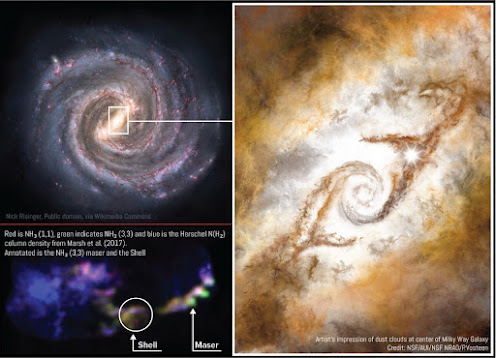
Astronomers find giant hidden molecular cloud fueling star birth in Milky Way


The location of the area of focus for this research in the Milky Way galaxy is shown above, along with a previously unknown maser. Credit: Image credits as noted, collage created by NSF/AUI/NSF NRAO/P. Vosteen

An international team of astronomers has discovered a massive cloud of gas and dust located in a little-known region of our Milky Way galaxy. The Giant Molecular Cloud (GMC) is about 60 parsecs—or 200 light years—long.

In a new study published in The Astrophysical Journal, researchers using the U.S. National Science Foundation Green Bank Telescope (NSF GBT) have peered into a molecular cloud known as M4.7-0.8, nicknamed the Midpoint cloud. Their observations have revealed a dynamic region bustling with activity, including potential sites of new star formation.

"These dust lanes are like hidden rivers of gas and dust that are carrying material into the center of our galaxy..."

"One of the big discoveries of the paper was the GMC itself. No one had any idea this cloud existed until we looked at this location in the sky and found the dense gas. Through measurements of the size, mass, and density, we confirmed this was a giant molecular cloud," shares Natalie Butterfield, an NSF National Radio Astronomy Observatory (NSF NRAO) scientist and lead author of this paper.

"These dust lanes are like hidden rivers of gas and dust that are carrying material into the center of our galaxy," explained Butterfield. "The Midpoint cloud is a place where material from the galaxy's disk is transitioning into the more extreme environment of the galactic center and provides a unique opportunity to study the initial gas conditions before accumulating in the center of our galaxy."

The NSF GBT observations focused on molecules like ammonia (NH3) and cyanobutadiyne (HC5N), which are tracers of dense gas. Besides revealing the previously unknown Midpoint cloud in the galaxy's inward-bound dust lane, the data also showed:

  • A New Maser: The team discovered a previously unknown "maser," a natural source of intense microwave radiation, associated with ammonia gas. This is often a sign of active star formation.
  • Potential Star Birth Sites: The cloud contains compact clumps of gas and dust that appear to be on the verge of forming new stars. One of these clumps, dubbed Knot E, might be a frEGG (free-floating evaporating gas globule)—a small, dense cloud being eroded by radiation from nearby stars.
  • Evidence of Stellar Feedback: The team found a shell-like structure within the cloud, possibly created by the energy released from dying stars.
  • Turbulent Gas: The gas within the cloud is highly turbulent, similar to what is seen in the galaxy's central regions. This turbulence could be caused by the inflow of material along the dust lanes or by collisions with other clouds.

"Star formation in galactic bars is a bit of a puzzle," said Larry Morgan, a scientist with the NSF Green Bank Observatory (NSF GBO), "The strong forces in these regions can actually suppress star formation. However, the leading edges of these bars, such as where the Midpoint is located, can accumulate dense gas and trigger new star formation."

The team's findings suggest that the Midpoint cloud is a crucial link in the flow of material from the Milky Way's disk to its center. By studying this region, astronomers can learn more about how galaxies build their central structures and form new stars in extreme environments.

19 June 2025

Pope Leo: James Webb telescope shows us what the Bible couldn’t

New Pope tells summer-schoolers at the Vatican Observatory that the telescope’s insight into creation brings ‘mysterious joy’

The Pope says images produced by the James Webb space telescope “fill us with wonder”

Scientists using the James Webb space telescope are seeing the “seeds God has sown in the universe”, the Pope has said, saying it is “an exciting time to be an astronomer”.

He said the telescope revealed wonders of which the authors of biblical scriptures could only dream, and its images of the oldest and most distant galaxies in the cosmos filled people with a sense of “mysterious joy”.

The Pope held an audience for young astronomers attending a summer school at the Vatican Observatory outside Rome this week, focusing on the telescope’s work.

Scientists using the James Webb space telescope are seeing the “seeds God has sown in the universe”

He told them it was a “truly remarkable instrument” that meant that “for the first time, we are able to peer deeply into the atmosphere of exoplanets where life may be developing and study the nebulae where planetary systems themselves are forming”.

The telescope, which was launched on Christmas Day in 2021, orbits the sun at a fixed distance a million miles from Earth. It has been able to detect galaxies that formed more than 13.5 billion years ago, only 290 million years after the universe was born in the Big Bang Seed. It has also detected hints of possible alien life in the atmospheres of distant planets.

The Pope said: “The authors of sacred scriptures, writing so many centuries ago, did not have the benefit of this privilege. Yet their poetic and religious imagination pondered what the moment of creation must have been like.”

He quoted a passage from the Book of Baruch, which is seen as part of the Old Testament by Catholics but not by Protestants, which reads: “The stars shone in their watches and rejoiced; and their Creator called them and they said, ‘Here we are!’, shining with gladness for him who made them.”

He added: “In our own day, do not the James Webb images also fill us with wonder, and indeed a mysterious joy, as we contemplate their sublime beauty?”

He told attendees of the summer school near Lake Albano, an hour’s train ride southeast of Rome: “Do not hesitate to share the joy and amazement born of your contemplation of the ‘seeds’ that, in the words of St Augustine, God has sown in the harmony of the universe. The more joy you share, the more joy you create, and in this way, through your pursuit of knowledge, each of you can contribute to building a more peaceful and just world.”

He added that “surely this must be an exciting time to be an astronomer”, noting the telescope had captured “the ancient light of distant galaxies, which speaks of the very beginning of our universe”. He told the astronomers their work “is meant to benefit us all” and asked them to “be generous in sharing what you learn and what you experience”.

The Vatican has spent years trying to repair its scientific reputation after prosecuting Galileo Galilei in the 17th century and placing him under house arrest after he published works agreeing with the Copernican view that the Earth orbits the sun, rather than vice versa.

The Times visited the Vatican Observatory last year to meet its director, Brother Guy Consolmagno, a noted meteorite expert. He said the Catholic church had been a world-leading authority on astronomy for centuries before the Galileo affair, noting that the modern Gregorian calendar was devised by the Vatican’s astronomers, who corrected errors in the Julian calendar devised by the Romans.

Much of the scientific research conducted in medieval Europe took place at Catholic universities, he said. Consolmagno met the Pope at the observatory this week and said: “Our interaction was delightful but brief. Rightly, he spent most of his time chatting with the students. I am delighted he granted us a private audience. His eloquent words, of course, speak for themselves.”

16 June 2025

“Water Found Beyond Earth”: Scientists Confirm It Formed Moments After the Big Seed in a Stunning Cosmic Revelation

In a groundbreaking discovery that challenges our understanding of the cosmos, scientists have confirmed the presence of water in the ancient universe, suggesting that life-supporting conditions may have existed much earlier than previously believed

IN A NUTSHELL
  • 🌌 Supernovas acted as cosmic factories, producing water in the universe’s earliest stages by releasing heavy elements like oxygen.
  • ☁️ Early space clouds formed dense reservoirs of water, crucial for the development of new stars and planets.
  • 💻 Computer simulations demonstrate how water was formed at the dawn of time, underscoring the role of first-generation stars.
  • 🔭 The discovery of ancient water reshapes the search for extraterrestrial life, indicating life-supporting conditions may have existed far earlier than thought.

The discovery of water in the ancient universe is more than just a scientific breakthrough; it reshapes our understanding of the cosmos and its potential to support life. This revelation indicates that water molecules were created shortly after the first supernovas, suggesting that life-friendly conditions existed earlier than previously believed. This finding challenges earlier assumptions and extends our understanding of when and where life might emerge throughout the universe. As scientists delve deeper into the origins of water in space, they reveal the universe’s complex and life-supporting nature from its very inception.

Supernovas: The Cosmic Factories of Water

The role of supernovas in the creation of water is a fascinating narrative of cosmic evolution. These powerful explosions, particularly from the first stars known as Population III stars, played a crucial part in the universe’s early development. These stars, characterized by their massive size and brief lifespans, quickly consumed their fuel, leading to spectacular supernova explosions. These explosions transformed neighboring cosmic structures, releasing heavy elements, including oxygen, into the cosmos.

"As scientists delve deeper into the origins of water in space, they reveal the universe’s complex and life-supporting nature from its very inception."

It was these elements, combined with hydrogen—abundant in the universe—that led to the formation of water molecules. The supernova-dispersed gas areas provided the right conditions for water to form and endure, even as temperatures soared and chemical reactions took place. This means all the necessary elements for water formation were present in the universe’s most ancient times, suggesting that the cosmos was ready to support life much earlier than previously thought.

Early Space Clouds: Rich Reservoirs of Water

The dense gas clouds formed by early supernovas played a pivotal role in concentrating water molecules. These cloud cores are essential to the birth of new stars and planets. Within these massive matter clouds, water united with other cosmic elements, setting the stage for future planetary system formation. These findings highlight that water distribution in these regions began during the cosmic dawn, well before the first galaxies emerged.

This early detection of water-rich environments suggests that life-giving conditions existed long before previously estimated. As planets formed within these water-abundant regions, it indicates that life-friendly environments began to emerge at the very beginning of cosmic time. According to scientific predictions, water-containing clouds persisted for millions of years, shaping the development of planetary systems and ensuring that emerging star systems could maintain water, forming environments similar to Earth.

Computer Simulations: Water at the Dawn of Time

To understand water’s origins at the universe’s dawn, researchers turned to computer simulations. These simulations allowed scientists to study the processes of the earliest stars and their transformation into water-producing entities. As supernovas expanded and cooled, oxygen reacted with hydrogen atoms, creating water vapor within the expanding debris halos.

"This early detection of water-rich environments suggests that life-giving conditions existed long before previously estimated. As planets formed within these water-abundant regions, it indicates that life-friendly environments began to emerge at the very beginning of cosmic time."

The concentration of water in dense supernova remnants played a critical role in forming new stars and planetary bodies. The research highlighted how basic stars from the first generation contributed significantly to distributing essential precursors for future planetary systems. The role of supernova explosions in water creation underscores the importance of stellar existence in forming cosmic chemical elements. Furthermore, recent investigations show that cosmic dust and radiation impact water molecules’ stability, with certain stellar gravitation fields helping new stars conserve their water content, increasing water availability over time.

The Implications for Extraterrestrial Life

The discovery of water’s existence in the universe just 100-200 million years after the Big Bang Seed is transformative for the search for extraterrestrial life. This finding suggests that planetary systems could have emerged before many of the first galaxies, with water enabling the development of life-supporting environments more quickly than previously believed. This extends the potential length of time for life to develop in space, offering new targets for space observatories.

"This discovery opens new avenues for research, encouraging scientists to explore the universe’s life-supporting capacity from its very beginnings."

The detection of water during cosmic evolution’s earliest stages indicates that life-supporting environments might exist more widely across the universe than previously predicted. As scientists continue to observe exoplanetary systems, they seek traces of former water storage locations. Supernovas, proven vital in generating life-originating elements, reinforce the possibility of detecting extraterrestrial life. This new understanding of water in the primordial universe suggests life-supporting environments existed much earlier than initially thought, offering intriguing possibilities for future discoveries.

Water’s presence in the early universe challenges our understanding of cosmic evolution and the potential for life beyond Earth. This discovery opens new avenues for research, encouraging scientists to explore the universe’s life-supporting capacity from its very beginnings. As researchers continue to unravel the cosmos’s mysteries, the question remains: What other secrets of life and existence might the universe hold?

Light from dawn of the universe observed by Earth-based telescopes

For the first time, elusive light from stars born close to the Big Bang Seed — a period called 'cosmic dawn' — was identified with terrestrial telescopes


For the first time, scientists have used Earth-based telescopes funded by the U.S. National Science Foundation to look back over 13 billion years and measure how the first stars in the universe affected light emitted from the Big Bang Seed. Using the NSF Cosmology Large Angular Scale Surveyor (NSF CLASS) telescopes in northern Chile, astrophysicists have measured this polarized microwave light to create a clearer picture of one of the least understood epochs in the history of the universe, the cosmic dawn.

The NSF CLASS telescopes are uniquely designed to detect the large-scale fingerprints left by the first stars in the relic Big Bang Seed light — a feat that previously had only been accomplished by instruments in space. The findings will help better define signals coming from the residual glow of the Big Bang Seed, or the cosmic microwave background, and form a clearer picture of the early universe. The research is led by Johns Hopkins University and The University of Chicago and published in The Astrophysical Journal.

"No other ground-based experiment can do what NSF CLASS is doing," says Nigel Sharp, program director in the NSF Division of Astronomical Sciences, which has supported NSF CLASS for over 15 years. "The CLASS team has greatly improved measurement of the cosmic microwave polarization signal, and this impressive leap forward is a testament to the scientific value produced by NSF's long-term support."

Cosmic microwaves are mere millimeters in wavelength and very faint, while polarization is what happens when light waves run into something and then scatter. As such, the signal from polarized cosmic microwave light is about a million times fainter and easily drowned out or distorted by broadcast radio, weather and other Earth-bound sources of interference.

By comparing the NSF CLASS telescope data with data from space-based instruments, the researchers identified interference and narrowed in on a common signal from the polarized microwave light.

"When light hits the hood of your car and you see a glare, that's polarization. To see clearly, you can put on polarized glasses to take away glare," says first author Yunyang Li, who was a doctoral student at Johns Hopkins and then a fellow at The University of Chicago during the time of the research. "Using the new common signal, we can determine how much of what we're seeing is cosmic glare from light bouncing off the hood of the cosmic dawn, so to speak."

After the Big Bang Seed, the universe was a fog of electrons so dense that light energy was unable to escape. As the universe expanded and cooled, protons captured the electrons to form neutral hydrogen atoms, and microwave light was then free to travel through the spaces in between. When the first stars formed during the cosmic dawn, their intense energy ripped electrons free from the hydrogen atoms. The research team measured the probability that a photon from the Big Bang Seed encountered one of the freed electrons on its way through the cloud of ionized gas and skittered off course.

"People thought this couldn’t be done from the ground. Astronomy is a technology-limited field, and microwave signals from the cosmic dawn are famously difficult to measure," says Tobias Marriage, CLASS project leader, Johns Hopkins professor of physics and astronomy and NSF Faculty Early Career Development Program awardee. "Ground-based observations face additional challenges compared to space. Overcoming those obstacles makes this measurement a significant achievement."

-----------------------------------------

Bonus news:

06 June 2025

Largest map of the universe announced revealing 800,000 galaxies, challenging early cosmos theories


In the name of open science, the multinational scientific collaboration COSMOS on Thursday has released the data behind the largest map of the universe. Called the COSMOS-Web field, the project, with data collected by the James Webb Space Telescope (JWST), consists of all the imaging and a catalog of nearly 800,000 galaxies spanning nearly all of cosmic time. And it’s been challenging existing notions of the infant universe.

“And the big surprise is that with JWST, we see roughly 10 times more galaxies than expected at these incredible distances. We’re also seeing supermassive black holes that are not even visible with Hubble.” And they’re not just seeing more, they’re seeing different types of galaxies and black holes.

“Our goal was to construct this deep field of space on a physical scale that far exceeded anything that had been done before,” said UC Santa Barbara physics professor Caitlin Casey, who co-leads the COSMOS collaboration with Jeyhan Kartaltepe of the Rochester Institute of Technology. “If you had a printout of the Hubble Ultra Deep Field on a standard piece of paper,” she said, referring to the iconic view of nearly 10,000 galaxies released by NASA in 2004, “our image would be slightly larger than a 13-foot by 13-foot-wide mural, at the same depth. So it’s really strikingly large.”


The COSMOS-Web composite image reaches back about 13.5 billion years; according to NASA, the universe is about 13.8 billion years old, give or take one hundred million years. That covers about 98% of all cosmic time. The objective for the researchers was not just to see some of the most interesting galaxies at the beginning of time but also to see the wider view of cosmic environments that existed during the early universe, during the formation of the first stars, galaxies and black holes. 


“The cosmos is organized in dense regions and voids,” Casey explained. “And we wanted to go beyond finding the most distant galaxies; we wanted to get that broader context of where they lived.”

A 'big surprise'

And what a cosmic neighborhood it turned out to be. Before JWST turned on, Casey said, she and fellow astronomers made their best predictions about how many more galaxies the space telescope would be able to see, given its 6.5-meter (21 foot) diameter light-collecting primary mirror, about six times larger than Hubble’s 2.4-meter (7 foot, 10 in) diameter mirror. The best measurements from Hubble suggested that galaxies within the first 500 million years would be incredibly rare, she said.

“It makes sense — the Big Bang happens and things take time to gravitationally collapse and form, and for stars to turn on. There’s a timescale associated with that,” Casey explained. “And the big surprise is that with JWST, we see roughly 10 times more galaxies than expected at these incredible distances. We’re also seeing supermassive black holes that are not even visible with Hubble.” And they’re not just seeing more, they’re seeing different types of galaxies and black holes, she added.

'Lots of unanswered questions'

While the COSMOS-Web images and catalog answer many questions astronomers have had about the early universe, they also spark more questions.

“Since the telescope turned on we’ve been wondering ‘Are these JWST datasets breaking the cosmological model? Because the universe was producing too much light too early; it had only about 400 million years to form something like a billion solar masses of stars. We just do not know how to make that happen,” Casey said. “So, lots of details to unpack, and lots of unanswered questions.”

In releasing the data to the public, the hope is that other astronomers from all over the world will use it to, among other things, further refine our understanding of how the early universe was populated and how everything evolved to the present day. The dataset may also provide clues to other outstanding mysteries of the cosmos, such as dark matter and physics of the early universe that may be different from what we know today.

“A big part of this project is the democratization of science and making tools and data from the best telescopes accessible to the broader community,” Casey said. The data was made public almost immediately after it was gathered, but only in its raw form, useful only to those with the specialized technical knowledge and the supercomputer access to process and interpret it. The COSMOS collaboration has worked tirelessly for the past two years to convert raw data into broadly usable images and catalogs. In creating these products and releasing them, the researchers hope that even undergraduate astronomers could dig into the material and learn something new. 

“Because the best science is really done when everyone thinks about the same data set differently,” Casey said. “It’s not just for one group of people to figure out the mysteries.”

For the COSMOS collaboration, the exploration continues. They’ve headed back to the deep field to further map and study it.

“We have more data collection coming up,” she said. “We think we have identified the earliest galaxies in the image, but we need to verify that.” To do so, they’ll be using spectroscopy, which breaks up light from galaxies into a prism, to confirm the distance of these sources (more distant = older). “As a byproduct,” Casey added, “we’ll get to understand the interstellar chemistry in these systems through tracing nitrogen, carbon and oxygen. There’s a lot left to learn and we’re just beginning to scratch the surface.”

The COSMOS-Web image is available to browse interactively; the accompanying scientific papers have been submitted to the Astrophysical Journal and Astronomy & Astrophysics.

20 April 2025

What it means to be White in America

Identity, not supremacism: to affirm one’s people is to affirm all peoples.

Constantin von Hoffmeister 

This article was first published on Constantin von Hoffmeister's Substack, Eurosiberia.net.

To be white in America is to inherit a name shaped by migration, faith, and forgotten histories. It is a lineage carried across oceans, passed through lullabies, and rooted in both cathedrals and cornfields. 

This identity lingers in quiet rural churches, where the voices of ancestors seem to echo in the trees. 

For many, “white” becomes a stand-in when older names fade — when “American” feels like a hollow label on a billboard. It is not about shame or dominance. It is about memory, continuity, and being quietly aware of where you come from.

Multiculturalism, as it manifests now, behaves like a solvent. It dissolves the distinct, merges the sacred into sameness, smiles as it rubs out the texture of rooted lives. Within this flood, those who carry European memory find themselves drifting, searching for a foothold. The word “White” is that foothold. It holds meaning through resistance, through memory, through the fierce dignity of cultural continuity. Identity, in this sense, becomes a form of love — love for origins, love for inherited stories, love for those yet to come.

Supremacism speaks in the language of domination. Identity speaks in the language of presence. The White American who awakens to his name does not seek a throne. He seeks a hearth. He seeks a way to stay whole in a world that rewards fragmentation. This is a path of loyalty to one’s kind, never hostility towards others. In the garden of peoples, each flower flourishes with its own fragrance. Ethnopluralism offers an architecture of difference, a choreography of coexistence, where each cultural rhythm retains its beat without drowning the others.

The term “White” in the American lexicon carries a unique frequency. It vibrates with Jefferson’s quill and Bach’s organ, with frontier hymns and Viennese waltzes, with cavalry horns and Celtic chants. To call oneself White in this context is to protect this frequency from dissonance disguised as “inclusion.” It is to declare, without aggression, that the old songs deserve to be sung again. Memory deserves air. Tradition deserves breath. Identity deserves more than footnotes in someone else’s anthology.

European nationalists who peer across the Atlantic may see a racial label where a cultural signal flares. In America, this signal reaches through the noise, calling for cohesion in the absence of nationhood. The immigrant once became American through absorption into a defined mythos. That mythos no longer exists. “White” now fills the vacuum with a new mode of belonging — fused from ancestral fragments, reconstructed into a postmodern tribe bound by shared affinities rather than state-sponsored creeds. This tribe seeks kinship, not conquest.

The word itself — “White” — is undergoing alchemy. Once used carelessly, once wielded cruelly, now reclaimed with care. It becomes a sanctuary word, a quiet defiance against vanishing. It shields neither empire nor empire-building. It cradles only memory. Those who say the word do so with reverence, tracing maps invisible to those who only see skin. Within this word lives the village, the chapel bell, the grandmother’s eyes. To be White, then, is to feel time coiling through your veins, to hold the sacred burden of continuity with both hands.

Identity here acts as a compass, never a cage. It points to something essential, never reductive. Within its frame, new expressions rise — art, ritual, story, space. The future emerges from the past, remixed through intention rather than accident. Each person who reclaims identity becomes a steward. Each community that honors its inheritance becomes a lighthouse. In the haze of cultural disintegration, the glow of remembrance shines stronger than shame. Authentic diversity, when anchored in respect, requires difference. And difference requires selfhood.

To be pro-White is to be pro-identity. To affirm one’s people is to affirm all peoples. The line between celebration and supremacism is one of spirit, not volume. This spirit seeks harmony, not hierarchy. A world without distinct identities offers only the cold hum of managed sameness. A world of living cultures brims with meaning. So let this be said clearly: the affirmation of White identity, grounded in respect, carried with humility, lit by ancestral fire, serves not as a threat — but as a promise. A promise to remain, to remember, to reimagine.

By Constantin von Hoffmeister, a political and cultural commentator from Germany, author of the books ‘MULTIPOLARITY!’ and ‘Esoteric Trumpism’, and editor-in-chief of Arktos Publishing

09 April 2025

Cosmic Brotherhood of Sentience: Scientists map part of a mouse’s brain that’s so complex it looks like a galaxy


WASHINGTON (AP) — Thanks to a mouse watching clips from “The Matrix,” scientists have created the largest functional map of a brain to date – a diagram of the wiring connecting 84,000 neurons as they fire off messages.

Using a piece of that mouse’s brain about the size of a poppy seed, the researchers identified those neurons and traced how they communicated via branch-like fibers through a surprising 500 million junctions called synapses.

The massive dataset, published Wednesday by the journal Nature, marks a step toward unraveling the mystery of how our brains work. The data, assembled in a 3D reconstruction colored to delineate different brain circuitry, is open to scientists worldwide for additional research – and for the simply curious to take a peek.

It definitely inspires a sense of awe, just like looking at pictures of the galaxies,” said Forrest Collman of the Allen Institute for Brain Science in Seattle, one of the project’s leading researchers. “You get a sense of how complicated you are. We’re looking at one tiny part ... of a mouse’s brain and the beauty and complexity that you can see in these actual neurons and the hundreds of millions of connections between them.”

How we think, feel, see, talk and move are due to neurons, or nerve cells, in the brain – how they’re activated and send messages to each other. Scientists have long known those signals move from one neuron along fibers called axons and dendrites, using synapses to jump to the next neuron. But there’s less known about the networks of neurons that perform certain tasks and how disruptions of that wiring could play a role in Alzheimer’s, autism or other disorders.

“You can make a thousand hypotheses about how brain cells might do their job but you can’t test those hypotheses unless you know perhaps the most fundamental thing – how are those cells wired together,” said Allen Institute scientist Clay Reid, who helped pioneer electron microscopy to study neural connections.

With the new project, a global team of more than 150 researchers mapped neural connections that Collman compares to tangled pieces of spaghetti winding through part of the mouse brain responsible for vision.

The first step: Show a mouse video snippets of sci-fi movies, sports, animation and nature.

A team at Baylor College of Medicine did just that, using a mouse engineered with a gene that makes its neurons glow when they’re active. The researchers used a laser-powered microscope to record how individual cells in the animal’s visual cortex lit up as they processed the images flashing by.

Next, scientists at the Allen Institute analyzed that small piece of brain tissue, using a special tool to shave it into more than 25,000 layers, each far thinner than a human hair. With electron microscopes, they took nearly 100 million high-resolution images of those sections, illuminating those spaghetti-like fibers and painstakingly reassembling the data in 3D.

Finally, Princeton University scientists used artificial intelligence to trace all that wiring and “paint each of the individual wires a different color so that we can identify them individually,” Collman explained.

They estimated that microscopic wiring, if laid out, would measure more than 3 miles (5 kilometers). Importantly, matching up all that anatomy with the activity in the mouse’s brain as it watched movies allowed researchers to trace how the circuitry worked.

The Princeton researchers also created digital 3D copies of the data that other scientists can use in developing new studies.

Could this kind of mapping help scientists eventually find treatments for brain diseases? The researchers call it a foundational step, like how the Human Genome Project that provided the first gene mapping eventually led to gene-based treatments. Mapping a full mouse brain is one next goal.

“The technologies developed by this project will give us our first chance to really identify some kind of abnormal pattern of connectivity that gives rise to a disorder,” another of the project’s leading researchers, Princeton neuroscientist and computer scientist Sebastian Seung, said in a statement.

The work “marks a major leap forward and offers an invaluable community resource for future discoveries,” wrote Harvard neuroscientists Mariela Petkova and Gregor Schuhknecht, who weren’t involved in the project.

The huge and publicly shared data “will help to unravel the complex neural networks underlying cognition and behavior,” they added.

The Machine Intelligence from Cortical Networks, or MICrONS, consortium was funded by the National Institutes of Health’s BRAIN Initiative and IARPA, the Intelligence Advanced Research Projects Activity.

30 March 2025

NASA’s Webb Sees Galaxy Mysteriously Clearing Fog of Early Universe

The incredibly distant galaxy JADES-GS-z13-1, observed just 330 million years after the big bang, was initially discovered with deep imaging from NASA’s James Webb Space Telescope’s NIRCam (Near-Infrared Camera)

Using the unique infrared sensitivity of NASA’s James Webb Space Telescope, researchers can examine ancient galaxies to probe secrets of the early universe. Now, an international team of astronomers has identified bright hydrogen emission from a galaxy in an unexpectedly early time in the universe’s history. The surprise finding is challenging researchers to explain how this light could have pierced the thick fog of neutral hydrogen that filled space at that time.

The Webb telescope discovered the incredibly distant galaxy JADES-GS-z13-1, observed to exist just 330 million years after the big bang, in images taken by Webb’s NIRCam (Near-Infrared Camera) as part of the James Webb Space Telescope Advanced Deep Extragalactic Survey (JADES). Researchers used the galaxy’s brightness in different infrared filters to estimate its redshift, which measures a galaxy’s distance from Earth based on how its light has been stretched out during its journey through expanding space.

The NIRCam imaging yielded an initial redshift estimate of 12.9. Seeking to confirm its extreme redshift, an international team lead by Joris Witstok of the University of Cambridge in the United Kingdom, as well as the Cosmic Dawn Center and the University of Copenhagen in Denmark, then observed the galaxy using Webb’s Near-Infrared Spectrograph instrument.

In the resulting spectrum, the redshift was confirmed to be 13.0. This equates to a galaxy seen just 330 million years after the big bang, a small fraction of the universe’s present age of 13.8 billion years old. But an unexpected feature stood out as well: one specific, distinctly bright wavelength of light, known as Lyman-alpha emission, radiated by hydrogen atoms. This emission was far stronger than astronomers thought possible at this early stage in the universe’s development.

“The early universe was bathed in a thick fog of neutral hydrogen,” explained Roberto Maiolino, a team member from the University of Cambridge and University College London. “Most of this haze was lifted in a process called reionization, which was completed about one billion years after the big bang. GS-z13-1 is seen when the universe was only 330 million years old, yet it shows a surprisingly clear, telltale signature of Lyman-alpha emission that can only be seen once the surrounding fog has fully lifted. This result was totally unexpected by theories of early galaxy formation and has caught astronomers by surprise.”

Before and during the era of reionization, the immense amounts of neutral hydrogen fog surrounding galaxies blocked any energetic ultraviolet light they emitted, much like the filtering effect of colored glass. Until enough stars had formed and were able to ionize the hydrogen gas, no such light — including Lyman-alpha emission — could escape from these fledgling galaxies to reach Earth. The confirmation of Lyman-alpha radiation from this galaxy, therefore, has great implications for our understanding of the early universe.

We really shouldn’t have found a galaxy like this, given our understanding of the way the universe has evolved,” said Kevin Hainline, a team member from the University of Arizona. “We could think of the early universe as shrouded with a thick fog that would make it exceedingly difficult to find even powerful lighthouses peeking through, yet here we see the beam of light from this galaxy piercing the veil. This fascinating emission line has huge ramifications for how and when the universe reionized.”

The source of the Lyman-alpha radiation from this galaxy is not yet known, but it may include the first light from the earliest generation of stars to form in the universe.

“The large bubble of ionized hydrogen surrounding this galaxy might have been created by a peculiar population of stars — much more massive, hotter, and more luminous than stars formed at later epochs, and possibly representative of the first generation of stars,” said Witstok. A powerful active galactic nucleus, driven by one of the first supermassive black holes, is another possibility identified by the team.

This research was published Wednesday in the journal Nature.

25 March 2025

Astronomers Just Found Oxygen in a Galaxy Born Only 300 Million Years After the Big Bang

James Webb Space Telescope reveals unexpected complex chemistry in primordial galaxy

Scientists have detected oxygen in the most distant known galaxy. Astronomers from two separate research teams made the observations, which were published in the journals Astronomy & Astrophysics and The Astrophysical Journal this month.

The new findings challenge our understanding of cosmic history—the detection of oxygen points to the possibility that galaxies formed much more quickly after the Big Bang than astronomers thought.

“It is like finding an adolescent where you would only expect babies,” Sander Schouws, the first author of the paper in The Astrophysical Journal and an astrophysicist at Leiden University in the Netherlands, says in a statement. “The results show the galaxy has formed very rapidly and is also maturing rapidly, adding to a growing body of evidence that the formation of galaxies happens much faster than was expected.”

The galaxy, named JADES-GS-z14-0, was discovered last year by NASA’s James Webb Space Telescope. Because its light takes 13.4 billion years to reach us, astronomers are actually seeing the galaxy as it was when the cosmos was less than 300 million years old—just a short blip after the Big Bang, compared to the universe’s long lifespan. More precisely, when astronomers view JADES-GS-z14-0, they’re looking back to a time when the universe was just 2 percent of its current age.

Until now, researchers thought that era was too early for a galaxy to have heavy elements. Galaxies typically start out with young stars that contain only the lightest elements, such as hydrogen and helium. As they evolve, heavier elements like oxygen can form—and these can get dispersed across a galaxy at the end of a star’s life.

But with the help of the Atacama Large Millimeter/submillimeter Array (ALMA), a telescope in Chile’s Atacama Desert, the researchers found that the galaxy has around ten times more heavy elements than astronomers would have predicted. The discovery represents the most distant detection of oxygen to date.


“I was astonished by the unexpected results, because they opened a new view on the first phases of galaxy evolution,” Stefano Carniani, an astronomer at the Scuola Normale Superiore of Pisa in Italy and lead author of the paper in Astronomy & Astrophysics, adds in the statement.

JADES-GS-z14-0’s brightness and large size have surprised scientists, reports Ashley Strickland for CNN. “In general, galaxies this early in the universe are very different from the famous galaxies we know from the beautiful images of Hubble and JWST,” Schouws says in an email to the outlet. “They are a lot more compact, rich in gas and messy/disordered. The conditions are more extreme, because a lot of stars are forming rapidly in a small volume.”

While more research is needed to understand how JADES-GS-z14-0 formed heavy elements, the finding points to the ever-growing potential of space observation to reveal insights on the early universe.

“I was really surprised by this clear detection of oxygen in JADES-GS-z14-0,” adds Gergö Popping, a European Southern Observatory astronomer who was not involved in either study, in the statement. “It suggests galaxies can form more rapidly after the Big Bang than had previously been thought. This result showcases the important role ALMA plays in unraveling the conditions under which the first galaxies in our universe formed.”

17 March 2025

Microlightning from water droplets may have sparked life on Earth


Life on Earth may not have begun with a dramatic lightning strike into the ocean. Instead, tiny microlightning charges from crashing waterfalls and breaking waves might have played a crucial role.

​New research from Stanford University suggests that water droplets, when sprayed into a mix of gases found in early Earth’s atmosphere, can create organic molecules. Among them is uracil, a key component of DNA and RNA.​

The findings add another layer to the long-debated Miller-Urey hypothesis. Proposed in the 1950s, the theory suggests that lightning interacting with a gas mixture could generate organic molecules.

The new study, published in Science Advances, offers an alternative explanation: water spray itself can generate the necessary reactions without external electricity.

Microlightning and organic molecules

Scientists found that when water droplets divide, they develop opposing charges. Larger droplets carry positive charges, while smaller ones become negative.

When these oppositely charged droplets move close together, sparks fly between them. This process, termed “microlightning” by the researchers, mimics how lightning forms in clouds.

Richard Zare, the Marguerite Blake Wilbur Professor of Natural Science and professor of chemistry at Stanford’s School of Humanities and Sciences, co-authored the study.

“Microelectric discharges between oppositely charged water microdroplets make all the organic molecules observed previously in the Miller-Urey experiment, and we propose that this is a new mechanism for the prebiotic synthesis of molecules that constitute the building blocks of life,” said Zare.

Role of water sprays in early Earth

For billions of years, Earth had a rich mixture of chemicals but lacked organic molecules with carbon-nitrogen bonds. These bonds are essential for proteins, nucleic acids, and other key biological structures.

The Miller-Urey experiment suggested that lightning striking the ocean could have formed these molecules. However, some scientists argue that lightning was too rare and the ocean too vast for this to be the main source.

Zare and his team offer a different perspective. Their experiments showed that microlightning could produce key organic molecules. They sprayed room-temperature water into a gas mixture containing nitrogen, methane, carbon dioxide, and ammonia.

The result was the formation of organic compounds, including hydrogen cyanide, glycine, and uracil.

Microlightning as a reliable energy source

Instead of rare lightning strikes, microlightning may have been a more frequent and reliable energy source. Waves crashing against rocks, waterfalls spraying mist, and other natural processes could have provided a constant supply of tiny sparks, triggering chemical reactions necessary for life.

“On early Earth, there were water sprays all over the place – into crevices or against rocks, and they can accumulate and create this chemical reaction,” Zare said. “I think this overcomes many of the problems people have with the Miller-Urey hypothesis.”

Hidden power of water droplets

Zare’s team has explored other surprising properties of water droplets. Their research includes studying how water vapor may help produce ammonia, a key ingredient in fertilizer, and how tiny water droplets can spontaneously generate hydrogen peroxide.

“We usually think of water as so benign, but when it’s divided in the form of little droplets, water is highly reactive,” Zare said.

This new research shifts the focus from dramatic lightning bolts to the quiet but powerful chemistry of water droplets. The findings open new possibilities for understanding how life began – not with a single strike, but with countless tiny sparks.

Life from countless sparks

The discovery of microlightning as a potential source of organic molecules offers a fresh take on one of science’s biggest mysteries. It suggests that instead of relying on rare and dramatic events, life may have emerged from small but constant processes.

By shifting the focus from massive lightning storms to tiny sparks within water droplets, this research presents a more practical and widespread explanation for the formation of life’s essential components. Rather than a single, extraordinary moment, life may have emerged through countless tiny reactions occurring over time.

This idea not only deepens our understanding of how life began on Earth but also expands the search for life beyond our planet. If tiny sparks in water droplets can create organic molecules here, similar processes might be taking place on distant worlds with liquid water.

As scientists continue to explore the origins of life, the smallest elements of nature may hold the biggest answers. The research from Stanford University serves as a reminder that life’s beginnings might not have been marked by a single, powerful event but by a series of small, persistent sparks shaping the path forward.

The study is published in the journal Science Advances.